The Seduction of Elegance
Representational Convergence and the Parts of the World
One must not mistake local success for an ontological one.
DOI PhilArchive lukefwalton.com CC BY-NC-ND 4.0
Abstract
It is easy — perhaps even seductive — to confuse structure for the parts, especially when structure is found through an opaque training process. Huh and colleagues hypothesize that neural networks are converging on a shared statistical model of reality, and name the hypothesis for Plato. Gröger and colleagues find that convergence survives one comparison and largely disappears under another, and name what survives for Aristotle. Robustness is the test, from Levins and Wimsatt, and on Schupbach's account it rules out rivals to an agreement. As stated it leaves one standing: that the comparison would have agreed had the parts differed. The comparison must keep the respect in which the parts could differ, a requirement apart from independence and not supplied by exactness. Two exact cases, on a rotated representation and on two qubits, and work on language-model features show it at work. Plato himself wrote of a Stranger, who noticed that one name could make unrelated peoples seem to be one kind, and shared mathematics invites the same inference, though it agrees because each field handed it an order. An agreement can show less than it appears to, and a disagreement, in a comparison that invents no difference, can show more. A claim that two procedures found the same parts should name the respect and come with a case, differing in that respect alone, which the comparison would have told apart. Exactness is not rightness, and it is not the opposite. One must not mistake local success for an ontological one.
In plain terms
Neural networks are said to be converging on one model of reality, and that convergence depends on which comparison is used. The comparison has to keep the respect in which the parts could have differed. One must not mistake local success for an ontological one.
Cite this paper when…
- You are treating a shared score for parts as evidence that two fields found the same parts.
- You need the distinction among usefulness, correspondence, and the inventory.
- You want the Zenodo record for this preprint (v2.1, November 11, 2026).
Cite
Walton, L. F. (2026). The Seduction of Elegance: Representational Convergence and the Parts of the World (Version 2.1) [Preprint]. Zenodo. https://doi.org/10.5281/zenodo.24128218
Walton, Luke F. 2026. “The Seduction of Elegance: Representational Convergence and the Parts of the World.” Preprint, version 2.1. Zenodo. https://doi.org/10.5281/zenodo.24128218.
@misc{walton2026seduction,
  author       = {Walton, Luke F.},
  title        = {The Seduction of Elegance: Representational Convergence and the Parts of the World},
  year         = {2026},
  month        = nov,
  howpublished = {Zenodo},
  note         = {Preprint, version 2.1},
  doi          = {10.5281/zenodo.24128218},
  url          = {https://doi.org/10.5281/zenodo.24128218}
}
TY - GEN
AU - Walton, Luke F.
TI - The Seduction of Elegance: Representational Convergence and the Parts of the World
PY - 2026
DA - 2026/11//
PB - Zenodo
N1 - Preprint, version 2.1
DO - 10.5281/zenodo.24128218
UR - https://doi.org/10.5281/zenodo.24128218
ER - Luke F. Walton, “The Seduction of Elegance: Representational Convergence and the Parts of the World,” preprint, v2.1, November 2026. DOI: 10.5281/zenodo.24128218.
Full text
1. Greek or Barbarian?
The Stranger of Plato’s Statesman describes how the Ancient Greeks divided humankind. They separated the Greeks from everyone else, giving all the other peoples, countless and unrelated in blood or language, a single name barbarian. “Because of this single name they expect it to be a single kind” (διὰ ταύτην τὴν μίαν κλῆσιν καὶ γένος ἓν αὐτὸ εἶναι προσδοκῶσιν; Politicus 262d; Burnet 1900–1907). Plato corrects this a page later: every kind (εἶδος) of a thing is a part (μέρος) of it, yet a part is not thereby a kind (263b). What would tell a part from a kind he does not say. A name can be doing the work an inquiry has not done, and so can a theorem, and so can a score.
In machine learning the expectation is now a hypothesis with a name. Huh et al. (2024) argue that neural networks, “trained with different objectives on different data and modalities, are converging to a shared statistical model of reality in their representation spaces,” and call it the Platonic Representation Hypothesis, after the cave. Their evidence is an agreement: as vision models and language models grow more capable, a measure of similarity between their representations rises. Gröger, Wen, and Brbić (2026) recalibrated the measures and found that the convergence “largely disappears” under the global ones and survives under the measure Huh et al. had chosen, which keeps who is near whom and discards how near. They named what survives for Aristotle. You et al. (2026) then put the question in so many words: “not only whether representations become more similar, but what exactly converges.” The dispute is over the comparison.
This paper is about what such an agreement shows. Robustness is the test the philosophy of science has for it: with Levins and Wimsatt, a result earns trust when independent procedures agree on it. Schupbach (2018) gave the test its logic: a further means of detection adds support when it can rule out a rival explanation of the result. That logic starts from a result already identified as one. For parts a rival comes before it, that the comparison would have agreed had the parts differed. The claim here is that the test needs a second requirement, which independence does not supply. Where two procedures are said to have found the same parts, the representation in which they are compared, the type of the comparison, has to keep the respect in which their parts could differ: had they differed in it, the comparison would have shown the difference. A comparison blind to a respect is not at fault; it answers another question. The fault is the inference from its agreement to sameness in the respect it cannot see, and independence does nothing to repair that inference. That a measure cannot see what it ignores is known to the field, and that alignment does not license metaphysics has been said by philosophers. What neither says is that the gap sits inside the robustness test, apart from independence. Campbell and Fiske asked the like of psychological tests, that they tell different traits apart, and Wimsatt asks it of decompositions whose parts are regions of points. Stated for decompositions in general, it is a condition on what counts as finding the same parts. Two results follow, and they are what the paper is for. An agreement can show less than it appears to. A disagreement can show more: in a comparison that invents no difference, it is a difference in the parts. The working form is one sentence. A claim that two procedures found the same parts should name the respect and come with a case, differing in that respect alone, which the comparison would have told apart.
Two exact cases show what a comparison can and cannot see, with nothing else varied: on a rotated representation, a comparison whose agreement is earned or empty according to what a part is taken to be; on two qubits, things true of the whole that agree across different parts. Current work on the features of language models shows the requirement deciding what gets reported. In every one of these cases the parts had to be found. A Hilbert space, the space a quantum system is written in, does not come factored into subsystems. A gene-expression state does not come labeled with the cell types it will settle into. A vector of activations does not come with the concepts it encodes written on its coordinates. Each procedure that finds them has a criterion inside it, and all of them use one seductive word, part.
Shared mathematics invites the Stranger’s inference too, and it is the plainest case of an agreement that could not have failed. Several sciences share a mathematics for what parts contribute. Jansma (2025a) showed that their measures of contribution, from epistasis to the Shapley value, are one operation — Möbius inversion — run on a partial order of said parts. A shared word, a shared theorem, and a shared space of comparison teach a shared expectation: one kind of thing, perhaps the inventory of the world. They may be. But sharing the score is not finding the same parts. The exactness lives in the handed order, and the operation would agree whatever was ordered. Jansma does not claim otherwise, and Huh et al. offer their hypothesis as a position, with its counterexamples listed. But it is the role of the philosopher to consider the ontological implications of technological change, and to ask of its agreements what they have earned.
What the requirement protects is a distinction among three things said of a decomposition: that it is useful for a purpose, prediction first among them; that it matches a division the system has; and that it is the inventory, the decomposition rather than one of several. Usefulness does not give correspondence, and correspondence does not yield the inventory. Robustness is what would carry the first to the second, which is why its second requirement matters. Run the three together one way, and two disciplines are taken to have found the same parts because their accounting agrees, while the difference between their parts, where a discovery would be, goes uninvestigated. Run them together the other way, and the world is taken to have one decomposition, or none because every decomposition is conditional on a procedure: a monism or a nihilism reached through the seduction of elegance. Both come easier as the procedures that find, score, and compare parts are run by machines, at a scale and with an exactness no earlier science had. Local success is not ontology.
Whether the networks have converged is being argued under the names of two Greeks, and the argument is about a comparison.
2. Plato or Aristotle?
Huh et al. state the hypothesis as a position and are careful about its object. They restrict attention to vector embeddings and characterize a representation by the similarity structure it induces, its kernel (2024, sec. 2). Alignment is a similarity between kernels, and they chose a nearest-neighbor overlap after finding that centered kernel alignment showed only a very weak trend. The appendix says centered kernel alignment “has a very strict definition of alignment, which may not fit our current needs” (appendix A). On the overlap they chose, more capable language models align better with more capable vision models, and the hypothesis reads the trend toward “a representation of the joint distribution over events in the world that generate the data we observe.” They list the limits themselves: similar but not the same representations, an alignment that reaches only 0.16 where the maximum is 1, left “as an open question” (sec. 6).
Gröger, Wen, and Brbić (2026) showed that such scores carry a systematic positive baseline even when representations are independent, and built a null by “breaking sample correspondences.” After calibration “the apparent convergence reported by global spectral measures largely disappears,” while “local neighborhood similarity, but not local distances, retains significant agreement.” They cut the hypothesis to “shared local neighborhood relationships,” noting that the measures “capture different invariances” and that “representational similarity has no groundtruth scale.” You et al. (2026) reply that the local–global contrast had changed scale and “what is compared” at once, and report that agreement on which samples are related holds at both scales while distance agreement weakens as it is made stricter.
None of this is news to the field that produced it. Kornblith et al. (2019), in the paper that brought centered kernel alignment to this use, gave a section the title “What Should Similarity Be Invariant To?” and showed that a measure invariant to every invertible linear transformation cannot “measure meaningful similarities between representations of higher dimension than the number of data points.” A comparison is fixed by what it ignores, and the practitioners say so. What the dispute leaves out is what an agreement under any of these comparisons is an agreement about. The hypothesis speaks of reality, and the measures of kernels.
The step to parts is being taken beside it. A kernel can be decomposed, and the decomposition is of the similarities. What it does not independently identify is which directions stand for concepts. On the working picture the parts of a representation are directions in its space that stand for concepts (Park, Choe, and Veitch 2024 state the picture as a hypothesis), and since a direction need not be a coordinate, a second procedure has to find them: a sparse autoencoder, trained to rebuild the activations from a few active features at a time. Two papers compare the features themselves, one across models and one across runs on a single model. The first reports an agreement and the second a disagreement.
Lan et al. (2025) report an agreement across models. Two models have two activation spaces, so before any feature can be called the same there has to be a way to say which feature is which. Theirs pairs each feature with the one in the other model whose activations correlate most closely, and keeps typically a fifth of the pairs. They start from the finding that sparse autoencoders learn some features in common and “a notable percentage of different features that are idiosyncratic” to the autoencoder, and their hypothesis, analogous feature universality, is cut to that finding: “even if SAEs across different models learn different feature representations, the spaces spanned by SAE features are similar, such that one SAE space is similar to another SAE space under rotation-invariant transformations.” What the final comparison keeps is the arrangement of the paired features, and what the authors claim is a likeness of arrangement. They are “not claiming that different SAEs consistently learn the same universal features captured by LLMs.” The claim has been fitted to the comparison, which is the requirement at work. What is left over is the word universality, and the shape of that is the Stranger’s.
Paulo and Belrose (2026) report a disagreement. They train sparse autoencoders on the same model and the same data, “differing only in the random seed,” and ask whether the same features come back. Their comparison matches the features of one autoencoder one-to-one with those of the other, by the directions of their encoder and decoder vectors, so that an autoencoder made by shuffling another’s features counts as having the same features. Both autoencoders read the same activation space, so a direction in one can be laid directly against a direction in the other. The comparison ignores the order, which is a relabeling, and keeps the directions, which is what a feature of an autoencoder is. In an autoencoder with 131K latents “only 30% of the features were shared across different seeds.” They name the hope the result answers, to “identify and enumerate over all features in a model,” and they conclude that what an autoencoder uncovers “should be viewed as a pragmatically useful decomposition of activation space, rather than an exhaustive and universal list of features ‘truly used’ by the model.”
The two belong side by side. In the first the features live in two spaces, a way of pairing them has to be chosen, and the agreement reported is about the arrangement of what the pairing kept; it shows less than the word for it. In the second the features are directions in one space, which gives the comparison its form, and in its largest case it finds most of them unshared. That disagreement is a result. It says how much of what an autoencoder returns does not come back on a second run, and whether the remainder belongs to the run, or to another way of splitting the same features, is the next thing to find out. Between them they hold the two things this paper has to say about agreement, at work already in a science that finds its parts by procedure.
Philosophers have replied to Huh et al. twice, and both replies are right as far as they reach. Landau and Keren (2026) argue from the philosophy of mental representation that “alignment evidence alone is insufficient for strong metaphysical conclusions”: kernel methods show that systems organize information alike and supply no criterion for what fixes a representation’s content. Ramidi and Scharp (2026) reject the claim that the shared structure is “a fundamental, Platonic level of reality,” give the alignment a home in metasemantics, and warn that an observed alignment has to be “a genuine property of the data, not an artifact imposed by the analytical tools used to find it.” Whether two spaces that “appear correlated under standard metrics” also “share the same conceptual axes” Ramidi and Scharp leave as an open question, and it is this paper’s. It is older than the machines, and it belongs to the philosophy of science. Levins and Wimsatt asked what agreement among independent procedures establishes about a thing itself. Robustness is their test for whether usefulness has reached correspondence: multiple means of determining the thing. On Schupbach’s account the means earn their keep by being “explanatorily discriminating” (2018, 288), each ruling out a rival the others left standing. The test assumes the procedures can be set side by side. What the comparison has to keep, for an agreement under it to be evidence that they found the same parts, Wimsatt says for parts that are regions of points and no further. This paper says it in general.
Before any comparison there have to be parts to compare, and physics met that question first: the space a system is written in does not come divided.
3. Before the Whole
Quantum systems are written in Hilbert space, and such a space does not come factored. A composite system is written as a tensor product of subsystem spaces. Entanglement and locality are defined relative to that product, and the product is not unique: a state entangled under one factorization can be a product state under another. Zanardi, Lidar, and Lloyd (2004) made that point operational. The structure is induced by the interactions and measurements one has access to, so being a subsystem is relative to what one can do with the system.
Before we can ask how the whole fits together, we must ask what constitutes its parts. This is the problem of quantum mereology, and each program that takes it up buys a determinate answer by paying a purpose. Carroll and Singh (2021) ask which factorizations of a finite-dimensional Hilbert space, given its Hamiltonian, the operator for the system’s energy, give a system approximately classical behavior; they say that generic Hamiltonians admit no such decomposition at all. Cotler, Penington, and Ranard (2019) argue that when a Hamiltonian is local in some factorization the spectrum alone almost always fixes that factorization up to local unitaries. Zanardi et al. (2024) propose that the natural subsystems are the ones that scramble information least. Their framework selects only among a family of subdivisions that operational constraints have already fixed, since a division, as they say, depends on the questions asked, the observer’s limits, and the physical regime (Zanardi et al. 2024, 1). Adil et al. (2026), starting from decoherence, find for a fixed Hamiltonian several factorizations whose pointer states are robust, so that pointer robustness by itself need not select one, and find that the decohering subsystems “do not necessarily align with our classical notion of locality.”
Zanardi et al. (2024) are right that the division depends on the question one is asking, and the paper takes that as the premise of the inquiry. A physicist, asked what a part is, answers with a criterion and a purpose, and a second physicist answers with another. Call a procedure that picks out parts by a criterion a selector. Where any two of them agree, the agreement may be a fact about the Hamiltonian. It may also come from an assumption they share, or from the comparison that set them side by side, and those have to be ruled out first.
Naturally, something can be useful without being complete. Newtonian celestial mechanics takes a planet as a point at its center of mass. Two senses of a good description come apart in the case: good because the calculation it supports is good, and good because it says what the system consists of. Quantum mereology is where the formalism writes that gap down, so that nobody can mistake it for a failure of nerve. The same gap is written into the mathematics that scores the parts once they are chosen, and there it is easier to miss, because that mathematics is exact.
4. When the Mathematics Agrees, What Agrees?
So let’s look at the score. Jansma (2025a) showed how much of the accounting of what parts contribute is one piece of mathematics. Möbius inversion is the combinatorial operation that recovers a function on a partially ordered set from its sums over lower elements (Rota 1964; the arithmetic case is Möbius 1832). This inversion is what partial information decomposition does when it extracts its atoms from a redundancy measure; what epistasis analysis does when it extracts gene interactions from fitness measurements; what interaction information does; and what the Shapley value does when it attributes a cooperative payoff to players.
The unification is a mathematical result that deserves credit as such. Jansma is also explicit that the result begins after a choice. “A Möbius inversion only solves the inverse problem relative to a chosen mereology,” and “while there are no universal criteria for a ‘good’ decomposition, the mereology should be motivated by knowledge of the system’s structure and the macroscopic property of interest” (Jansma 2025a, in the discussion). So, a choice comes first.
Where does the unification live? In the order. Inclusion–exclusion holds on every powerset, whatever the elements are, and the incidence algebra of a locally finite partial order is a fact about the order. What the fields were shown to share is the form of a question: given a quantity on wholes and an order of parts, what did each part add? It is a structural fact about genes and players both that each supports a quantity on wholes which an order of parts decomposes. The operation would run unchanged on any order whatever was ordered. The exactness is what makes it feel like the same parts. That is the Stranger’s inference with a theorem in place of a name.
A proof checker, of the kind now run on proofs that machines write, is as exact as an inversion, and what it certifies is the statement it was handed. Exactness is not rightness, and it is not the opposite. Whether the statement was the one wanted, and what its proof shows about anything beyond it, were never the checker’s to say.
Jansma’s informal account of the same mathematics opens on three rings, the Borromean rings (Jansma 2025b). Any two of them can be separated. The three cannot, and a description that stops at the pairs misses the link. What the picture records is how the rings are arranged. The rings are already the parts.
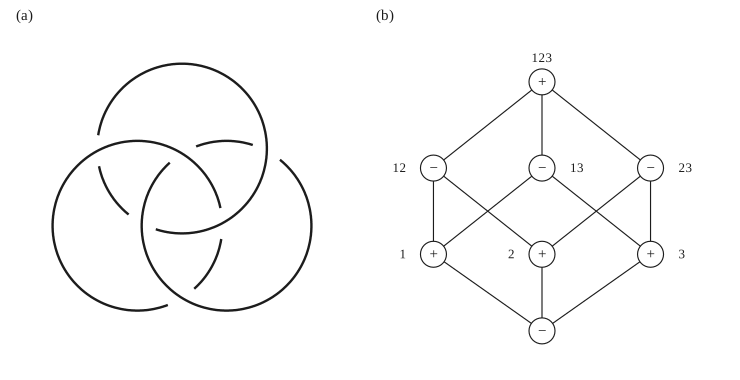
The inversion tells you what the parts contributed. It does not tell you which parts to inquire of.
A restriction the accounting imposes is not a finding about the system. The inversion needs a locally finite partial order with the whole at its top, and a quantity of the whole to invert over the parts below it. The parts of one factorization of a finite-dimensional space make such an order, a finite lattice, and the inversion runs over it without difficulty. The factorizations themselves, ordered by refinement, do not: they are a continuum with no canonical meet, infinitely many lie below the undivided whole, and no quantity of the whole has been defined on them. Nothing in the accounting ranges over that second order. Read the exactness of the first as a verdict on the second, and a limit of the math has turned into a fact about the system: finitely many parts, parts that cannot be split, or a decomposition that survives a finer cut.
5. Parts Found for Something
Two fields have a word for what survives a coarse-graining, and in one case the two words have been proven to name one thing. The renormalization group’s word is relevance: an operator whose scaling dimension is low enough to govern larger-scale behavior. Under an information bottleneck, what is relevant is the information about a target that survives compression (Tishby, Pereira, and Bialek 1999). Gordon et al. (2021) proved that, for statistical systems a field theory describes, with short-range interactions and a large buffer, the degrees of freedom the bottleneck keeps are the operators of lowest scaling dimension. Two definitions of a part, shown to be one inside a scoped theorem, with a target the user fixes.
Computational mechanics did the same for time series. Shalizi and Crutchfield (2001) define a process’s causal states as the classes of histories that predict the same future, and prove that the machine built from those states is the unique minimal maximally predictive representation. Still et al. (2010) tie that criterion to the bottleneck’s: when the relevance variable is the process’s own future and the distribution is known, the bottleneck recovers the causal-state partition as the complexity penalty vanishes. Where the theorem holds, the bottleneck and the causal states coincide by proof, and their agreement there is a fact about the criteria.
Millions of parts, found by a procedure with a criterion inside it: the phenomenon is older than the machines, and the machines industrialize it. What a trained network holds gets read as a direction, a subspace, or a cluster. Locatello et al. (2019) are the brake. Unsupervised learning of disentangled representations is impossible without inductive biases on both the model and the data, and across large experiments the disentanglement a method reports depends on hyperparameters and the random seed more than on which objective was used. The data alone does not select a decomposition; something has to be brought. Every procedure above that found parts brought it: a target the user fixes, a future to predict, a penalty on how many features may be active, a Hamiltonian and a purpose.
Biology is where you want one principle for the whole thing. A cell type, on this reading, is a part of an organism’s state space that the dynamics makes stable. Huang et al. (2005) drove one cell line along two biochemically distinct paths in gene-expression space that diverged and then converged on a common state, evidence for an attractor reached from different directions. A subsystem that stays robust under its Hamiltonian, a cell type that stays stable under its regulatory dynamics, a representation that stays useful under its objective. The resemblance is real, and it is the moment a reader reaches for one principle organizing stars, cells, and minds. The objects differ, a region of a state space and a factor of a Hilbert space, and the resemblance is not a theorem.
The next question is whether a boundary found in a model is a boundary in the world. Bruineberg et al. (2022) distinguish a Pearl blanket, which lives in a model, from a Friston blanket, posited as a boundary in the world, and argue that the mathematics does not pay for the second. Todd (2026) makes the same cut for a Bayesian description of an embodied task. Predictive accuracy is not the mechanism. The scientist’s partition and the organism’s inferential states can change independently. A decomposition found in a representation is a decomposition of the representation until something further is shown.
Let’s ask what the word part is doing in each of these practices. It names a factor whose pointer states survive a dynamics; an operator of low scaling dimension; a class of histories that predicts; a direction in an activation space; an attractor of a regulatory network. Each is a part for something, and the something is in the criterion. The uses resemble one another the way games do, and a family of uses need share no common essence (Wittgenstein 2009, §§65–67). That is a reason to look for a theorem, and Gordon et al. and Still et al. each found one, inside a scope. A theorem for two of the uses does not give the family an essence. What would it mean for two of its entries to be the same?
6. Things Come Apart
The rings hold together as three, but three claims made about any decomposition do not.
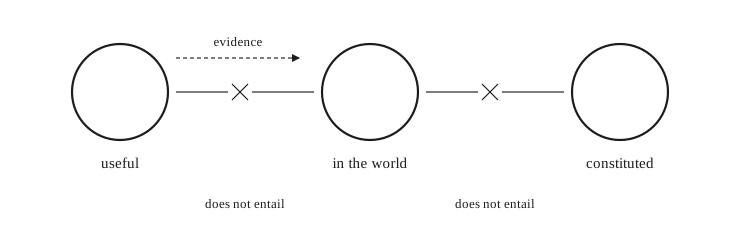
A decomposition is useful when the calculations and predictions it supports are good for the purpose they were built for. It corresponds when the division it makes is the system’s and not only the method’s. It constitutes when it is the inventory, so that any other division of the same whole is a redescription of it and not a rival.
That a division survives changes of procedure and purpose which have nothing to do with it is the evidence that it corresponds, not the definition. What a discovery of parts claims is correspondence. Constitution is a further result, the rival divisions excluded, and the exactness of a description does not do that excluding. That further result is the claim a powerful decomposition is seduced into making.
Aristotle marks a whole off from a total by whether position makes a difference: where the arrangement of a quantity’s parts changes nothing he says a total (πᾶν), and where it does, a whole (ὅλον) (Metaphysics Δ.26, 1024a1–10; Ross 1924). Wimsatt’s conditions for a system property to be a mere aggregate of the properties of its parts are that distinction made operational, and they are relative to the decomposition: intersubstitution of parts, size scaling, decomposition and reaggregation, and the absence of cooperative or inhibitory interactions (Wimsatt 2007, 280–281). A decomposition that comes closer to the conditions is easier to calculate, and the move he names a functional localization fallacy follows: “a move from the claim that a decomposition is particularly powerful or revealing to the claim that the entities and forces it yields are all that matters,” a “nothing but” claim he counts false or misleading if it says the preferred entities are the only real ones (Wimsatt 2007, 305). That is the seduction of elegance in the calculation, ease of calculation taken for discovery, named by a philosopher who likes the heuristics.
Usefulness does not entail correspondence, and the cases in which the two come apart are the ones in which a decomposition that works does not survive a change that should not have mattered. The epicycles are the familiar case: a decomposition of a planet’s motion into circles, exact to the precision of the tables for fourteen centuries, which did not survive a second, independent procedure — dynamics found the motion contained no circles — and whose circles nobody now counts among the parts of the motion. Locatello et al.’s experiments are the contemporary case: a factorization that moves with the seed may be a division of the data or an artifact of the run, and what the representation is good for does not say which. Paulo and Belrose’s seeds are the same result for the features of a language model.
Dennett (1991) counts a pattern real when some description shorter than the data’s bit map captures it. By that measure a factorization that compresses the data as well on one seed as on another is as real on either, which is permissive by design. Here’s what his criterion doesn’t ask: whether two useful factorizations are one division or two. Survival under changes that have nothing to do with the purpose is Wimsatt’s robustness, and it is evidence that one decomposition corresponds. Whether two that survive are the same parts waits on the comparison. The convergence hypothesis draws the arrow as a plot, capability on one axis and alignment between models on the other, with the trend read as an approach to what is there; what the trend survives is what Gröger et al. went and tested. Usefulness is evidence for correspondence, and how strong the evidence is depends on what the usefulness survived.
Correspondence does not entail constitution. Cells and molecules both divide an organism truly, and that leaves it unsettled whether one of them is the inventory and the other a redescription of it. Adil et al. find several factorizations of one Hamiltonian in which pointer states stay robust, each with features of its own; if each survives what it should, that survival is evidence that each corresponds, and the plurality, if the evidence holds, tells against any one of those factorizations being the sole division of that Hamiltonian.
The philosophical arguments that run from entanglement to a thesis about composition all begin after the parts have been chosen. Schaffer’s priority monism keeps the inventory of parts fixed while it reassigns priority among them: “The world has parts, but the parts are dependent fragments of an integrated whole” (Schaffer 2010, 33), and the entanglement in that argument is defined for a system and “its n components” (51), a definition that does not choose the components. Calosi and Tarozzi (2014) ask what mereology the parts satisfy once the factorization is given, and formal mereology (Varzi 2026) is handed its inventory the same way.
7. The Type of a Comparison
Agreement can look earned in three places. First, the word was the Stranger’s. Second, the mathematics was Jansma’s: the inversion agrees across fields because every field handed it an order, and the agreement is about the form of the question. Third, the comparison. Two selectors can be said to agree only once both outputs are read into one representation, the type of the comparison, and the condition on a type is plain. The type has to keep the respect in which the parts would differ. A type that identifies every decomposition of the whole shows nothing. A type that counts one factorization written in two local bases as two invents a difference. A type that keeps some other respect is not wrong. It answers another question, and its agreement is evidence about that one.
An adequate type would show a difference exactly where the parts differ, so that the transformations it ignores are the ones that preserve the parts, local unitaries and relabelings among them. The requirement is the half of that which an agreement needs: no difference in the respect at issue erased. A disagreement needs the other half, no difference invented. The working form is the control on the requirement. One case that differs in the respect alone, and is told apart, does not prove the comparison sees every such difference. Where no such case can exist, the agreement is empty. The condition has a name in the lineage Wimsatt’s robustness descends from. Campbell and Fiske asked of a battery of tests not only that different methods converge on one trait but that they tell different traits apart, discriminant validity beside convergent validity (Campbell and Fiske 1959; Thompson 2026), and a type on which every decomposition agrees fails the discriminant half. What fixes the respect is the question the comparison serves, and where the formalism says what a part is, it fixes the type as well.
Two exact cases follow, and they do different work. In the first nothing says what a part is, and the comparisons in use are shown for what they can see. In the second the formalism says what a part is, so an adequate type exists and returns a verdict.
Take a representation in which each datapoint activates a few coordinates, and rotate it. Every inner product between datapoints is unchanged, so the kernel is the same kernel, and any measure defined on kernels, centered kernel alignment and the nearest-neighbor overlap alike, reports full agreement. The sparse code has become a dense one. Which coordinates carry the activation has changed, and nothing in the kernel says which coordinate system, if either, is the network’s own. If a part is a direction the data fix, as one that separates a concept’s examples from the rest is, the rotation carries it along and this is one decomposition written in two bases; if the parts are the units, it is two decompositions. The kernel reads the same in both cases. On the first reading sameness of kernel gives sameness of parts, though not the converse, and it does not say which directions the parts are. On the second the agreement is empty. If the parts are directions a further procedure picks out, the kernel does not decide: Paulo and Belrose’s autoencoders read the very same activations and returned mostly different directions. Nothing in the comparison says which reading holds, and that is what the case shows: the respect has to be named before the agreement means anything. A second change separates the two measures from each other. Pass every entry of the kernel through an increasing function, and each datapoint keeps its neighbors in their order while the similarities between them change: the nearest-neighbor overlap stays at its maximum and centered kernel alignment falls below it.1
Read through the type, the field’s comparisons sort themselves. Kornblith et al. argued for invariance to rotation, so a comparison of kernels answers whether two representations arrange the data alike, and was never going to say whether two networks share their units. The nearest-neighbor measure ignores more, every change that keeps the neighbors, which is why the agreement it reports is about neighbors. A feature of a sparse autoencoder is a direction, and Paulo and Belrose’s two autoencoders read one activation space, so the type has its form: directions laid against directions, order ignored, a threshold for how close counts. Lan et al.’s read two, so the pairing had to be chosen, and features paired at random score far lower, so the score rests on it. Their control is another: autoencoders trained on a model with randomized weights, which the comparison finds little like the originals (appendix D). Their claim stops at what the comparison can carry. Each measure answers the question its invariances pose. What no invariance supplies is what a part of a network is, or the step from a network’s parts to the world’s.
Where a formalism says what a part is, the comparison can be exact. Wimsatt states a test for two decompositions. It asks whether the parts’ boundaries coincide, and these parts must be regions of points. Two parts coincide when any two points in one of them fall inside a single part of the other, and conversely. A factorization of a Hilbert space supplies no such points. Carrying it across takes a translation: something in the factorization has to stand in for the points.
Zanardi, Lidar, and Lloyd made a subsystem the thing a set of observables induces: a tensor-product structure is a family of commuting subalgebras of operators whose join is the full algebra, and two factorizations are the same when the families are.
Let’s draw it on two qubits. Conjugating the two one-qubit algebras by a controlled-NOT, with the first qubit as control, gives a second pair, the algebra generated by σ_z ⊗ 1 and σ_x ⊗ σ_x and the algebra generated by σ_z ⊗ σ_z and 1 ⊗ σ_x, neither of which lies inside either of the first. The Bell state (|00⟩ + |11⟩)/√2, entangled under the first factorization, is a product state under the second. A two-dimensional factor has no proper refinement, so the two factorizations have no common refinement, an instance of the incompatibility Pasqualini and Fortin (2026) describe. The coupling σ_z ⊗ σ_z is an interaction between the parts of the first factorization and a field on one part of the second, which is Wimsatt’s interactional complexity in quantum dress: a system is interactionally complex to the extent that its subsystems under one decomposition cross the boundaries another decomposition draws (Wimsatt 2007, 181). Two things true of the whole, which no change of factorization alters, cannot show that difference.
The algebra all the parts generate is the full algebra for every complete factorization. The spectrum of the Hamiltonian is unchanged by any change of factorization, and here σ_z ⊗ σ_z and 1 ⊗ σ_z have the same spectrum, so a spectral comparison cannot tell the coupling from the field. The case lies outside Cotler, Penington, and Ranard’s result for a plain reason: on two qubits every Hamiltonian is two-body in every factorization, so locality constrains nothing and the spectrum has nothing to pick out. Where their result holds, with enough factors that locality is a constraint, a quantity of the whole does pick out a factorization, and that is the sense in which a fact about the whole can pay for parts.
Nothing turns on the gate; any unitary that is not local does the same. And a difference of parts need not show in what the selectors are given. A field on the first qubit, σ_z ⊗ 1, is a field on one part under both factorizations. The parts differ, and the Hamiltonian reads the same. That is a degeneracy, several factorizations one Hamiltonian cannot tell apart, and no selector given only that Hamiltonian could have preferred one.2
Where two selectors return objects of different kinds, the formalism fixes no type and the choice is real. A causal state is a partition of the histories of a measured record, and it enters a space of observables only through the observable whose record it compresses. So the reading that puts a class of histories beside a tensor factor is itself a selection, and a comparison that reports agreement after it has to say which observable was chosen and why the choice did not make the agreement. The central result of Huh et al. brings a pairing to a comparison of kernels. An image model and a language model have no inputs in common, and to measure their alignment “we use paired datasets to bridge the two modalities” (2024, sec. 2): the kernels are computed over images and their captions. The pairing is the observable. It decides which image stands beside which sentence, the sentence was written for the image, and an agreement reported after it has to say why the pairing did not make the agreement. Something has to be brought, and what is brought decides what can be found.
8. What an Agreement Returns
Robustness, in the technical sense, is what would join usefulness to correspondence. Levins called a result several independent models recover a robust theorem, “our truth is the intersection of independent lies” (1966, 423), and Wimsatt made robustness the working criterion for “the reality or trustworthiness of the thing which is said to be robust” (2012, 74), with two caveats that bind here. The robustness is illusory when the means of detection supposed to be independent are not (64, 84). And a system can have robust boundaries while “the different criteria used to decompose it into parts produce radically different boundaries” (76). Independence is the first requirement, and for selectors it asks what they share: a target, a handed family, a source of data, and whether the sharing drives the agreement. Call that the proviso. For the networks it asks whether a model of text and a model of images are two looks at the world, or one look and its description. Text is written by people who see, and much of it is written about what they see, so the dependence may run through the describer and not through the scene. That is a fact about what a language model is trained on, apart from the captions of the last section, which belong to the comparison. Huh et al.’s own figure shows a dependence between models raising the score: CLIP models, “which are trained with explicit language supervision, exhibit a higher level of alignment,” and “this alignment decreases after being fine-tuned on ImageNet classification” (2024, fig. 3). It does not show how much of the alignment among models trained apart runs through the describer, and until that is known the proviso has not been shown to be met. Ramidi and Scharp ask it of all such structure: how to tell what is invariant from what arises because “all our data is generated under human-specific conditions on Earth.”
The second requirement is a different matter from independence. Two selectors with nothing in common agree on the generated algebra for nothing, so that agreement is not the illusion a shared assumption makes, and it is empty all the same. Fully independent methods supply no evidence of the same parts through a comparison that would have agreed had their parts differed. Independence asks whether the procedures could have failed separately. The second requirement asks whether the comparison would have told their parts apart had they differed. Schupbach’s logic takes the result as given, one result that several means have each detected, and asks what explains it. In his cases the result is one on its face, a motion seen in each sample. For parts, that the result is one is what the comparison is for, and there is an inference before his. From a score to the same parts, the rival is that the comparison would have agreed had the parts differed. A comparison that keeps the respect rules it out, and one that does not cannot discriminate, in his sense, between the same parts and different ones. From the same parts to parts the system has, the rival is that something the procedures share produced the sameness, and the proviso answers that. Schupbach sets independence aside and keeps that rival. The demand is his at both steps. Robustness as Levins and Wimsatt state it makes the demand at the later step, and at the earlier only for parts that are regions of points.
Gordon et al.’s theorem and Still et al.’s are where a sharing is proved rather than suspected. Two procedures agree inside a scope, and the common structure that produces the agreement is identified, which Weisberg counts as a robustness analysis carried through (Weisberg 2006). Wimsatt’s corroboration is agreement by means that can fail one at a time.3 A theorem that two criteria coincide makes their agreement, inside its conditions, a fact about the criteria. What can still fail one at a time is everything the theorem does not cover: the application of each criterion to a case, and the criteria themselves outside the conditions. Agreement there corroborates, and that is the robustness wanted here.
Here’s where I need more from Wimsatt than he claims. His test for two decompositions asks that the parts coincide both ways (§7; Wimsatt 2007, 182). Without the converse, a part contained in a larger part would count as the same part, and a refinement would pass as sameness. What the two-qubit case applied was a translation, inclusion among the parts’ algebras, and the translation returned his verdict, parts that cross one another’s boundaries. The translation is not in his account. It is the type the formalism fixes where the formalism says what a part is. Where the procedures return objects of different kinds, or objects in different spaces, the formalism supplies no carrier for a translation, and the type is a choice that has to be made and defended. A theorem can supply one inside a scope, as Gordon et al.’s does. Sameness of parts is typed. Two selectors can each recover a robust decomposition, and whether they recovered the same parts is settled only in a type. A general account of sameness across kinds is a further work and not this paper’s. The condition any such account has to meet is this paper’s.
A comparison, when it is run, has three outcomes. The selectors can return the same parts. They can return compatible descriptions at different resolutions, which is the case Rosas et al. (2024) order in a lattice of closed coarse-grainings. Or they can return incompatible decompositions, which Pasqualini and Fortin supply.
So an agreement returns less than it appears to. In a type that keeps the respect, it shows that the procedures returned the same parts in that respect. Under the proviso as well, the sameness is evidence that the parts are the system’s, evidence for a correspondence it does not establish. In a type that does not keep the respect it is evidence about whatever the type does keep, and it bears on the parts only where a further result ties the two, as Cotler, Penington, and Ranard’s ties the spectrum to a factorization. The inventory claim waits on the rivals the comparison did not include.
And a divergence returns more. It is not, on its own, a finding that a part is a part for a purpose. It may be incompatible parts, the same parts at different scales or timescales, a degeneracy among several factorizations, or a loss in the translation into one family of observables, and each of those is something to find out. The last is the type inventing a difference, the half a disagreement has to rule out. The features Paulo and Belrose found unshared measure how much of a decomposition does not come back, and the finding did not wait on independence. What procedures share can explain a sameness and cannot be what makes them differ, and the more they share the fewer places a difference can come from. Two runs that share everything but a seed and still differ have shown that the model, the data, and the objective do not fix what an autoencoder returns. Whether the same features lie beneath it under another splitting, or a looser threshold, is the half still open. Adil et al.’s several factorizations are a fact about one Hamiltonian. Incompatibility settles that the divisions compared are not one division, and that is a result. The difference between two sets of parts is where a discovery would be.
Neither a universal mereology nor its denial follows. The monism infers from a shared accounting, or a shared stability, to one inventory. The nihilism infers from the conditionality of every selector to there being no parts, or no trustworthy account of them. No author cited asserts either outright. The nearest to the first are the hope Paulo and Belrose record, to enumerate every feature of a model; the hypothesis of a shared statistical model of reality, which speaks of one representation and not of one inventory; and the program that seeks a privileged quasi-classical factorization, whose authors say generic Hamiltonians admit none. The nearest to the second is Pasqualini and Fortin’s relativity of parthood, which stops short of denying parts. The two inferences run in opposite directions from the same place, a representation, on the same unpaid premise, that a fact about the representation is a fact about the world. Neither the agreement of the accounting nor the conditionality of the selectors pays it. I decline both. Neither has been earned. What can be earned comes first and is narrower: that these procedures found the same parts, shown in a type that keeps the respect, and then, under the proviso, that the parts are the system’s.
9. Part-icular
A universal theory of parts would be a discovery, and this paper says what the discovery would have to show. The counterfeit has three places: the word, the handed order, and a comparison that does not keep the respect. In each the difference at issue could not have shown. The real thing has two requirements. What the procedures share must not be what made them agree, which Wimsatt asks as independence. And the comparison has to keep the respect in which the parts could differ, which is Campbell and Fiske’s discriminant demand carried to decompositions, and the one added here to robustness. Each rules out a rival, the form Schupbach gave the test: that something shared produced the sameness, and, before it, that the comparison would have agreed had the parts differed. An agreement in a comparison that keeps the respect shows that the procedures found the same parts in that respect. With the proviso met as well it is the beginning of a discovery, evidence that the parts are the system’s. Without the second requirement it shows less than it appears to. A disagreement, in a comparison that invents no difference, is a finding too, and it does not wait on independence. A claim that two procedures found the same parts should name the respect and come with a case, differing in that respect alone, which the comparison would have told apart.
Work of three kinds shows a claim about parts earned and not assumed. Gordon et al. and Still et al. proved two criteria the same, inside a scope and for a target, and inside the scope nothing is left for an agreement to show. Cotler, Penington, and Ranard argue that where locality is a constraint a quantity of the whole almost always fixes a factorization. Paulo and Belrose ran a comparison that ignores the order of the features, and so invents no difference there, and reported what it returned, which in the largest case was mostly difference. None of them needed the inventory first, and none concluded that there are no parts.
The convergence dispute is this discipline being worked out in public. Its parties have named a respect, who is near whom or how near, calibrated a null, and asked what exactly converges, and each step has made the claim more exact about its object. What the agreement is evidence of is still the kernel. Whether the networks share parts waits on what a part of a network is, which no measure says, and whether those parts are the world’s is a further claim again. A checked proof and a score are alike in this: each is exact about what it was handed.
The mistake is to take a relation between descriptions for a relation between things. The descriptions now organize what is retrieved, what is counted as similar, and which distinctions survive. The mistake is cheap, and it feels like progress.
The Stranger’s division was a name, and the expectation was a kind. Ours is a name, a theorem, and a space of comparison, and the expectation is one inventory of the world. The Stranger said, show the part to be a kind, then never finished. The showing has a form now: independent procedures, and a comparison that would have told their parts apart. The procedures are exact enough to run it. That exactness is the seduction; it makes one name feel like one kind.
Disclosures
Competing interests. The author is the founder of Surmado, Inc., which builds AI systems. The paper is written in a personal capacity, without employer involvement and without funding.
Generative AI. Generative AI systems from OpenAI, Anthropic, and xAI were used for research assistance, source location and verification, partial drafting assistance, and editorial review under the author’s direction. The framing, the argument, and the final text are the author’s, and the author takes full responsibility for the work.
Acknowledgments. The observation that text is written by people who see, so that a model of text and a model of images may not be independent looks at the world, is Jordan Sorokin’s, in correspondence.
Prior version. A longer synthetic working paper, Mereology and the Möbius Inversion: What Does It Mean to Find the Same Parts?, is deposited on Zenodo (doi:10.5281/zenodo.23463198). The present article is a reframing of its argument. Preprint v1.0 (24 October 2026) remains at doi:10.5281/zenodo.23628076. Preprint v2.0 (10 November 2026) remains at doi:10.5281/zenodo.24117358. Cite all versions with doi:10.5281/zenodo.23628075, which resolves to the latest.
References
- Adil, Arsalan, Manuel S. Rudolph, Andrew Arrasmith, Zoë Holmes, Andreas Albrecht, and Andrew Sornborger. 2026. “Search for Classical Subsystems in Quantum Worlds.” Physical Review D 113 (10): 103535. doi:10.1103/vj4x-96fk
- Bruineberg, Jelle, Krzysztof Dołęga, Joe Dewhurst, and Manuel Baltieri. 2022. “The Emperor’s New Markov Blankets.” Behavioral and Brain Sciences 45: e183. doi:10.1017/S0140525X21002351
- Burnet, John, ed. 1900–1907. Platonis Opera. 5 vols. Oxford: Clarendon Press.
- Campbell, Donald T., and Donald W. Fiske. 1959. “Convergent and Discriminant Validation by the Multitrait-Multimethod Matrix.” Psychological Bulletin 56 (2): 81–105. doi:10.1037/h0046016
- Calosi, Claudio, and Gino Tarozzi. 2014. “Parthood and Composition in Quantum Mechanics.” In Mereology and the Sciences: Parts and Wholes in the Contemporary Scientific Context, edited by Claudio Calosi and Pierluigi Graziani, 53–84. Synthese Library 371. Cham: Springer. doi:10.1007/978-3-319-05356-1_3
- Carroll, Sean M., and Ashmeet Singh. 2021. “Quantum Mereology: Factorizing Hilbert Space into Subsystems with Quasiclassical Dynamics.” Physical Review A 103 (2): 022213. doi:10.1103/PhysRevA.103.022213
- Cotler, Jordan S., Geoffrey R. Penington, and Daniel H. Ranard. 2019. “Locality from the Spectrum.” Communications in Mathematical Physics 368 (3): 1267–1296. doi:10.1007/s00220-019-03376-w
- Dennett, Daniel C. 1991. “Real Patterns.” The Journal of Philosophy 88 (1): 27–51. doi:10.2307/2027085
- Gordon, Amit, Aditya Banerjee, Maciej Koch-Janusz, and Zohar Ringel. 2021. “Relevance in the Renormalization Group and in Information Theory.” Physical Review Letters 126 (24): 240601. doi:10.1103/PhysRevLett.126.240601
- Gröger, Fabian, Shuo Wen, and Maria Brbić. 2026. “Revisiting the Platonic Representation Hypothesis: An Aristotelian View.” Proceedings of the 43rd International Conference on Machine Learning, PMLR 306. arXiv:2602.14486.
- Huang, Sui, Gabriel Eichler, Yaneer Bar-Yam, and Donald E. Ingber. 2005. “Cell Fates as High-Dimensional Attractor States of a Complex Gene Regulatory Network.” Physical Review Letters 94 (12): 128701. doi:10.1103/PhysRevLett.94.128701
- Huh, Minyoung, Brian Cheung, Tongzhou Wang, and Phillip Isola. 2024. “Position: The Platonic Representation Hypothesis.” Proceedings of the 41st International Conference on Machine Learning, PMLR 235: 20617–20642.
- Jansma, Abel. 2025a. “Mereological Approach to Higher-Order Structure in Complex Systems: From Macro to Micro with Möbius.” Physical Review Research 7 (2): 023016. doi:10.1103/PhysRevResearch.7.023016
- Jansma, Abel. 2025b. “Complex Systems and Quantitative Mereology.” Blog post, abeljansma.nl, 28 January 2025. https://abeljansma.nl/2025/01/28/mereoPhysics.html
- Kornblith, Simon, Mohammad Norouzi, Honglak Lee, and Geoffrey Hinton. 2019. “Similarity of Neural Network Representations Revisited.” Proceedings of the 36th International Conference on Machine Learning, PMLR 97: 3519–3529.
- Lan, Michael, Philip Torr, Austin Meek, Ashkan Khakzar, David Krueger, and Fazl Barez. 2025. “Quantifying Feature Space Universality Across Large Language Models via Sparse Autoencoders.” Preprint, arXiv:2410.06981.
- Landau, Gilad D., and Aviv Keren. 2026. “The Concept of Representation in ML: Beyond Plato and Aristotle.” Preprint, arXiv:2607.17800.
- Levins, Richard. 1966. “The Strategy of Model Building in Population Biology.” American Scientist 54 (4): 421–431.
- Locatello, Francesco, Stefan Bauer, Mario Lucic, Gunnar Rätsch, Sylvain Gelly, Bernhard Schölkopf, and Olivier Bachem. 2019. “Challenging Common Assumptions in the Unsupervised Learning of Disentangled Representations.” Proceedings of the 36th International Conference on Machine Learning, PMLR 97: 4114–4124.
- Möbius, August Ferdinand. 1832. “Über eine besondere Art von Umkehrung der Reihen.” Journal für die reine und angewandte Mathematik 9: 105–123. doi:10.1515/crll.1832.9.105
- Park, Kiho, Yo Joong Choe, and Victor Veitch. 2024. “The Linear Representation Hypothesis and the Geometry of Large Language Models.” Proceedings of the 41st International Conference on Machine Learning, PMLR 235: 39643–39666.
- Pasqualini, Matías, and Sebastian Fortin. 2026. “Towards a Tensor Product Structure-Grounded Mereology.” Entropy 28 (6): 627. doi:10.3390/e28060627
- Paulo, Gonçalo, and Nora Belrose. 2026. “Sparse Autoencoders Trained on the Same Data Learn Different Features.” In Proceedings of the International Conference on Learning Representations.
- Ramidi, Akhil, and Kevin Scharp. 2026. “The Representational Alignment Hypothesis: Evidence for and Consequences of Invariant Semantic Structure Across Embedding Modalities.” Preprint, arXiv:2602.16584.
- Rosas, Fernando E., Bernhard C. Geiger, Andrea I. Luppi, Anil K. Seth, Daniel Polani, Michael Gastpar, and Pedro A. M. Mediano. 2024. “Software in the Natural World: A Computational Approach to Hierarchical Emergence.” Preprint, arXiv:2402.09090.
- Ross, W. D., ed. 1924. Aristotle’s Metaphysics. 2 vols. Oxford: Clarendon Press.
- Rota, Gian-Carlo. 1964. “On the Foundations of Combinatorial Theory I. Theory of Möbius Functions.” Zeitschrift für Wahrscheinlichkeitstheorie und Verwandte Gebiete 2 (4): 340–368. doi:10.1007/BF00531932
- Schaffer, Jonathan. 2010. “Monism: The Priority of the Whole.” Philosophical Review 119 (1): 31–76. doi:10.1215/00318108-2009-025
- Schupbach, Jonah N. 2018. “Robustness Analysis as Explanatory Reasoning.” The British Journal for the Philosophy of Science 69 (1): 275–300. doi:10.1093/bjps/axw008
- Shalizi, Cosma Rohilla, and James P. Crutchfield. 2001. “Computational Mechanics: Pattern and Prediction, Structure and Simplicity.” Journal of Statistical Physics 104 (3–4): 817–879. doi:10.1023/A:1010388907793
- Still, Susanne, James P. Crutchfield, and Christopher J. Ellison. 2010. “Optimal Causal Inference: Estimating Stored Information and Approximating Causal Architecture.” Chaos 20 (3): 037111. doi:10.1063/1.3489885
- Thompson, Morgan. 2026. “William Wimsatt, Donald Campbell, and the Idea of Robustness.” Acta Biotheoretica 74: 33. doi:10.1007/s10441-026-09543-6
- Tishby, Naftali, Fernando C. Pereira, and William Bialek. 1999. “The Information Bottleneck Method.” Proceedings of the 37th Annual Allerton Conference on Communication, Control and Computing, 368–377. arXiv:physics/0004057.
- Todd, Ian. 2026. “Bayesian Descriptions are not Mechanisms: Predictive Processing and the Realisation Gap in Embodied Neural Dynamics.” Minds and Machines 36: 45. doi:10.1007/s11023-026-09801-z
- Varzi, Achille. 2026. “Mereology.” In The Stanford Encyclopedia of Philosophy (Fall 2026 Edition), edited by Edward N. Zalta and Uri Nodelman. https://plato.stanford.edu/archives/fall2026/entries/mereology/
- Weisberg, Michael. 2006. “Robustness Analysis.” Philosophy of Science 73 (5): 730–742. doi:10.1086/518628
- Wimsatt, William C. 2007. Re-Engineering Philosophy for Limited Beings: Piecewise Approximations to Reality. Cambridge, MA: Harvard University Press.
- Wimsatt, William C. 2012 [1981]. “Robustness, Reliability, and Overdetermination.” In Characterizing the Robustness of Science: After the Practice Turn in Philosophy of Science, edited by Léna Soler, Emiliano Trizio, Thomas Nickles, and William C. Wimsatt, 61–87. Dordrecht: Springer. First published in Scientific Inquiry and the Social Sciences, edited by Marilynn B. Brewer and Barry E. Collins (San Francisco: Jossey-Bass, 1981). doi:10.1007/978-94-007-2759-5_2
- Wittgenstein, Ludwig. 2009. Philosophical Investigations. 4th ed. Translated by G. E. M. Anscombe, P. M. S. Hacker, and Joachim Schulte. Chichester: Wiley-Blackwell.
- You, Junwon, Mihyun Jang, Sangwoo Mo, and Jae-Hun Jung. 2026. “What Converges in the Platonic Representation Hypothesis? Structure over Geometry.” Preprint, arXiv:2609.27252.
- Zanardi, Paolo, Daniel A. Lidar, and Seth Lloyd. 2004. “Quantum Tensor Product Structures Are Observable Induced.” Physical Review Letters 92 (6): 060402. doi:10.1103/PhysRevLett.92.060402
- Zanardi, Paolo, Emanuel Dallas, Faidon Andreadakis, and Seth Lloyd. 2024. “Operational Quantum Mereology and Minimal Scrambling.” Quantum 8: 1406. doi:10.22331/q-2024-07-11-1406
Footnotes
-
A script in the supplement builds the three representations and computes both measures. The increasing function is the exponential, entry by entry, which keeps the kernel positive semidefinite. ↩
-
A second script in the supplement checks these identities computationally. ↩
-
The debate over what independence requires is live (Thompson 2026). ↩