Love Music More
It's the Circle of Fifths
And it moves us all...
First published on Love Music More (Substack). Full text hosted here. Companion episode: listen.
In the last post I talked about the perfect octave and perfect fifth, and how the 12-tone scale was derived. I’d highly suggest reading that one before graduating to this magic circle.
Are you ready for the magic?
To recap: when you stack perfect fifths on top of each other, you move twelve steps before ultimately ending up back where you began.
In other words, that journey to find all twelve notes makes a circle.
Not just any circle. The circle. Every notch on this clock is a perfect fifth. Notice the 12 slices? Each stop shows the relationship between notes. It also reveals the difference and similarity between “keys” (closer are more related).
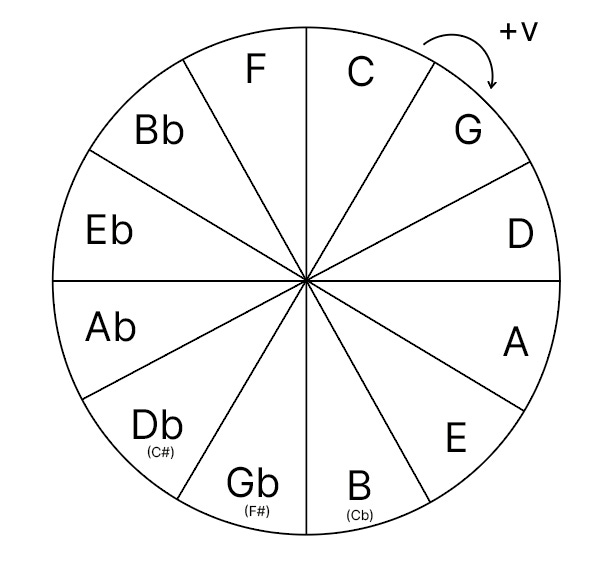
Changing “Keys”
A key is another word for a musical scale. Aka a tonality. It’s what people mean when they say the song’s in C major. When you change keys (modulation), it’s easier to move one step forward (or backward) on the circle, because they are more related. Related meaning more similar.
More specifically, the keys of C and G have only one note that’s different from each other.
G and D have only one note that’s different from each other. (See how they’re neighbors?)
C and D have two notes that are different from each other, because they’re two stops away from each other on the circle. C major and A major? Three notes different — A major’s three sharps (F♯, C♯, G♯) are the distance around the circle.
But wait. What happens if we go backwards on the clock?
The Perfect Fourth (4:3 Ratio)
There’s one final “perfect” interval to consider. We have the octave, the fifth, and now may the fourth be with you.
The reason these intervals are called perfect is that their ratios are simple. They’re more in that Pythagorean vibe. The other notes… well, they have to fudge the numbers a bit to make them all fit. (Turns out the universe isn’t perfect.)
But the people making early music theory were trying to find God in numbers (Pythagoras) or in all things (early Catholic church). And fancy circles made them feel like there was more order to the universe. Naturally, they built our music system around it. And we still use it today. Not because it’s perfect, but because it’s cultural.
Adding to the “ah-ha” of these math nerds: the perfect fourth is the inverse of the perfect fifth. Meaning if you go up a perfect fifth (C to G), you go down a perfect fourth to return (G to C).
So when you’re going counterclockwise on the Circle of Fifths, it becomes the Circle of Fourths.
C to G is up a perfect fifth. G to C is down a perfect fourth.
C to D is up two perfect fifths. C to B♭ is down two perfect fourths.
Fun(?) Fact
The perfect fourth used to be called the diatessaron, which means “made of four [ingredients].” It also refers to “a harmony of the four [Christian] Gospels edited and arranged into a single connected narrative.” I think that helps show where the music theory’s creators’ heads were at.
A Solar System of Music
The movements of the notes are related to the movements of the planets. At the same time as the development of music theory, geocentrism was in vogue. The Earth was the center of the universe.
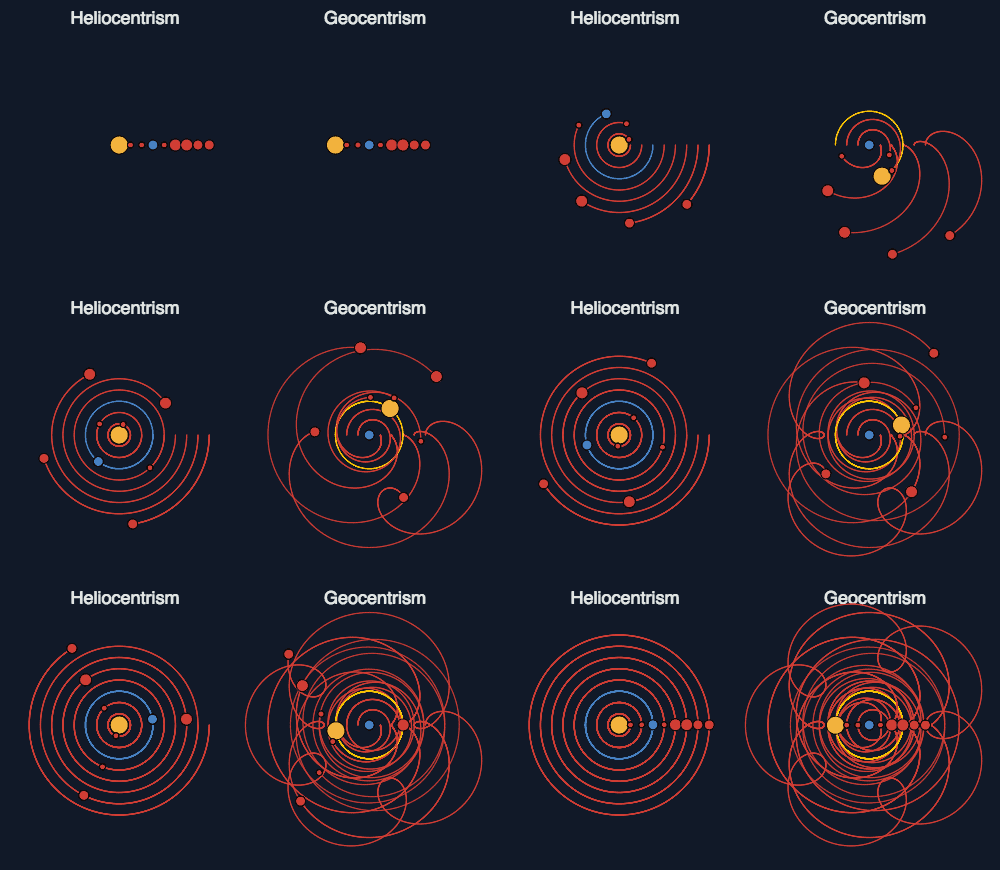
The math looked perfect at the time. But as we got better telescopes, we realized we had to fudge the numbers… a bit… to make it all work. Later, scientists accepted that the cleaner model of revolving around the sun was accurate. But music theorists didn’t get the memo. We’re still fudging the numbers. And that’s okay, because music is cultural.
Sharps and Flats
Have you heard of notes like F♯ (F sharp)? Those are the black keys on the keyboard. The white keys don’t have sharps or flats.
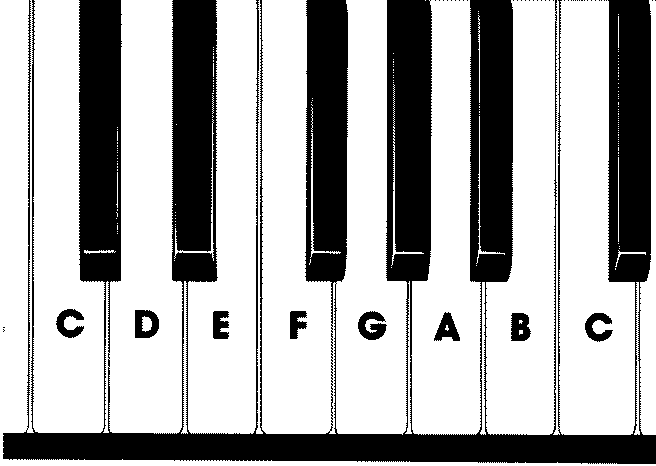
But when you do the legit Pythagorean math, notes like F♯ and G♭ (G flat) shouldn’t be the same note. They’re a liiiiitle different. So musicians treated them that way for quite a while. It was all cool if you were playing solo, but as people played music in ensembles, orchestras, and big groups, they realized it’d be nice to fudge the numbers a bit and simplify. It helps things sound a bit more together.
So they created a concept. Ready for it? It’s a spicy word. Enharmonic.
That’s the word for making notes equivalent.
Here’s a more accurate keyboard to chew on:
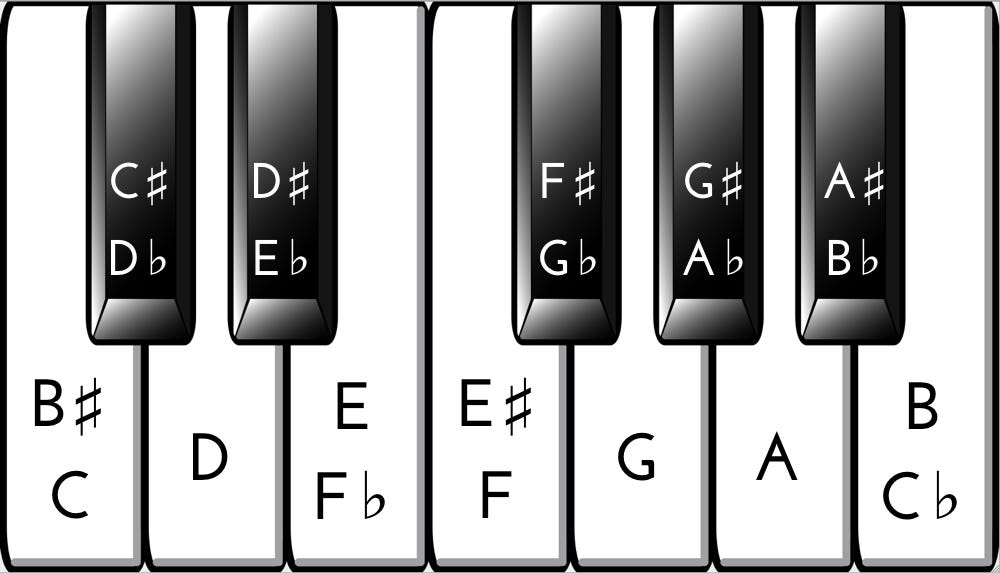
Put another way: without fudging the numbers, without this concept of enharmonic, the Circle of Fifths isn’t a great circle. It’s a spiral. It just goes off and off and off into oblivion.
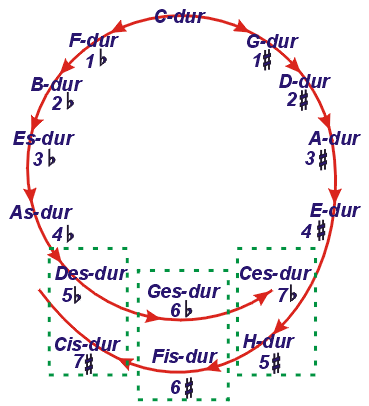
But like the geocentric universe, we fudge the numbers, make the math work, and are amazed at the beauty of the universe (…that we created).
That’s enough talking about a circle. We can dig into keys and chord changes and modulation in a future post. For now: listen to how people make the circle dance — and check the companion episode.
Next in the series: 440 or 432 Hz — what frequency is better?