Love Music More
Tuning into the Universe's Frequency (What Are Notes?)
What are frequencies?
First published on Love Music More (Substack). Full text hosted here. Companion episode: listen.
“I would rather write 10,000 notes than a single letter of the alphabet.” — Ludwig van Beethoven
I say to Beethoven: thank you.
What Are Notes?
In my very first podcast episode, I asked “Why are there 12 notes?”.
Silly me. I thought that was an appropriate beginning for the story of music. Instead, I should’ve been asking, what are notes?
Or better yet: what are frequencies?
Riding the Wave
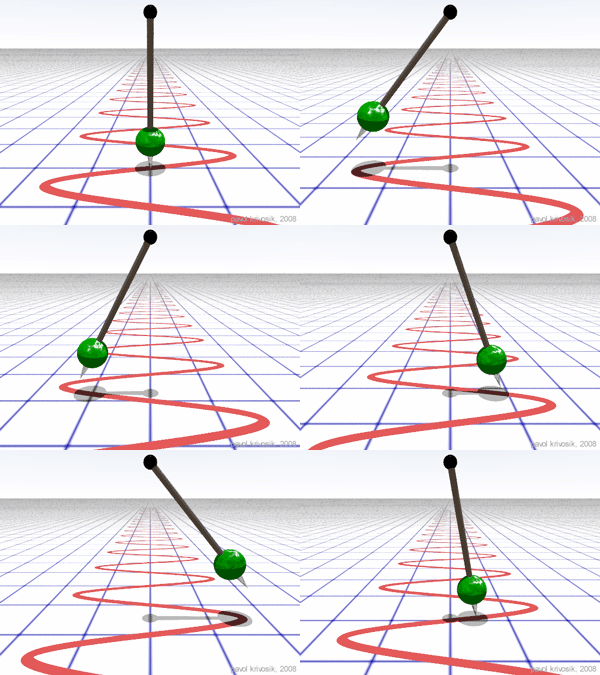
All notes are frequencies. All frequencies are waves. In Wikipedia’s words, a “number of occurrences of a repeating event per unit of time.”
There are all sorts of waves. Sound waves. Light waves. Ocean waves.
All waves are connected.
Guitarists Love String Theory
Space.com sums it up: string theory is a theoretical-physics concept that suggests everything in the universe is made of tiny vibrating strings smaller than atoms, electrons, or quarks. As those strings twist, fold, and vibrate, they create matter, energy, and other phenomena — gravity, electromagnetism, particle physics. Humans interpret those effects as everything from large-scale phenomena to subatomic particles.
God’s a shredder?
Light Becomes Sound Becomes Light
If you have two minutes, check out this simple experiment converting sound into light and then back into sound:
Sound in Space?!
Of course there’s no sound in the vacuum of space. But apparently there’s enough gas around a black hole that it can groan. Weird. (There’s probably some other stuff going on, like shifting the frequencies into the range of human hearing.)
There are other examples of the “music of the spheres,” where oscillations get converted from one end of the wave spectrum waaaaay over to the auditory spectrum. You can do this with light, ocean waves, and even earthquakes.
So can we say we can “hear” the light? Or listen to the earth quake? Sorta. Idk. Something must be lost in translation.
But regardless, it’s helpful for understanding how waves relate.
And it leads me to believe that audio is so human. We are not beings of light. We are beings of language. Of singing. Of drums. Of birdsong and myths.
In other words, bringing light down to the level of sound is kind of like turning bread into crumbs for us ants.
Microwaves and Nukes
Know the famous E = mc² equation? It’s about creating equivalence between energy and mass. There’s a butt-ton of energy in mass, which is why you multiply the mass by the speed of light squared to find it. Energy here is expressed as a wave.
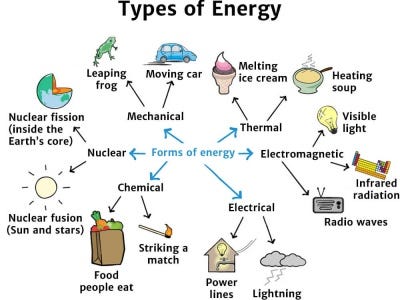
A microwave excites the water molecules in your food and heats it. Gamma rays from a dirty bomb can give people cancer. And we can only see a small subset of these frequencies — bees see a psychedelic ultraviolet world we don’t.

Same deal with hearing, but we’ve got a pretty broad swath of the spectrum covered. That’s why dog whistles and teen anti-loitering alarms work.
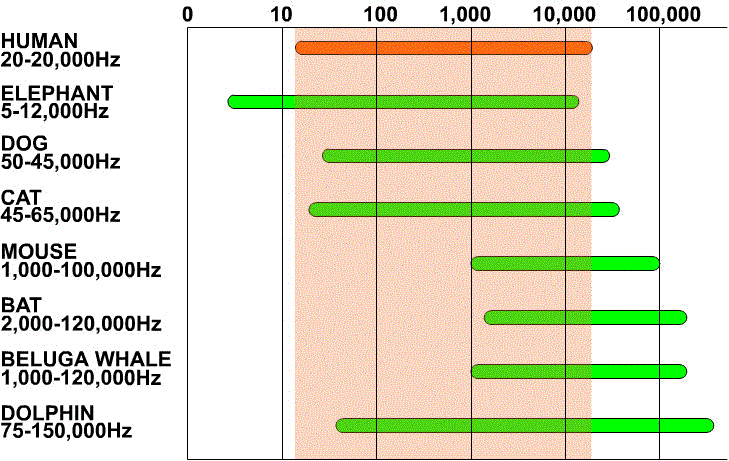
Naturally, our choice of musical notes corresponds to our hearing range. But imagine an alien species with a dolphin’s range of hearing. Wouldn’t their music be a trip? We’d probably have to scale it down just to perceive it. Maybe they’d be able to hear the earthquakes coming.
Feedback Loops (Feedback Loops, Feedback Loops)
Ever heard that scream at a concert or on a Jimi Hendrix recording? That’s a speaker feedback loop: the frequency emitted by the speaker is returned to the speaker by the microphone, creating infinite recursion.
A mirror facing a mirror does the same thing with light.

One of my best friends did some great research about seizures. When I asked him about it, he compared a seizure to a feedback loop: a recursion between electrical signals. The wave builds upon itself like the speaker and the microphone. And by understanding the wave, you’re able to intervene and stop the seizure. There are some tools to do this, but research is still ongoing.
(Converting those seizure waves to human hearing requires converting the pulses to audio and then raising their pitch by orders of magnitude. I hope Jordan makes his art installation some day.)
Converting Our Way to Understanding
I find waves easier to grasp when I consider them all as equivalent. It’s like looking at a problem from different angles. And it allows for a unique sort of creative thought.
For example, when I run a vocal into a feedback loop, I’m giving the computer a mini seizure. What am I saying with that? What emotional response does that elicit? It’s bigger than just adding “vibe.” It’s adding meaning beyond words.
We Can’t Grasp Light
The reason it took Albert Einstein for humanity to grasp relativity wasn’t because there weren’t smart people around. It’s that the problem of light is deeply counterintuitive.
Sound is easier for us to grasp. We’re beings of sound. Of footsteps. Of wind. Of lion roars and wounded prey in the brush.
We’re Faster than Sound
“Mach One” is a measurement based on the speed of sound, frequently used to describe rockets or jets. One Mach = the speed of sound (around 761 mph at sea level on a standard day).
Heck, even I’ve flown over 700 mph in a passenger plane with a healthy tailwind. I was producing music at the time. Making sound at nearly the speed of sound.
There was even a plane that went Mach 9.6.
We’re Both Bound to a Medium
Unlike light, we cannot exist without the air around us. Sound is like us. Requiring a medium humanizes it. Makes it more familiar. And it behaves in more expected ways.
We can see the speakers vibrate. We can find the resonant frequencies of rooms just by ear. Or we can break glasses with our voice.
A Universe of Sound
Since we can understand audio more than light, and can manipulate audio to great effect, I argue that music is our most powerful connection to the universe. I think there’s more than cultural exchange or virtuosity in every note, in every frequency, in every wave.
Rhythm is order. Dance is communion. Harmonies are relationships incarnate. It’s bigger than that. It’s bigger than that black hole. It is the universe itself. And music is finding our place in it. It’s playing the strings of life itself.
So, What Is a Note?
Every frequency is valid. A note is just what we agree upon in an ensemble. In a later post I cover the 440 Hz vs 432 Hz debate, the history of different notes, and different cultures’ perspectives on tones. Here’s a taste:
Really, most of what we consider “in or out” of pitch is cultural and contextual. If the band is playing in 440, you better fit in.
There are also a ton of examples where tape has intentionally or unintentionally changed the pitch of a recording. One of my favorites: The Beatles’ “Rain.” Same song, same recording, but the pitch was manipulated via tape playback speed. Compare these two:
Notes Are Malleable; Notes Are Infinite
The composer can push off from or lean into any trope or cultural understanding. That’s the real power of knowing our history and the genre’s typical tuning.
I believe there’s a freedom that comes from disconnecting the notes on the keyboard from all that is possible. There aren’t 12 notes. There’s an infinite gradient of frequencies. These frequencies settle into 12 familiar spots, but they are familiar by culture and history, not by their essential nature.
(Next: why Western music landed on 12, the history of Pythagoras — the bean hater! — and all that jazz.)
How Do I Love Music More?
I hope you take this understanding and consider how frequencies, waves, light, and music interact.
How there is music in a sunset.
How gradients of frequencies can open our understanding.
How to look and listen to our world in a new way.
Thanks for reading, internet friend,
Scoob