Folklore

A genealogical cold case

Find Minjim

My paternal line ends at John T. Walton, born 1811, whom the family record calls John Tabb. The theories are ranked under this sentence, and the unread papers are grouped by the question each one would move. None of it above him is proved.

The theories

Ranked. None of these is a finding. The essay, with the citations, is further down.

  1. Leading. George Walton as Minjum’s father

    The Cumberland man who married Margaret Tabb in 1759, dead by February Court 1817, when the estate went to the sheriff. Unproved as Minjum’s father, and the hypothesis with contemporary paper. On 20 October 1805 a George Walton gave him power of attorney over South Carolina land. On 31 March 1807 Minjum, of Cumberland, sold that land and signed the deed. On 15 March 1817 he bought at the sale of Geo. Walton’s Cumberland estate, a line read as $57.10, on a list with Wm. F. Mann and a Mrs. Walton. Whether that George is this George is the identification to test. Kerns, pages 35 and 36, lists Minjum as the seventh child, born about 1779, and lists Maurice as a different son. In the later sketch, the footnote under the sentence that calls him George’s son is an Ancestral File number. The power of attorney Kerns cites, Deed Book 10, page 73, 29 October 1805, he attaches to Maurice. The deed I read is signed Minjum and recites 20 October 1805. A power of attorney is not the word son.

  2. Serious hypothesis. John T. Walton as Minjum and Sally F. Mann’s son

    Unproved. John Julian Walton is the proved son of the Alabama John T. The open question is the generation above that John T. Letters on Minjam Walton were granted 23 December 1839. In January a John Walton bought at the sale. In March, Sarah F. Walton consented to Elizabeth M.’s marriage, and fifteen days later the same surety stood on John Walton’s bond to Jane Hudgins. No sentence says son. The January buyer has no initial.

  3. Documented, then a reading. Sally F. Mann as his wife

    The 5 February 1806 bond is the documented marriage. Sarah F. Walton, consenting alone on 8 March 1840, is that wife only if the widow and the consenting mother are the same woman. Elizabeth M. is then a possible daughter. I have not established a second wife.

  4. Weaker. William Walton Jr. as Minjum’s father

    The father the family record and the DAR applications chose. He was born in January 1767. The censuses put Minjum’s birth between 1775 and 1784, and the 1830 line, if it is his, between 1780 and 1784. A father at about eight to seventeen. He has no paper of the kind George now has. The Tillman history gives him nine children and no Minjum.

  5. Open, beside the leading theory. Edward George Walton as Minjum’s brother

    Born about 1778, on the same census pages, and the overseer of the poor on the 1838 indenture Minjum witnessed. His own father is not on paper. The 1807 will that was supposed to be his father’s names no Edward. The 1817 sale lists Minjum and does not name Edward. If both were late sons of George, no record read so far says so.

  6. A theory about the name, not the father. Minjum as a clerk’s Benjamin

    William M. Walton’s 1860 Goochland marriage names his parents Benjamin H. Walton and Sally. He is Minjum’s son only if Minjum was Benjamin. The 1838 signature and the 1807 signature both read Minjum. I have not collapsed the two into one legal name.

  7. The reading to test first. Maurice as an expansion of an unexplained M.

    The 1997 Tabb compilation does not say Maurice. It says M. H. T. Walton, born 1765, and the page narrates “M. died. M. was born,” with no citation. Frakes, dated 4 October 2005, prints Maurice H. Tabb Walton, born 1765, and cites nothing under that son. Kerns, pages 35 and 36, lists Maurice and Minjum as two sons. Maurice has no birth year there. The about 1765 birth is Thomas G. Walton’s. Minjum is born about 1779, died about 1839, and Kerns has him marry Sally F. Mann on 5 February 1806. Kerns puts the South Carolina appointment on Maurice, not on Minjum: Cumberland Deed Book 10, page 73, 29 October 1805. The Laurens deed I read is signed Minjum and recites 20 October 1805. Those are not yet the same paper. A man named Maurice taking the name Minjum is a different claim, and nothing on these pages shows it.

Ink signatures at the foot of an 1838 indenture: Minjum Walton in a large hand under the words Signed sealed and delivered in the presents of, John T Johns below it, and at right Edwd Walton, Daniel B Meador and Joseph Jenkins, each beside a drawn seal.
His signature, 10 March 1838. The one line of his we have in his own hand. He witnessed the overseers of the poor binding Martha Jenkins, a free girl of colour, to Joseph Jenkins, and signed the second indenture of the day, for her brother Isham, the same way. Dots over the i and the j, a hand unlike any other on the sheet, and the spelling is his: Minjum. Reads: Signed sealed and delivered in the presents of: Minjum Walton; John T Johns. At right, each with a seal: Edwd. Walton, Daniel B. Meador, Joseph Jenkins. the scan at the Library of Virginia · Library of Virginia, Virginia Untold · the record

The situation

The paternal line is on record from me back to John T. Walton, the family’s John Tabb, born in Virginia in 1811, died in Hale County, Alabama, in 1892. Every link below him has a document. His will and his probate name his wife and his children. No record I have found names his father.

There is one candidate. A Cumberland County, Virginia man the clerks spelled Minjam, Minjium, Minchun, Minjum, Mingum and Mygum, who signed himself Minjum, and who as far as any record shows never set foot in Alabama. The most Alabama name ever written down. My uncle’s family record says he was John Tabb’s father. The Daughters of the American Revolution say so too, and give him a middle name. Nobody has ever produced a document that says it.

The file still asks three questions. Who was he? Was he John T. Walton’s father? And does he connect the rest of the line, the one my uncle’s record runs back to 1049? It no longer treats the answers as equal. The theories are ranked above this, and the unread papers are grouped by the question each one would move. George Walton as Minjum’s probable father, Sally F. Mann as his documented wife, and John T. as a serious hypothesis for their son. Everything we have follows, each item marked by how close I got to the record: an image I read, an index entry, a typed transcript, or someone’s compilation. If you are holding the paper that answers any of the three, you will know exactly where it fits.

The trace

George Walton as Minjum’s father is the leading hypothesis, and it is probable rather than proved. It rests on contemporary documents, independently of the family genealogies. On 20 October 1805 George Walton granted Minjum Walton power of attorney to dispose of his land on Durbins Creek in Laurens District, South Carolina. On 31 March 1807 Minjum, writing himself a resident of Cumberland County, Virginia, sold that land to Leonard Miller for $350 and signed the deed Minjum Walton. On 15 March 1817 Minjum bought at the sale of the estate of Geo. Walton in Cumberland, a line read as $57.10, and Wm. F. Mann and a Mrs. Walton were on the same list of purchasers. Later, Wilmer Kerns lists Minjum among the children of George Walton and Margaret Tabb. I write George as probable father. I do not write him proved.

The qualification is why the word stays probable. A power of attorney was not reserved for a son. George might have appointed a nephew, a brother, a trusted neighbor, or a man he sent to transact across a state line. The George who owned the South Carolina land has not been shown to be the George whose Cumberland estate was sold in 1817, though the Cumberland connections make that the identification to test. On 4 April 1805, the year of the power of attorney, the tax list charged Minjum Walton in his own name and a Geo. Walton on another line. Same county, same year, two charges. The list does not say father and son. What would settle the upper link is the original instrument of 20 October 1805. The 1807 deed only recites it. If it survives, it may name George’s residence, say what Minjum was to him, or say “my son.”

William Walton Jr. is the father the family record and the DAR applications chose, and the two hypotheses are no longer equal. He was born in January 1767. If the 1830 line is Minjum’s, the head was born between 1780 and 1784, and William Jr. was about thirteen to seventeen. The 1810 census and the 1820 census, taken together, put the birth between 1775 and 1784, and William Jr. was eight to seventeen. A father that young is not impossible. It is a strained chronology, and he has no contemporary paper of the kind George now has. The Tillman history gives him nine children and no Minjum.

Sally F. Mann is the part on the bond. On 5 February 1806 Minjum gave bond in Cumberland to marry her, with the consent of William F. Mann. In 1807 he executed George’s sale. In 1817 William F. Mann and a Mrs. Walton bought at George’s estate sale, on the list with Minjum. On 8 March 1840 a Sarah F. Walton consented, alone, to her daughter Elizabeth M. Walton’s marriage to Jesse D. Parker. The 1817 line does not identify Mrs. Walton. The 1840 consent does not say Sarah F. was Sally F. Mann. If she was, Minjum’s wife was acting as a mother the spring after his death, and Elizabeth M. is a possible daughter. Sally is one wife the records name. I have not established whether there was another.

John T. is the next link, and it deserves the same standard as George. Minjum’s estate entered administration in December 1839. On 11 January 1840 a John Walton bought a bay colt for $25.50 at the sale. On 8 March 1840 Jesse D. Parker gave bond to marry Elizabeth M. Walton, with Sarah F. Walton’s consent. Fifteen days later, on 23 March, Jesse stood surety when John Walton married Jane Hudgins in Cumberland. If Sarah F. was the widow, the months after the death are one sequence: the estate, a purchase, a daughter’s marriage, and that new son-in-law on the next groom’s bond. A surety was usually kin. That is a family network rearranging itself, in the weeks after a death.

Two distinctions keep John a hypothesis. George put legal authority in Minjum’s hands. Buying a colt does not do that, and a purchase at an estate sale does not by itself make a man a son. The sale writes John Walton, with no initial, and does not say he is the John J. or John T. who married in March. I will not call him Minjum’s son. Fatherhood is a serious hypothesis. The relationship the paper shows is a close one, inside the same households and the same sureties. The sentence that would settle it, either way, has not been found.

The name Maurice is a later expansion, and it is the reading to test. The 1997 Tabb compilation stores a son of George and Margaret as M. H. T. Walton, born 1765, and the software narrates “M. died. M. was born,” with no citation. Frakes, dated 4 October 2005, prints Maurice H. Tabb Walton, born 1765, and nothing under that son says where the name came from. Kerns, on pages 35 and 36, lists them as two sons. Maurice is the fourth, with no birth year, and the son whose father appointed him to sell 200 acres in South Carolina. Minjum is the seventh, born about 1779. The about 1765 birth on that list is Thomas G. Walton’s. The censuses, if the 1830 line is his, put Minjum’s birth at about 1780 to 1784, which sits with about 1779 and does not sit with 1765. Nothing read so far shows a man named Maurice taking the name Minjum.

Who he was

The contemporary trail starts before the marriage. On 4 April 1805 the Cumberland tax list charged Minjum Walton in his own name, a short line, and charged a Geo. Walton separately. On 20 October 1805 a George Walton gave him power of attorney to sell land on Durbins Creek in Laurens District, South Carolina. On 31 March 1807 he used it: “I Minjum Walton of the State of Virginia and County of Cumberland,” to Leonard Miller, for $350, signed Minjum Walton. On 15 March 1817 he bought at the sale of the estate of Geo. Walton, a line read as $57.10, on a list with Wm. F. Mann and a Mrs. Walton. None of those papers calls him a son.

Born between 1775 and 1784, by the censuses. On 5 February 1806 he gave bond in Cumberland to marry Sally F. Mann, with her father’s consent and Benjamin Fuqua and William Mann Jr. as sureties; the clerk wrote his name so badly that Eggleston, abstracting the bond in 1931, printed “Minjinn (?)” and FamilySearch indexed him as Miryium. In 1810 he is Minchun Walton with two small boys, a page from John H. Parker, Jesse Parker and William F. Mann. In 1817 he witnessed John Holt Parker’s deed of trust beside Jesse Parker. In 1820 he is Minjum, with two boys under ten, two of ten to sixteen, and a girl.

A compiled sketch says it: In 1827 he bought 72 acres from Jesse Parker. The deed has not been found. In 1830 the line I read as Minjum, and two agents read as Morgan, has a man and a woman of forty to fifty, one boy of fifteen to twenty, four boys under ten, a girl, and one enslaved woman. In 1831 he sold 85 acres to a Jesse Walton, bounded by John H. Parker, Bartlett Cox and Robert Robinson. In 1836 he gave 23 cents to the Jenkins church. On 10 March 1838 he witnessed an apprenticeship indenture and signed it himself, large and flourished: Minjum Walton. The paper was the county binding out a free woman’s children to a neighbor, Minjum as witness; the overseer of the poor who signed it was Edward George Walton, born about 1778, who died in 1840 leaving a will, a widow and nine children, and whose own father is not on paper. If he was a late son of George and Margaret Tabb, he and Minjum were brothers. In 1839 he is Mingum on the tax list, for the last time.

Then the household is gone. In the 1840 census no Walton of any of his spellings heads a household in Cumberland. A Sarah Walton, fifty to sixty, with a boy of ten to fifteen and one enslaved woman, sits among Cox, Robinson and the Parkers, the men who bounded the 85 acres in 1831. On 8 March 1840 a Sarah F. Walton consented, alone, to her daughter Elizabeth M.’s marriage to Jesse D. Parker. The family record says he died in 1839. Letters on the estate of Minjam Walton were granted on 23 December 1839, so a man of that name was dead by then. The letters do not name a widow or a child. One thing still cuts against calling that man the 1806 groom: a Benj H Walton kept the new Oak Forest post office in Cumberland through 1842, and a B. H. Walton of Cumberland was in Richmond in 1846. Whether that was him, a younger man of the same initials, or another man is open.

No record names his children. One register names a father, and the father it names is not written Minjum: William M. Walton, born about 1809, whose 1860 Goochland marriage entry calls his parents Benjamin H. Walton and Sally. That is a son of a Benjamin H. and a Sally. He is Minjum’s son only if Minjum was Benjamin, which is the theory below and not a record. The trees add a list. Jesse W., born 1807, died in Goochland in 1889, and an index of his 1858 marriage reads his father as Morgan. The 1831 buyer is a Jesse Walton, and the deed does not say that Jesse is this one. Elizabeth M. Walton married Jesse D. Parker in 1840 with the consent of her mother, Sarah F. Walton. Then a Mingum H. born about 1820, the junior of the church books, who farmed in Powhatan until 1880. John T., born about 1811, and Joseph M., born about 1814, are on that list only if the leading theory is right. The family record calls the first of them John Tabb. William M. named a son Minjum Howard in 1868, and that grandson carried the name through five censuses to his death in 1944. A name passed down does not name Minjum’s children.

In his hand, and in the clerks’

Three names written one under another at the foot of a deed, below the words signing and sealing: Minjium Walton, Betsy Bradley, Jesse Parker.
The witness block, 1817. Not his hand. The deed of trust John Holt Parker made for his mother on 29 September 1817 sits as an exhibit in a Cumberland chancery file of 1826, and the three witness names look to be in the one hand with the deed itself, so they are a copy, not autographs. It is the earliest form of the name after the 1806 bond, with an extra i, and the first time he stands beside a Parker on paper. Reads: signing & sealing. Minjium Walton. Betsy Bradley. Jesse Parker. the page in the chancery file · Library of Virginia, Cumberland County chancery 1826-007 · the record
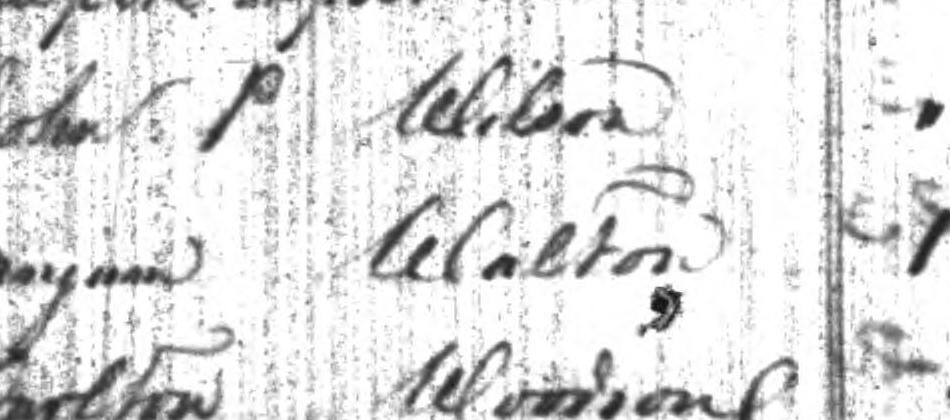
Three lines of names from an 1830 census page: John P Wilson, then a Walton whose given name I read as Minjum and two agents read as Morgan, then Carlton Woodson.
Line 26, 1830: Minjum. The fair copy of the Cumberland schedule, page 210, in the copyist’s hand. Mingum, said one agent; Morgan, said two. I went back to it with this plate in front of me: it is Minjum, not Morgan. No Morgan Walton appears anywhere else in Cumberland, in any census or bond. The two dissents stay on the record, and so does the second item on the Wanted list. Tell me what you see. Reads: John P. Wilson. M[ingum or organ] Walton. Carlton Woodson. the frame · National Archives microfilm M19, roll 192, via the Internet Archive · the record
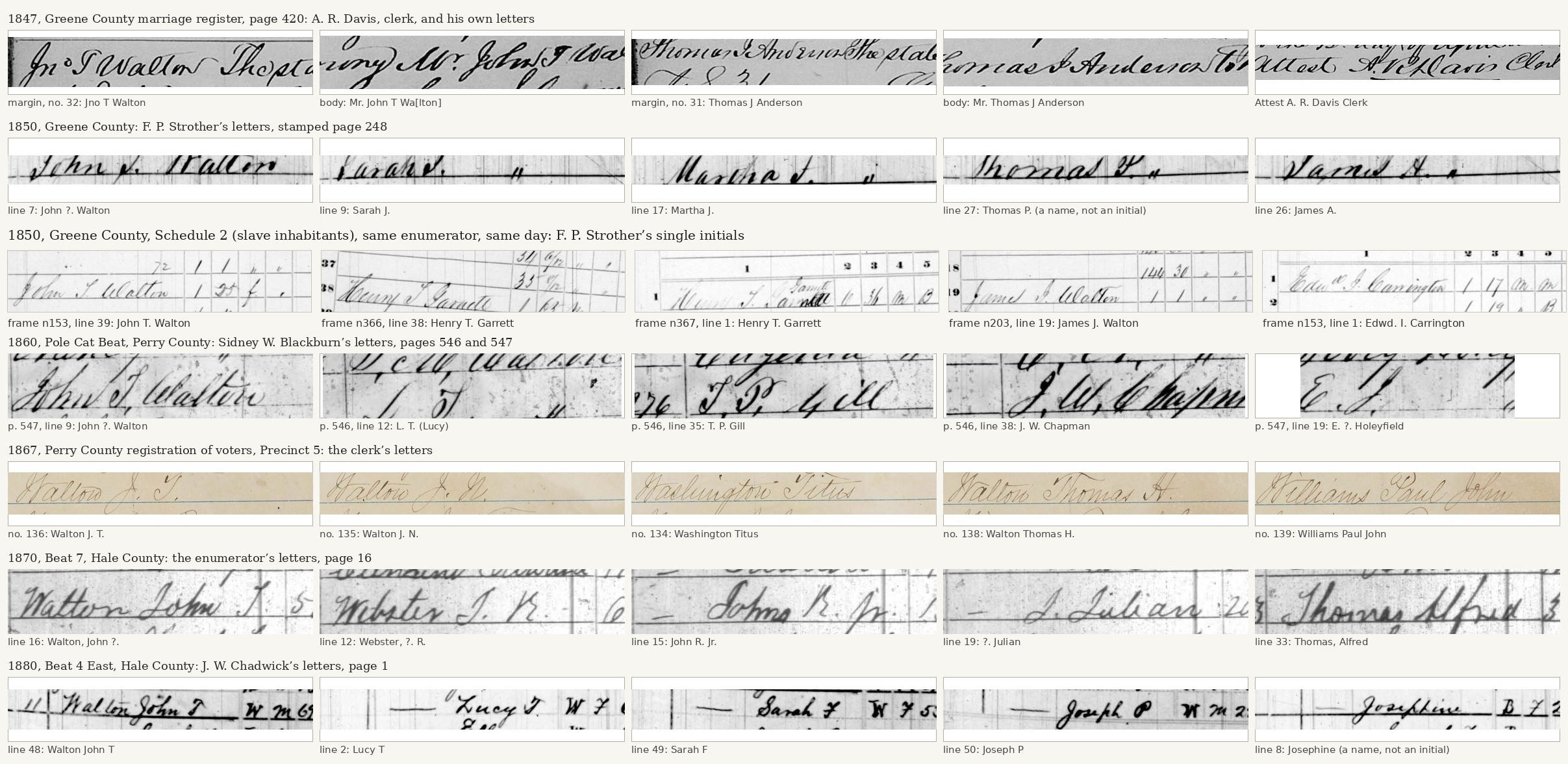
Thirty-five strips from seven pages, the 1847 Greene County marriage register, the 1850 Greene County census and its slave schedule, the 1860 Perry County census, the 1867 Perry County voter registration, the 1870 Hale County census and the 1880 Hale County census, each row showing the Walton initial beside the same writer’s J, T and F.
T or J: six hands, 1847 to 1880. Not his hand; three enumerators’ and two clerks’, and the lesson of the page is which letters count as controls. A capital at the head of a written-out name, Thomas, Joseph, July, is a different letter from the same writer’s single initial, and the control has to be the single initial; I used the wrong kind twice before I learned it. A. R. Davis, licensing the marriage in April 1847, wrote Jno T Walton in the margin and Mr. John T Walton in the body, and one entry up wrote Thomas J Anderson twice the same way; his T and his J are two letters, and the initial is the T. Strother in 1850 wrote the initial on the population page as he wrote Sarah J. and Martha J. on the same page, so J by match; on Schedule 2, headed the same day, he wrote it as the T he gave Henry T. Garrett, a hooked stem with a foot that stays on the line, and not as the dropped loop he gave James J. Walton and Edward I. Carrington, so T by match. One hand, one day, two letters, and 1850 cannot say which he meant. Blackburn in 1860 wrote L. T. for Lucy, T. P. for the Gill son and J. W. for a Chapman on the page before, all with the hooked stem and foot loop he gave John’s initial; Luke read a J, and the shape is one his J and his T share, so the scan will not split them. The 1867 clerk wrote J. T. with the two letters side by side and unlike each other, his T the T of Titus and Thomas H., so T beyond argument. The 1870 enumerator’s letter is his T in Thomas and his initial for the Webster whose son is John R. Jr., so J and T at once. Chadwick in 1880 wrote John T with the letter he wrote for Lucy T., a T by her stone, so T by match, with no single-initial J of his on the page to set against it. Two T beyond argument, in 1847 and 1867, a T by match in 1880, a hand in 1850 that gave him its J on one schedule and its T on the other, two hands that cannot say; the clerks who printed, typed and indexed him all say T. In his own hand we have nothing. Luke does not trust a machine to tell these letters apart, and after this page neither do I; the strips are here for eyes that have read a thousand 1850s hands. On 15 October 2026, with the seventh row in front of him, Luke said it is probably a T. His call, recorded here; the strips stay for anyone who wants to read them again. Reads: 1847: Jno T Walton to Sarah F Gills; Mr. John T Walton; Thomas J Anderson; Mr. Thomas J Anderson; Attest A. R. Davis, Clerk. 1850: John ?. Walton; Sarah J.; Martha J.; Thomas P.; James A. 1850, Schedule 2: John T. Walton; Henry T. Garrett; Henry T. Garrett; James J. Walton; Edwd. I. Carrington. 1860, page 547 and the page before: John ?. Walton; L. T.; T. P. Gill; J. W. Chapman; E. ?. Holeyfield. 1867: Walton J. T.; Walton J. N.; Washington Titus; Walton Thomas H.; Williams Paul John. 1870: Walton, John ?.; Webster, ?. R.; John R. Jr.; ?. Julian; Thomas, Alfred. 1880: Walton John T; Lucy T; Sarah F; Joseph P; Josephine. the 1860 frame · Greene County marriage register, on the image attached to the FamilySearch tree; National Archives census microfilm via the Internet Archive (1850 Greene, population and slave schedules, 1860 Perry, 1870 and 1880 Hale); Alabama Department of Archives and History, 1867 registration of voters, Perry County · the record

The spellings

One row per spelling, oldest record first. The last column says how close this page got to the record itself.

SpelledYearWhereTier
Minjam 1806 Genealogy Trails transcript of the Cumberland marriage register: Walton, Minjam, married Sally F. Mann, 5 February 1806. transcript
Minjinn (?) 1806 J. D. Eggleston’s abstract of the same bond, printed in the DAR Magazine in 1931, question mark his. Consent of Wm. F. Mann; sureties Benj. Fuqua and Wm. Mann Jr. transcript
Minchun 1810 The 1810 federal census of Cumberland County, read on the frame: two boys under ten, a man and a woman of 26 to 45. John H. Parker, Jesse Parker and William F. Mann Sr. are on the next page. read in the image
Minjium 1806 Katherine Elliott’s abstract of the Cumberland marriage bonds, the W section, read in the image: Walton Minjium, Mann Sally, bond 5 February 1806, sureties Wm. F. Mann and Benj. Fuqua. read in the image
Miryium or Minjium 1806 FamilySearch’s index of the same bond. This is why a search for Minjam or Benjamin finds nothing: the indexer could not read it either. index entry
Minjum 1807 His signature on a Laurens District, South Carolina deed, 31 March 1807: Minjum Walton of Cumberland County, Virginia, selling George Walton’s land under a power of attorney of 20 October 1805. read in the image
Benjamin 1807 The same deed. A dower note on the signature page, and John Meador’s acknowledgment of 4 August 1807, were read as Benjamin Walton. Left as written, beside the Minjum he signed. read in the image
Minjum or Mingum 1820 The 1820 federal census of Cumberland County, re-read on the frame: a man and a woman of 26 to 45, two boys under ten, two boys of ten to sixteen, a girl under ten. The June 2026 read had missed the two older boys. read in the image
Minjium 1817 A deed of trust by John Holt Parker, 29 September 1817, witnessed by Minjium Walton, Betsy Bradley and Jesse Parker. Found in a Cumberland chancery file; the witness block is faint and on the second scan, and the date is on the first. I read it after a verifier did. read in the image
Mincham 1836 The Cumberland Baptist Church treasury account, in the Library of Virginia’s volunteer transcription: a contribution of 23 cents, entered beside Jesse Parker’s. transcript
Minjum 1838 His own hand. The witness signature on a Cumberland apprenticeship indenture, 10 March 1838, read on the scan: a large, flourished “Minjum Walton,” dots over the i and the j, in a hand unlike any other on the sheet. read in the image
Minjum, read Morgan by two agents 1830 The 1830 federal census of Cumberland County, read on the frame three times with two answers and then by me, as Minjum: one man and one woman of 40 to 50, one boy of 15 to 20, four boys under ten, one girl of 10 to 15, one enslaved woman. If the name were Morgan, this row would not be his. read in the image
Minjum 1831 Cumberland Deed Book 20: Minjum Walton sells 85 acres to Jesse Walton for $350. Read in the image. read in the image
Mingum 1839 The Cumberland personal property tax book. The last tax entry under any of these spellings. index entry
Minjam 1839 Cumberland order book, 23 December 1839: letters of administration on the estate of Minjam Walton, deceased, to Thomas Powers. Edward Walton and Geo. C. Walton were his securities. The order names no widow and no child. read in the image
Minjums 1840 Cumberland Will Book 10, pages 212 and 213: the inventory of Minjums Walton, 30 December 1839, and the sale of 11 January 1840. The sale names Mrs. Walton and a buyer, John Walton, and calls neither an heir. read in the image
Benj H 1842 The Official Register of the United States for 1843: Benj H Walton, postmaster of Oak Forest, Cumberland County, to 31 December 1842. Whether this is the 1806 groom or a younger man of the same initials, the register does not say. read in the image
Minjim jnr, Mingun Jr 1852–1859 The same church’s books, in transcription: a junior baptized in 1852 with a Sarah and an Elizabeth Walton, and dismissed by letter with a Sarah Walton in May 1859. A junior means a senior. transcript
Morgan 1858 The FamilySearch index of Jesse W. Walton’s Goochland marriage register names his father Morgan Walton and his mother Hannah; a second index of the same entry, behind a login, reads the mother as Sarah. If Jesse W. was the 1806 groom’s son, an indexer made Morgan of the clerk’s rendering, as a verifier made Morgan of the 1830 census line. If he was not, there was a Morgan Walton, and the trees have the wrong eldest son. index entry
Benjamin H. 1860 The Goochland County marriage of William M. Walton, 51, born about 1809 in Cumberland: father Benjamin H. Walton, mother Sally. Whether this Benjamin H. is the 1806 groom is my theory, not a record. index entry
Minjam H., Minjam Howard 1919 onward Six DAR applications under the patriot William Walton Jr., citing “Family Bible and traditions.” Howard looks like someone expanding the H. compiled
Minjum Howard 1868–1944 A grandson, if Benjamin H. is the 1806 groom. Minjum Howard Walton, born 4 February 1868 in Richmond, son of William Mann Walton by the index of his 1944 death certificate and by the tree, died 1944; his stone reads “MINJUM H. WALTON,” and the 1940 census has “Walton, Minjum.” The name was passed down and used as a given name. His indexes also spell him Mingen, and the 1880 census taker, when he was twelve, wrote Major H. read in the image
Minjum [Benjamin] 2005 Wilmer Kerns, Waltons of Old Virginia (Heritage Books, 2005), in the sketch of Minjum H. Walton Sr. He says the name may have been a variation of Benjamin, and that the public records write Minjum. Pages 35 and 36, the children of George and Margaret, list him as Minjum H. and put no bracket on the name. compiled
Minjam H. T. 2012 The family record my uncle gave me: “Minjam H. T. Walton (1779-1839).” The same initials, M. H. T., are on a 1997 Tabb compilation as a son born in 1765, with no citation, and Frakes writes them out as Maurice. The record cites nothing. compiled

The name, my theory

My theory: Minjam is Benjamin. A diminutive, the way a Southside Virginia family said it at home. Benj’m. Swallow the first syllable and the last and the word that comes out is the one on the bond, and the clerks wrote what they heard, each a little differently. The one record that names a Benjamin H. Walton as a father is William M. Walton’s 1860 marriage register, which calls William that man’s son, and that William named his own boy Minjum Howard. Whether the Benjamin H. is Minjum is the theory. It would also explain why a search for Benjamin Walton, Cumberland, 1806, returns nothing: the bond is indexed under Miryium. Some of the dead ends were the wrong syllables. On the 1807 Laurens deed he signed Minjum, and a dower note on the same page and the acknowledgment of 4 August 1807 were read as Benjamin. The two spellings stay as written.

Against it, two things, one of them heavy. He signed his own name on an 1838 indenture, and he signed it Minjum. And in ninety years of records for the two later Mingums, the Powhatan man and the Richmond grandson, four censuses each, a muster roll, a marriage index, a death index and the city directories, no clerk ever wrote Benjamin for either of them; the church books have a Mincham and a Mingum junior and no Benjamin either. The other readings stay on the table: a real given name nobody can place, handed down because it was theirs. One register would settle it, Jesse W. Walton’s of 1858, which names his father and which an indexer read as Morgan. Nobody has seen the page. Virginia kept no death register before 1853. The court did keep an estate. On 23 December 1839 it granted letters on Minjam Walton. The inventory and the January 1840 sale name a widow and a buyer named John Walton, and neither calls him a son. A settlement report was laid over on 23 March 1840 and was not confirmed in the minutes read through 25 January 1841. The confirmed account, the one that would name heirs, has not been found.

Was he John T. Walton’s father?

The case for Minjum

The leading theory, and it is unproved. George Walton, who married Margaret Tabb in Cumberland in 1759, is Minjum’s probable father, on contemporary paper and on Kerns. Minjum’s documented wife is Sally F. Mann. John T. Walton, born about 1811 and called John Tabb in the family record, is a serious hypothesis for their son. No record from his life spells Tabb, and no record names his father.

For it

The contemporary association, which does not depend on Kerns. On 20 October 1805 George Walton gave Minjum Walton power of attorney to sell land on Durbins Creek in Laurens District, South Carolina. On 31 March 1807 Minjum, of Cumberland County, Virginia, sold that land to Leonard Miller for $350 and signed the deed. On 15 March 1817, at the sale of Geo. Walton’s Cumberland estate, Minjum Walton bought for $57.10, and Wm. F. Mann and a Mrs. Walton bought on the same list. A power of attorney across a state line is a substantial relationship. It does not say son.

The name the story uses. Tabb is a Cumberland surname. Thomas Tabb (1719–1782) left a will naming his daughter Walton. George and Margaret had a son they called Langhorn Tabb Walton, who posted a marriage bond in 1786. George died intestate in 1817. An earlier note said Langhorn T. administered that estate with a John Tabb standing surety. Will Book 6, pages 262 and 263, are Elizabeth Palmore’s division, and those letters have not been found. Those Tabbs were real. Nothing from John T. Walton’s life says he was given their name.

Kerns lists a Minjum among George’s seven children, and the Minjum of the records was really there: the 1806 bond, the 1820 household with two boys under ten, the land in 1827 and 1831.

A John T. Walton married Jane D. Hudgins in Cumberland on 23 March 1840, with Jesse D. Parker as surety, and that June a “Jno T Walton,” twenty to thirty, headed a three-person Cumberland household. In 1850, John T. Walton’s household in Greene County had a daughter Sarah J., 9, born in Virginia about 1841, and Lucy, 7, born in Virginia about 1843; the next child, Betty, was born in Alabama about 1846; and he married Sarah F. Gills in Alabama in 1847. A first wife who died around 1845, a widower who moved south with two small daughters and remarried: the shape fits. The Hudgens kin went to Missouri in those same years. This John T. did not. In August 1841 the Cumberland groom was still in Cumberland: he and “Jane, formerly Hudgins” sold her 75 acres, bounded by William E. Carrington, with her brothers and sisters, and he acknowledged the deed before the county justices on the 26th. The Alabama man’s first daughter was born in Virginia that year, and Jane D.’s sisters were a Sally and a Lucy.

Then what October 2026 added. The surety on that 1840 bond, Jesse D. Parker, had given bond to marry Elizabeth M. Walton, daughter of Sarah F. Walton, fifteen days earlier; Sarah F. is, on my reading, Minjum’s Sally F. Mann, consenting alone the year after his last tax entry. The 1830 census gives the household on the line I take to be Mingum Walton’s, if it is his, exactly one boy born between 1810 and 1815. And the J. M. Walton on the page before John T.’s in Pole Cat Beat is Joseph M. Walton, born about 1814, who married Lucy Gills in Amelia in 1838, Sarah Frances’s sister by the compiled list, and whose 1888 Greensboro estate the June file had mistaken for another family’s. Two Walton men marrying two Gills sisters and settling beside their father-in-law: the trees call them brothers and Minjum’s sons. And the Gills family reaches back into Cumberland: Jesse D. Parker, the surety on the 1840 bond and Sarah F. Walton’s son-in-law, married a third Gills sister, Mary Jane, in Amelia in 1845.

Against it

No document names John T. Walton, or the family record’s John Tabb Walton, as the son of Minjum, Mingum, Minjium or Benjamin H. Walton. Not the 1806 bond, not the 1831 deed, not the 1817 estate, not the 1839 administration, not the 1840 inventory and sale, not his own will. I have looked where such a sentence would be and it is not there.

The one proved child of Benjamin H. and Sally is William M. Walton, born about 1809 in Cumberland, who married in Goochland in 1860 and died in Henrico in 1883. He never left Virginia. Neither, as far as the record shows, did anyone else in the cluster: Mingum is on the 1839 tax list, a Benjamin H. Walton is in Cumberland court dockets for decades, and the later Mingums are in Powhatan and Richmond. Nothing puts any of them in Alabama.

The 1840 groom is identified by initials and chronology, not by an age. The original bond, which would carry a groom’s age or a parent’s consent, is on a Library of Virginia microfilm I have not read. And the initial is a problem. Three printed abstracts of the bond, Eggleston in 1931, Hart in 1933 and Elliott in 1969, read John J.; Raider’s transcription of the 1841 deed reads the signature John J. Walton; the 1840 census and FamilySearch’s abstract register read T. Two Cumberland documents, read by four people, give J. Every Alabama record gives T, and the one Alabama hand that wavers, the 1850 enumerator’s, looks like a J. Either the Cumberland man was John J. Walton, a different man who stayed, or one man’s initial was read two ways on two sides of a state line. The original bond and the deed book would settle it.

And the Cumberland trees are a mess. FamilySearch gives George Walton sixteen children, including a “Minjum H T Walton” listed as female with zero sources. Kerns, pages 35 and 36, gives seven: Langhorn Tabb, Jesse, Thomas G., Maurice H. Tabb, Lockey, Elizabeth Hatcher and Minjum. He calls Jesse a proved son, and he says Elizabeth is not a proved daughter. Maurice and Minjum are two people on that list. The Tabb compilation gives four, with an “M. H. T.” born 1765 and no Minjum at all. Frakes is the compiler who writes Maurice into that M., and he cites nothing under the son. The 1817 sale lists Minjum Walton, Wm. F. Mann and a Mrs. Walton among the purchasers and names no heir. A power of attorney was not reserved for a son, and the George who owned the South Carolina land has not been proved to be the George who died in Cumberland in 1817. Kerns names Minjum as George and Margaret’s son. In the later sketch, the footnote on that sentence is an Ancestral File number, not a will or a deed. The appointment he cites, he gives to Maurice.

And every strong fact here is about other people. They put Jesse D. Parker inside Minjum’s household and Joseph M. Walton beside John T. None of them puts a pen to paper over the words “John T. Walton, son of.”

Verdict. Unproved, and the leading theory, held to the same standard on both links. George Walton as Minjum’s probable father: the 1805 power of attorney, the 1807 sale of George’s South Carolina land by a Minjum of Cumberland, the 1817 purchase at George’s estate sale beside Wm. F. Mann and a Mrs. Walton, and Kerns. Another relationship to that George remains possible. William Walton Jr. is chronologically strained and has no comparable contemporary paper. Sally F. Mann is the documented wife. Sarah F. Walton in 1840 is her, if the widow and the consenting mother are the same woman, and Elizabeth M. is then a possible daughter. John T. is a serious hypothesis for a son, on the January 1840 purchase and the two March bonds, and not a proved son. The sale does not call the buyer a son, and it does not give him the initial of the groom. What is still missing is one sentence of filiation, in either direction. The original power of attorney of 20 October 1805 is the paper most likely to carry the upper one.

What is proved below him

The proved paternal line ends at John T. Walton, whom the family record calls John Tabb; no record from his life spells the T out, and the hands that wrote it with him in the room do not agree on the letter. He married Sarah F. Gills in Greene County, Alabama, on 15 April 1847, by license of the 13th; farmed Pole Cat Beat, Perry County, in 1860, Virginia-born, 49, with six children; told the 1880 census taker both his parents were born in Virginia; and died in Greensboro on 21 July 1892. His will and probate name his wife, sons John J. and Joseph P., daughters Lucy C. Ricard and Alice Walker, and a grandson, Urbin Lovell. The rest is on the family page with its sources.

John Julian Walton is the son the line runs through, then Jack Thomas Walton, then my grandfather Frank, then my father Mark, then me. Those links are federal paper: Social Security records, census pages, and the Alabama Supreme Court opinions on Jack’s murder. They are not the mystery. The mystery is one generation up.

One more thing belongs at the top, not the bottom. The 1850 slave schedule of Greene County lists John T. Walton as holding three people, a woman of twenty-five and two children of four and two; the 1860 slave schedule lists John T. Walton of Pole Cat beat as holding fifteen, a man of fifty-eight, a woman of forty-five, and thirteen women, girls and boys from thirty-two years down to an infant of three months. The schedules name him John T. Walton, the man this page is about. I say so on the family page and I will say it here: chattel slavery was an atrocity, and no amount of interest in who his father was changes what he did with his life.

Where he came from, scored

Virginia Documented
The 1850, 1860, 1870 and 1880 censuses have him born in Virginia. The 1880 census has both of his parents born there. His children said the same in eleven of thirteen census statements between 1880 and 1920, and none of them ever named a county.
The move, about 1843 to 1846 Documented
Sarah J. (about 1841) and Lucy (about 1843) were born in Virginia. Betty (about 1846) was born in Alabama. He married in Greene County in 1847.
Cumberland County Unconfirmed
The 1840 Cumberland marriage of a John T. Walton fits him in every particular the record gives, the 1840 census has that John T. heading a newlywed household there, and in August 1841 the same groom signed a Cumberland deed with his wife. No record says it is him. Three printed abstracts of the 1840 bond, and a typed transcription of the 1841 deed, read the groom’s initial as J. On 27 July 1840 the Cumberland court wrote John T. Walton as defendant in a debt suit it dismissed. That order does not say he is the groom, the buyer at the estate sale, or anyone’s son. In Alabama the printed, indexed and clerk-copied records make it T, and the five hands that wrote it with him in the room give two T beyond argument, the county clerk of 1847 and the registration clerk of 1867, a T by match in 1880, a hand in 1850 that wrote the letter as its J on the population page and as its T on the slave schedule the same day, and two hands, 1860 and 1870, whose J and T are one shape. A second 1840 John T. Walton, in Halifax County, keeps Cumberland from being the only fit.
Tabb Unproved
No record made while he lived spells his middle name. The earliest writing that calls him John Tabb is his granddaughter’s DAR application of about 1921, and the five later applications copy her line. Of the hands that wrote his initial with him in the room, two made a T beyond argument, one a T by match, one a J by match, and two cannot be read.
Minjam Open
No document names the father of the John Walton who died in Hale County in 1892. The leading theory is that Minjum was, and that George Walton was Minjum’s father. Probable on the upper link, a serious hypothesis on the lower, and unproved on both.

So the joke was historically accurate. They really did leave Virginia for Alabama, and the paper trail turned into a nightmare at the state line. They should have stayed in Virginia.

Does he connect the rest of the line?

The leading theory makes George Walton Minjum’s probable father, on the 1805 power of attorney, the 1807 deed and the 1817 sale, with Kerns beside it. The Tabb family’s own compilation gives George and Margaret four children and no Minjum. The son it does list, born in 1765, is written M. H. T., and a 2005 genealogy is the one that expands the M. to Maurice. The DAR story makes him a son of William Walton Jr. instead, and that hypothesis is the weaker one. My uncle’s record, which splices Minjum onto William Jr., is the first thread below and not a source.

The first thread: my uncle’s record

A three-page Word document my uncle gave me, created on 16 December 2012, last saved the next day, and sent to the family on the 18th as an early Christmas present, with a note that he had “a lot more research and a tree that now includes almost 900 forebears.” The document is that tree’s spine, printed. It cites nothing. This is the whole of it, as written, question marks included; the blank lines are his.

Walton Paternal Lineage

35 Generations from

Waldeve deWalton I of Walton, Lancashire, England

to

Luke Walton of Carlsbad, California

Years 1049 to 2012

  1. Waldeve deWalton I (1049 - )
  2. Waldeve deWalton II (1070-1130)
  3. Waldeve deWalton III (1091-1157)
  4. Gilbert deWalton (1117-1196)
  5. Richard deWalton (1139-1199)
  6. Herbert deWalton (1167-1237)
  7. William deWalton I (1190-1250)
  8. William deWalton II (1222-1281)
  9. William deWalton III (1246-1306)
  10. John deWauton (1270-1330)
  11. William deWauton (1295-1358)
  12. John deWauton (1311-1339)
  13. Thomas deWauton (1328-1385) Died in Hungary
  14. Sir John deWalton (1354-1393)
  15. Sir Thomas Walton (1370-1437) Speaker of the House of Commons
  16. Richard Walton (1397-1463) Fought and Died in the Ottoman War in Bosnia
  17. William Walton (1423-1505) ??
  18. James Walton (1505-1561) Died in Hungary
  19. Andrew Walton (1530-1567)
  20. William Walton (1556-1581) ??
  21. Robert Walton (1583-1613)
  22. Rev William Walton (1605-1668) Left Devon, England and emigrated to Marblehead, Massachusetts
  23. Sir John Walton of Devon, England (1628-1669) Brought his Family to Virginia
  24. Edward Walton Sr. (1645-1688)
  25. Edward Walton Jr. (1668-1720)
  26. Dr. John Walton (1709-1772) Brother of the Grandfather of Declaration Signer George Walton of Georgia
  27. Major William Walton Sr. (1736-1806)
  28. William Walton Jr. (1767-1844) Youngest Soldier Serving in the Revolutionary Army
  29. Minjam H. T. Walton (1779-1839)
  30. John Tabb Walton (1811-1892)
  31. John Julian Walton (1850-1912)
  32. Jack T. Walton (1880-1945)
  33. Francis James Walton (1919-1991)
  34. Mark Francis Walton (1953-present)
  35. Luke Walton (1991 – present)

The DAR story: William Walton Jr. of Amherst

The story, and it is unsupported. The applications say William Walton Jr., Revolutionary War pensioner of Strawberry Hill, Greene County, Alabama, had a son Minjam H. Walton who married Sarah Mann, and that Minjam’s son was John Tabb Walton.

For it

Six DAR applications say so, filed from about 1919 into the 2020s and re-certified across a century. The patriot is real. His pension file is real. His grave at Strawberry Hill is marked. John T. Walton did marry in Greene County in 1847, where William Jr.’s daughters were marrying Glovers, Creswells and Webbs.

Against it

The authority those applications cite is “Family Bible and traditions.” When I went to buy the supporting documents in June 2026, there were none on file. The record copy of an application costs $15. The supporting-documents option, which costs $30 and appears only when a Bible page, deed or will was submitted, does not appear on the Minjam-line applications. Nobody ever filed the paper.

William Jr.’s documented children are Amelia Tillman, Justina, Louisa, John Gennerick, and Jane. That list comes from the UNC Walton Family Papers, the 1946 Tillman family history, and the Strawberry Hill burials; Find a Grave cites the 1919 DAR Magazine for it, and the Magazine has no such list. No Minjam. No Benjamin.

His own sworn deposition, Greene County, 12 January 1833, names his father William, his brother Tilman and his uncle Jesse, and no son. It puts him in Augusta County, Virginia, from 1784 to 1791, Burke County, North Carolina, from 1791 to 1800, and Charleston, South Carolina, from 1800 to 1815. John T. Walton was born in Virginia around 1811. A son can be raised by Virginia kin while his father is in Charleston. It is friction, not a wall.

And there is a homonym. William Jr. did have a son John: John Gennerick Walton, born about 1811, married Elizabeth Ann Glover in 1841, died in Texas about 1870. Different middle name, different death, different birthplace. He is not the man who died in Hale County in 1892. He is exactly the coincidence that lets a compiler weld two Johns born in 1811 into one, and then reach for a Minjam to explain the Tabb the family wrote in later.

Then the arithmetic, which came last and should have come first. William Jr. was born in January 1767. The 1810 and 1820 censuses put Minjum’s birth between 1775 and 1784, and the 1830 line, if it is his, between 1780 and 1784. The family record says 1779. A son born when the father was eight to seventeen. The 1946 Tillman family history gives William Jr. nine children by two wives, the eldest born in 1795, and no Minjam, no Benjamin, no Minjum.

Verdict. Unsupported, and on the dates next to impossible. A real patriot spliced onto a Cumberland man by people who believed it and wrote down that they were going on tradition. Not formally disproved, because no document says Minjam was anyone else’s son. A father at twelve is where I stop pretending this is open. The story also has none of the contemporary association the George theory now has.

The threads

Four threads. Each runs the records, then my readings of them, then what would settle it. The tier on a record says how close this page got: an image I read, an index entry, a typed transcript, or someone’s compilation. Mine. Readings of documents already in the ledger, not new documents. They are where the case could move, and if one is wrong I want someone to say so. The family page keeps the sources for the proved line.

Minjum in Cumberland, 1805 to 1846

The records that make him a real man: the bond, the censuses, the land, the church, his own signature, the tax list, the estate, and the people the trees call his children. The “who was he” thread.

The records

  • 1806 Minjium Walton and Sally Mann, Cumberland bond, 5 February 1806 read in the image

    Shows The marriage, with sureties Wm. F. Mann and Benj. Fuqua, in Elliott’s abstract register (FamilySearch film 007738535, item 7, image 21). FamilySearch indexes the groom as Miryium or Minjium. Genealogy Trails transcribes him as Minjam.

    Does not show His parents, his age, or his children. The original bond is on Library of Virginia Reel 40 (Cumberland marriage bonds 1789–1811) and has not been read.

  • 1810 Minchun Walton, 1810 census, Cumberland County, stamped page 139 read in the image

    Shows Read on the Internet Archive frame by an agent in October 2026. Free white males under 10, two; 26 to 45, one. Free white females 26 to 45, one. Every other column a dash. The next page lists, in order, Josiah Cox, John H. Parker, Jesse Parker, William F. Mann Sr. and Francis Flippin. George Walton is on page 140 with Robert Walton Sr.

    Does not show Names of the two boys. Two sons born between 1800 and 1810 is what the compiled list gives, Jesse W. in 1807 and William Mann in 1809.

  • 1817 Deed of trust by John Holt Parker to John and Samuel Hatcher for his mother Susanna Parker, 29 September 1817, witnessed by Minjium Walton, Betsy Bradley and Jesse Parker; in Cumberland chancery 1826-007 (the first page, with the date) read in the image

    Shows A dated appearance of Minjum, read on the scan by an agent in October 2026, in the same witness block as the Jesse Parker who sold him land in 1827, on an instrument of the John H. Parker whose land bounded his in 1831. The bill in the same file says Susanna Parker later married a William Mann.

    Does not show Any Walton relationship. A witness is a neighbor with a pen.

  • 1820 Minjum or Mingum Walton, 1820 census, Cumberland County, the page after stamped page 109 (Internet Archive frame) read in the image

    Shows The figures lined up against the page’s totals row. Free white males: under 10, two; 10 to 16, two; 26 to 45, one. Free white females: under 10, one; 26 to 45, one. One person in agriculture. No enslaved people, no free people of color. Seven in the house. The given name reads Minjum to me, the fourth letter uncertain between j and g; an agent reading it fresh called it Minsum. Same page as Thomas M., Thomas H. and Edward Walton; the line above is a Daniel A. Wilson, the line below Izard Wilkinson.

    Does not show Any name but his. The first read of this line gave the 10 to 16 column as empty; the frame has two there. The head was born between 1775 and 1794.

  • 1830 Minjum Walton, read Morgan by two agents, 1830 census, Cumberland County, page 210, line 26 (the facing page with the slave columns) read in the image

    Shows The given name is the problem. One agent read it as Mygum or Mingum. A second, sent to refute the first, read it as Morgan. A third compared the letters against the two “Mary” entries above it and also came down for Morgan, while noting that no Morgan Walton exists in Cumberland in 1810, 1820 or 1840 or in any marriage bond, and that the head’s and the wife’s age brackets run unbroken from 1810 through 1820 into this line, both born 1780 to 1784. I went to the frame myself, twice. The first time I saw a capital M, a short letter, a looped descender, and an ending that could be “um” or “an,” and would not call it. The second time, 14 October 2026, with the line cropped and in front of me as the plate above, I called it: Minjum. The two Morgan readings stay on the record. The household on that line: free white males, under 5, one; 5 to 10, three; 10 to 15, none; 15 to 20, one; 20 to 30, none; 40 to 50, one. Free white females: 10 to 15, one; 40 to 50, one. One enslaved woman aged 24 to 36. Nine in all. The other Waltons on the page are Wm. D., Edward, George C. and Nathan, the middle two read in their own entry on the bond thread, and no John T. or Benjamin Walton heads a Cumberland household that year.

    Does not show Whose household it is beyond my reading. If the line read Morgan it would not be him, and no other Cumberland line in 1830 could be, so a man taxed in 1839 and selling land in 1831 would be missing from the 1830 count; read Minjum, it is the only candidate line and it fits. I read Minjum, so the 1830 figures are used as his below, with the two Morgan readings noted where they bear. If it is his: exactly one boy born between 1810 and 1815, which fits a boy born about 1811 and fits a boy born about 1814, and cannot be both; and four boys born in the 1820s, more sons than the compiled list has ever given him. The schedule is a fair copy in alphabetical order, so the neighbors cannot be read from it. The 1810 and 1820 brackets alone put the head’s birth between 1775 and 1784; the 1830 bracket narrows it to 1780 to 1784 on my reading of the line.

  • 1827 Jesse Parker to Minjum Walton, 72¼ acres, 4 April 1827 compiled

    Shows Reported in a genealogy.com family sketch. Minjum buying land from a Parker.

    Does not show It has not been found in the deed books; Deed Books 18 and 19 would need a page-by-page browse.

  • 1831 Minjum Walton to Jesse Walton, 85 acres, $350, Cumberland Deed Book 20, 20 March 1831 read in the image

    Shows “He the said Minjum Walton hath granted Bargain & Sold… unto the said Jesse Walton… Eighty five acres,” bounded by John H. Parker, Bartlett Cox and Robert Robinson, to Jesse “his heirs & assigns forever.”

    Does not show Who Jesse was to him. It is a sale for money, not a gift to a son. It names no other Waltons.

  • 1838 “Minjum Walton,” in his own hand, witnessing the overseers of the poor’s indentures of Milly Jenkins’s children to Joseph Jenkins, Cumberland County, 10 March 1838 (the Library of Virginia transcription) read in the image

    Shows In the Library of Virginia’s Virginia Untold indentures; I read the scan myself. What the paper is: the county court ordered in February 1838 that the overseers of the poor bind out the eight children of Milly Jenkins, and the Library files the indentures among its records of free Black Virginians, which is what a mother’s eight children bound to one man by the overseers usually were. Edward Walton and Daniel B. Meador, as overseers of the poor, bind Martha, twelve, to Joseph Jenkins until she is eighteen, for her keep and twelve dollars at the end; the indenture is signed and sealed by the three of them, and under “Signed sealed and delivered in the presents of” stand two witnesses: a large, flourished “Minjum Walton,” dotted over the i and the j, and below it a smaller “John T Johns.” The witness signature is in a hand unlike the clerk’s body text, unlike the three sealed signatures, and unlike Johns’s. The same pair witnessed the indentures of Martha’s brothers and sisters that day. The Library’s volunteer transcriber wrote: “I have been rendering Walton’s first name as Mingum but I have seen enough of the that appear to have two dots that I think that it is Minjum.” Alive, in Cumberland, signing, in March 1838.

    Does not show That the signature is autograph; a witness signature on a loose original usually is, and I cannot prove it. If it is, this is the one time the man wrote his own name in anything this file has seen, and he wrote Minjum. It names no child and no parent. Isham Parker and Jesse Parker were in the same church, and the 1827 grantor Jesse Parker and Joseph Jenkins, the master here, sit together in its 1836 accounts.

  • 1836–1859 Cumberland Baptist Church, the Jenkins church, minute books 1836–1856 and 1856–1896, in the Library of Virginia’s crowd-sourced transcription: “Mincham Walton,” 1836; “[Minjim] Walton jnr,” Sarah Walton and Elizabeth Walton, 1852; “Mingun Walton Jr” and Sarah Walton dismissed by letter, 20 May 1859 (the members list, on Genealogy Trails) transcript

    Shows In the 1836 treasury account, among Jesse Parker, Byrd Farmer and Jesse Cridle, a “Mincham Walton” gave 23 cents. A list headed “The following persons baptized september 1852” runs over a page and ends with “[Minjim] Walton jnr,” “Sarah Walton” and “Elizabeth Walton dead,” the given name in the transcriber’s brackets. In the later book, under white members, “Mingun Walton Jr (dis. by letter May 20th 1859)” and “Sarah Walton (do do do),” and in the minutes of June 1859 the clerk is told to furnish “brother Mingum Walton” with a letter of dismission at the request of brother Isham Parker. A junior means a senior, and a Sarah Walton was in that congregation with him in the 1850s. Genealogy Trails carries the members list from the same book, with the meetings at Tar Wallet and Bookers meeting houses, a George T. Walton dead, a Thomas Walton inserted above a line, and an enslaved member listed as Vilet, M. Walton’s. The 1856–1896 book is on the Library of Virginia site.

    Does not show Who the Sarah was: the widow of 1840, a sister, or the junior’s own wife, who was Judith by every census. Whether the senior was alive in 1852. The page images could not be opened from here, so every spelling rests on the transcriber, who flagged the 1852 one as uncertain. The junior as the Powhatan Mingum H. is my identification, not the book’s.

  • 1809–1859 Edward George Walton, about 1778 to 1840, the overseer of the poor on the 1838 indenture: his two marriages, his will of 15 March 1840 (Cumberland Will Book 10, page 209, proved 23 March 1840), and his estate in the chancery suits of 1850 and 1859 (the WikiTree profile, which cites Kerns and the will image) read in the image

    Shows Two chancery files read on the Library of Virginia scans. In Hewlett and wife against the administrator of Edward Walton, 1859, the bill of Thomas Hewlett and Jane his wife opens: Edward Walton, the father of your oratrix, departed this life in the year 1840 having published his last will, admitted to record in Cumberland, and the testator meant to divide his estate equally among his children “except his son Edward,” who was excluded; a Martha Walton answers as his widow. In Lewis J. Walton against Edward G. Walton and others, commissioners in April 1850 allotted Lewis J. “his interest in the estate of Edward Walton deceased as directed by his will, that is to say one third of one third of the personal estate,” after the widow’s dower, out of an estate of $7,775 that was mostly twenty-seven enslaved people listed by name, age and price, Ben, John, Jack, Jesse, Jim, Lovina and her child Lucy, Nicey and her children, Cealy, Polly, Mariah, Amy, Archer, Woodson, Louis, Ellen, Susan, Anthony, Ann and Ned, old Mariah, old Rachel and old Violet. The compiled profile, citing Kerns’s pages 92 to 94 and the will image, has him born about 1778, married first in Powhatan in 1809 to Janette Carson McLaurine, widow Swann, with Edward George and Jane Winfield Scott by her, and second in Cumberland in 1820 to Martha Wright, born Isbell, with James C., Thomas S., Lewis I., Mary W., Martha L. and Cornelia I. by her; the will names the wife, the nine children and executors Samuel Hatcher and Dr. Robert Henderson. The same Edward Walton was guardian of the Johnson orphans in 1818, bought the Baughan tract in 1839, and had his executor sued in 1842 and 1844. The Isbell marriage is why the younger Benjamin A. Walton, his ward, boarded at James Isbell’s.

    Does not show Whose son he was, and that is the point. The compiled profile attaches him to Edward Walton of 1746 to 1807 and Nancy Murray, and then says in its own words that this is probably wrong, a merger artifact: that older Edward’s 1807 will names seven children, Sallie, Judith, Thomas M., Sarah, Patsy, Susanna and Phoebe Ann, and no Edward. So a man named Edward George, born about 1778 in a county where George Walton was the patriarch, has no father on paper. If he was a late son of George and Margaret Tabb, as Minjum would be, the two men who signed the same sheet in March 1838 were brothers. His will names no Minjum and no Benjamin, which is what a will of a man with nine children would do either way. His signature on the will has not been set beside the “Edw’d Walton” of the indenture.

  • 1839 Mingum Walton, Cumberland personal property tax book, 1839 index entry

    Shows The only indexed “Mingum Walton” in any Virginia tax year. He was alive and taxed in Cumberland in 1839.

    Does not show That he died. The order book is the next record: letters on Minjam Walton, 23 December 1839. Whether the Oak Forest postmaster of 1842 is this man is still open.

  • 1839 Letters on Minjam Walton, Cumberland order book, 23 December 1839, page 83 read in the image

    Shows On the motion of Thomas Powers, who made oath, and with Edward Walton and Geo. C. Walton his securities, bond of eight hundred dollars, certificate for letters of administration on the estate of Minjam Walton, deceased. Appraisers: Jesse Parker, Robert Robertson, James Flippin, Isham Parker and Thomas Booker, or any three. The order writes Minjam and Thomas Powers, with no middle initial on Powers.

    Does not show A widow, a child, or John Walton. It does not say what Edward Walton or Geo. C. Walton was to the dead man. They secured the bond. The will book writes the same estate Minjums, and the March order writes Thomas M. Powers.

  • 1840 Inventory and sale of Minjums Walton, Cumberland Will Book 10, pages 212 and 213 read in the image

    Shows “Inventory and Appraisement of the Est. of Minjums Walton decd. made this 30th of December 1839,” signed Robert Robertson, Jesse D. Parker and Isham Parker. Household and farm goods, a mare and colt, net $433. No enslaved people. Recorded 23 March 1840. The sale, the facing page: “Sale of the Est. of Minjums Walton decd made this 11th of Jany. 1840 by Thos. M. Powers, admr. Credit till 11th July next.” Mrs. Walton bought the household column, carried at $132.30. The page sets out reservations for the widow under the law of 1837 and does not write her given name. John Walton bought one bay colt for $25.50. Other buyers, as written: Wm. M. Powers, Alm. Booker, Thos. Booker, John F. Cox, Benj. Ford.

    Does not show A child, a father, or an heir. John Walton has no initial and is not called a son. Mrs. Walton is not given a name. The credit date is the whole sale’s, not a preference for one buyer. The will-book index calls the administrator’s account page 217, and page 217 is Thomas Robson’s will.

  • 1840 Settlement of Thomas M. Powers, administrator of Minjums Walton, laid over 23 March 1840 read in the image

    Shows “A Report of the settlement of the accounts of Thomas M. Powers administrator of Minjums Walton decd. was presented in Court, and ordered to lie for exceptions till next Court.” The sale had given credit until 11 July 1840, so this March report cannot include sale money not yet due. It was not among the reports confirmed on 25 January 1841, and it is not in the minutes read from April 1840 through that January day.

    Does not show Who brought the report in, or any heir. It is not a confirmed account. The page the will-book index names for the account is Thomas Robson’s will. The account is unconfirmed in the minutes read. It is not assumed lost.

  • 1841 Benj. H. Walton, ward of Edward Walton: his guardian account (1831–1839, recorded 1841) and the payment that closed it, 1841 (the Cumberland microfilm list (reel 38, guardians’ accounts)) read in the image

    Shows The account itself is on Library of Virginia microfilm (reel 38, guardians’ accounts 1834–1860) and is not read yet; its catalogue heading gives him as “Dr. Benjamin A. Walton” and has him boarded and tutored at James Isbell’s. The payment that closed it is read, in Hewlett and wife against the administrator of Edward Walton (Cumberland chancery 1859-009, image 141): Samuel Hatcher, Edward Walton’s executor, in 1841, “pd. Benj H. Walton, bal due from E. Walton his Gdn,” $1526.84, with interest from 1 January to 21 April 1841. The initial is an H: the same clerk’s H in “Thos. H. Hewlet” and “Hatcher” on that page, against his pointed A in “Chs. A. Merryman” and “James Agee.” The same executor paid Henry Walton in two parts that year (21 May, $370.70; 25 October, “bal in full,” $287.80). The 1825 heirs’ bill made Edward Walton guardian ad litem for Thomas M. Walton’s infants Henry and Benj’n H.; two brothers settled out of Edward’s estate in one year fits that pair. Born about 1820. There were at least three Benjamin Waltons in Cumberland at once.

    Does not show Anything about the 1806 groom. This one is a generation too young to be anyone’s father in 1811. A decoy, logged so nobody falls for it twice.

  • 1821–1827 Thomas M. Walton’s will, 7 May 1821, and the 1825 bill that names his children: George, Maria M. Wilkinson, Phebe A., Ellen S., Nathaniel, Henry and Benjamin H., and no John (the will, copied into the 1824 file) read in the image

    Shows Read on the Library of Virginia scans on 15 October 2026, after Luke asked whether the T might be Thomas. The will: “I Thos. M. Walton of Cumberland County,” lending his whole estate to his wife Francis A. Walton for life “for the support & education of our children,” the lands to be sold after her death and divided “among the legatees that each one may get an equal proportion,” his son George to have a good horse, saddle and bridle over his share; executors Edward Walton, Samuel Wilson and George C. Walton; witnesses Edw’d Walton, Thos. H. Walton and Simeon Toler; dated 7 May 1821, proved at June court 1821 on the motion of George C. Walton. The bill of 1825: John Wilkinson and “Maria M. his wife formerly Maria M. Walton the daughter of Thos. M. Walton” pray a division of the estate among the distributees, “a certain George Walton who was left & afore qualified as exor of the said will, Phebe A. Walton, Ellen S. Walton, Nat. Walton, Henry Walton & Benj’n H. Walton, the last four being infants,” the widow being also dead, with Edward Walton to be guardian ad litem for the infants. Seven children of Thomas M. Walton and Frances Ann Carrington, two more than Hopkins gives, Henry and Benjamin H.; and no John. The Benjamin H. Walton who was an infant in 1825, a ward of Edward Walton, is the likeliest reading of the Benjamin whose guardian account Edward Walton returned for 1831 to 1839, and a candidate for the Benj. H. Walton who was postmaster of Oak Forest to 1842 and the B. H. Walton of Cumberland at Richmond in 1846. He is not the Benjamin H. the 1860 Goochland register makes William M. Walton’s father, who had a son by 1810.

    Does not show John T. Walton. If his T were Thomas for a father named Thomas, this was the Thomas Walton of Cumberland in his generation, and the man’s own will and his heirs’ bill leave him out; a son of a Carrington would also have made the Greene County Carringtons kin rather than neighbors, and nothing says so. The estate’s division, the later images of the file, and whether the 1841 guardian account’s initial is A. or H., which I read as A. on the catalogue page and have not read on the scan.

  • 1842–1846 Benj H Walton, postmaster of Oak Forest, Cumberland County, to 31 December 1842, in the Official Register for 1843; and “B. H. Walton, Cumberland” among the arrivals at the Columbian Hotel, Richmond, 29 September 1846 (Richmond Daily Whig, 30 September 1846, page 3) read in the image

    Shows The Post Office Department’s Virginia list for 1843 has Oak Forest, Cumberland: Wm. E. Agee to 31 December 1841, then “Benj H Walton, to Dec. 31, 1842,” then Zachariah Talley, who holds the office through the 1845, 1847, 1849 and 1851 registers. So a Benjamin H. Walton kept the Oak Forest post office for about a year. Four years later the Whig lists a B. H. Walton of Cumberland at a Richmond hotel. These are the first records anyone has found of a Benjamin H. Walton in Cumberland while he could still write his own name, and both fall after the last Mingum tax entry of 1839.

    Does not show Which Benjamin H. Three men could answer to it: the 1806 groom himself, if he did not die in 1839; his son of about 1822, the Minjum H. Jr. of the compiled sketch, who would have been twenty in 1842; and the Benjamin H. Walton, son of Henry C., who died in Cumberland in 1865. The register gives no age and no parents, and the office was new: the 1839 register has no Oak Forest in Virginia. If the postmaster is the 1806 groom, the family record’s 1839 death is wrong and the widow reading below goes with it. If he is the son or the other man, nothing moves. The ledger that would settle it, the Record of Appointment of Postmasters, is a federal microfilm behind a login.

  • 1834–1889 Jesse W. Walton in the Goochland registers: the 1858 marriage entry, indexed with parents “Morgan Walton” and “Hannah Walton”; the 1834 bond; the 1889 death entry index entry

    Shows Virginia, Vital Records, 1715–1912: Jesse W Walton, 50, married Phobe A Jordan, 35, in Goochland County on 31 August 1858; the groom’s parents are indexed as Morgan Walton and Hannah Walton, the bride’s as Reuben and Phobe Jordan. A second index of the same register entry, in a collection that needs a login, is attached to Sarah Mann’s tree profile under the title “Sarah in entry for Jsp. W Walton,” so a second indexer read the mother as Sarah. The father’s name in that second index cannot be seen from outside. Jesse W.’s first bond, to Elizabeth E. Cheatham in Goochland on 15 December 1834, names only her father; a Cheatham family Bible at the Library of Virginia, accession 42301, records his children by her: Phebe Emeline, 21 October 1835; Sarah Elizabeth, April 1837; a son Cheatham, 18 October 1839; Mary Louisa, 3 May 1842; Susan Alice; and Jesse Woodson, 12 April 1846. It names no parent of his. The 1850 Goochland census, dwelling 532, has those children in his house, Mary L. among them at 8. The Library of Virginia death register index has him dying at Dover, Goochland, on 10 August 1889, “90 years,” of old age, and indexes no parents.

    Does not show The register page, which is restricted to FamilySearch centers and affiliate libraries; nobody here has seen the clerk’s hand. Whether Morgan is what the clerk wrote, or what an indexer made of Minjum, as a verifier made Morgan of the 1830 census line. Whether Hannah or Sarah is right. And whether Jesse W., the man who bought Minjum’s 85 acres in 1831 by the trees’ account, was the 1806 groom’s son at all: this is the one register in the family that names his parents, and it names a Morgan.

  • 1870–1896 Crump and wife against Jesse W. Walton and others, Goochland chancery 1896-006: the bill, Jesse’s answer, Phebe Ann Walton’s will, the depositions (Phebe Ann Walton’s will, 4 October 1866 (image 82)) read in the image

    Shows Found by ChatGPT, which read the first ten scans; the answer, the will and the depositions read here on 15 October 2026. A creditor’s suit begun in 1870 over a judgment of 1866 against “Jesse W. Walton & Phebe A. his wife,” filed under the year it closed. The bill: Phebe A. Walton died on 25 December 1869; she and Jesse had a child, born alive, who died before her; her heirs are her Jordan kin, among them Susan Shepherd, Sarah F. Crump (the plaintiff’s wife) and Samuel M. Jordan. Her will, 4 October 1866, leaves Jesse the ten acres “which I have inherited from my brother Joseph W. Jordan.” Jesse’s answer (images 15–21) argues the land’s value, names her Jordan heirs, and says nothing of his own family. Richard Powell, deposing in July 1870, had known Walton’s lands since he was a boy. Jesse claimed a homestead on 30 August 1870 and again in 1871 as “a house holder and head of a family”; he was adjudged bankrupt in the federal court at Richmond in November 1873, and his land was sold from 1874, 150 acres of it to a Mary L. (Mollie) Walton, later the wife of William Johnson.

    Does not show His parents, his brothers, or anyone in his family but his wife and her kin. All 158 images were opened; every relative named is a Jordan. Who Mary L. Walton was to him is not stated. The candidate already in his records is Mary Louisa, born 3 May 1842, his daughter by Elizabeth Cheatham: she is the Mary L., 8, in his 1850 house, and the 1860 line in her place reads Mary E., 19. Nothing here marries her to William Johnson. Mollie Brand, who married W. P. Walton in Perry County in 1869, is another woman.

  • 1860 Jesse W. Walton, 1860 census, Goochland County, Coal Hill post office, page 94, dwelling 732: William M. Walton, 50, in his household index entry

    Shows Jesse W. Walton, 53, farmer, $9,000 in land and $8,500 in personal estate, born Virginia; Phebe A., 38; Isham C., 20, lumber merchant; Mary E., 19, schoolteacher; Susan A., 17; William M., 50; and Thomas Cousins, 10. The frame, enumerated 29 September 1860 by Isaac W. Pleasants, has been read once; the index agrees. So the William M. Walton whose Goochland register three months later names his parents Benjamin H. and Sally was living under Jesse W.’s roof.

    Does not show What they were to each other; the 1860 census did not ask. Co-residence, not filiation. One caution: a younger William Miner Walton, born about 1832, who married Margarett Ann Gill in Henrico in 1853, is merged into the elder man’s tree profile, and any Henrico record of a William M. Walton has to be sorted between them. The man of fifty in this house is the 1809 one.

  • 1860 William M. Walton, 51, born about 1809 in Cumberland, marries Margaret Seay, Goochland, 24 December 1860 index entry

    Shows Father Benjamin H. Walton, mother Sally. This is the one record that names a child of a Benjamin H. and Sally. He is the William Mann Walton of the trees, died Henrico 1883.

    Does not show That Benjamin H. is the Minjium of 1806, or that John T. Walton was his brother. A duplicate index entry gives the groom’s age as 31; treat it as a transcription error and cite this one.

  • 1864–1880 The later Mingums, 1850–1944: Mingum H. Walton of Powhatan in four censuses; Minjam H. Walton, Company A, 10th Battalion Virginia Heavy Artillery; and Minjum Howard Walton of Richmond, 1868–1944, in five censuses, a marriage index and a death index (the 1880 Powhatan frame, “Walton Minqum H,” on the Internet Archive) read in the image

    Shows The name was given again, twice over, and every census frame for both men has been read. The Powhatan man: 1850, “Mingum H Walton,” 30, overseer, born Cumberland, with Judy, 22, Betty, 3, and Thomas, three months, next door to a James Gill, 35, born Nottoway; 1860, “Mingum Walton,” 38, farmer, born Cumberland, with Judith and four children; 1870, “Walton Minjum,” 48, with Judith, six children and two Palmores in the house; 1880, “Walton Minqum H,” 58. The grandson: Minjum Howard Walton, born 4 February 1868, son of William Mann Walton, which would make him the 1806 groom’s grandson if Benjamin H. is that groom. In 1880, at twelve, he is “Major H” in his father’s house at Tuckahoe, Henrico, with his mother Margarett, 36, and her mother Eliza Seay; his 1890 marriage index reads Mingen H., parents Wm and Margaret; the 1900, 1910 and 1920 Richmond censuses read Walton Minjum, Minjum H and Minjum H, a street-cleaning foreman and then a city stableman at 1266 Ashland Street; the 1910 Miracode card reads him Miriam; the 1940 census, read on the frame, has him at 69 with his wife Jennie; his stone, read in the photo, says “MINJUM H. WALTON”; and the index of his 1944 death certificate names his parents William Walton and Margaret Seay. The Confederate index has one Virginia Walton named Minjam H., a private in Company A, 10th Battalion Virginia Heavy Artillery, and no Benjamin H. Walton in any Virginia unit. In every one of these records, 1850 to 1944, the name is some form of Minjum. No clerk wrote Benjamin for any of them. A Benjamin H. Walton who died in Cumberland on 28 October 1865 had parents Henry C. and L. A. Walton and is a different man; that family’s Bible, at the Library of Virginia, gives Henry C.’s parents as a Nathaniel Walton and Eveline B. Payne, the couple of an 1828 Cumberland bond, and has no Minjum in it.

    Does not show That any of them went to Alabama. None did. Which Minjam H. served in 1864. Whether the Powhatan man, born in Cumberland about 1820 and already Mingum H. at thirty, is the 1806 groom’s son; the compiled sketch says so, and he would be one of the four small boys in the 1830 household if that line is his father’s. The Richmond city directories of 1879 to 1894 have no Minjum and no Benjamin H.

  • 1834–1839 Cumberland chancery 1834-032, Thomas H. Walton and wife v. the administrator of Ludwell Brackett, and 1838-018, Edward G. Walton v. Joseph Baughan and others (1838-018) read in the image

    Shows Every scan of both read, 45 and 20 images. The 1834 case settles the estate of Ludwell Brackett, who died under age; Thomas H. Walton’s wife Nancy H. was his sister, and Thomas H. acted for himself, the Howard orphans and two Bracketts, and bought three enslaved people, Matilda, Samuel and Fanny, at the sale. The 1838 case is a Baughan family partition in which Edward G. Walton, having bought four of ten heirs’ shares, got the whole 138¾-acre tract at $3 an acre in 1839. Hobson and Flippin are Baughan sons-in-law in that file, not Walton kin.

    Does not show Minjum, Mingum, Benjamin, Sally, Jesse or John Walton; Mann, Tabb, Parker or Robert Robinson; any Walton’s father or son; any deposition. The two Waltons who do appear are the Thomas H. and Edward of the Cumberland dockets, in their own affairs, which turn out to be other families’ estates.

  • 1769–1913 Library of Virginia chancery index, Cumberland and Powhatan: every Walton case, and Walton with Mann index entry

    Shows About 170 Walton records, none naming Minjam, Minjum, Benjamin H., John Tabb, Mann or Tabb in a way that bridges anything. Powhatan 1804-004, Treadway v. Jesse Walton, is a store ledger: rum, oysters, horse feed.

    Does not show A bridge. The George Walton and Margaret Tabb branch barely litigated and goes quiet after about 1804.

  • 2003 A genealogy.com forum sketch, “Minjum Walton Jr.,” Walton forum thread 3133 compiled

    Shows Read on 15 October 2026. Wilmer Kerns, 30 March 2003: “Minjum H. Walton, son of George and Margaret (Tabb) Walton, was born circa 1779 in Cumberland County, Virginia and died circa 1839.” He says the name may have been a variation of Benjamin, and that the records write Minjum. Children: Jesse W. (1807), William Mann (1809), a daughter about 1812 taken from the census, Joseph M. (about 1814), Minjum H. Jr. (about 1821, married Judith Palmore in Buckingham on 13 April 1848), and a John T. Walton about 1823, from the Cumberland tax list of 1843 and 1844, with the question of what became of him. The 1827 purchase from Jesse Parker, 72 and a quarter acres, and the 1831 sale of 85 acres to Jesse W. as eldest son. He asks that the sketch not be published.

    Does not show A citation, in the 2003 post, for the sentence that calls Minjum George’s son. The book, read on 15 October 2026, puts an Ancestral File number on that sentence, not a will or a deed. The post’s John T., dated about 1823 from the 1843 and 1844 tax lists, is not the book’s John T., whom the later sketch dates 28 March 1811 and still identifies through those same lists. I have not finished that sketch’s footnotes. The seven brothers and sisters are on pages 35 and 36, and Maurice is one of them, not a spelling of Minjum. If the post’s John T. of 1843 is a man born in 1823, Cumberland had two. If he is ours, the 2003 note guessed the age from a tax list, and ours could still have been in Cumberland in 1844, which Lucy’s Virginia birth in 1843 allows.

  • undated WikiTree Mann-3752 and an Ancestry message board on William Ford Mann of Cumberland compiled

    Shows Sally F. Mann as William Ford Mann’s daughter, on a message-board thread the WikiTree manager flags as not a valid source. Mann sold land in 1799 and died intestate on an unknown date.

    Does not show Any Mann estate naming a daughter Sally Walton. None surfaced; the Cumberland Mann chancery 1830–1845 is dry.

Readings, not findings

Three censuses, one household, and room for a boy born in 1811

Put the 1810, 1820 and 1830 lines side by side. In 1810, Minchun Walton has two boys under ten: the trees’ Jesse W., born 1807, and William Mann, born 1809, fit those ages. In 1820, Minjum Walton has two boys of ten to sixteen and two under ten, and a girl under ten: those two, thirteen and eleven, fit the first pair; a boy born in 1811 and one born in 1814 would fill the second; the girl would fit the Elizabeth M. who married Jesse D. Parker in 1840. An earlier read had the ten-to-sixteen column empty; the frame has two there, and the compiled ages fit those columns. In 1830, the line I read as Minjum, and two agents as Morgan, has exactly one boy of fifteen to twenty, four boys under ten, one girl of ten to fifteen, and a man and woman of forty to fifty. If it is his: one boy born between 1810 and 1815 still at home, who could be John T. or Joseph M. and not both; the other was nineteen or sixteen and somewhere else. And four boys born in the 1820s, where the compiled list has one, the Mingum H. who was thirty in 1850; the list is short by three sons, and the 1840 household’s boy of ten to fifteen is one of them if that household is his. The two eldest were gone, as men of twenty-one and twenty-three would be. The head’s birth falls between 1775 and 1784 on the first two counts, and between 1780 and 1784 if the third is his. None of this names anyone. It says the household the records give Minjum had room for sons in every slot the compiled list uses, every time anyone counted, with the 1830 count held at arm’s length until someone reads that name better than I can.

Edward George, the man beside him: cousin, or brother

Two Cumberland Waltons born within a few years of each other, 1778 and about 1780, on the same census pages from 1810 to 1830, signing the same indenture in March 1838, one as overseer of the poor and one as witness. Edward George Walton had the elevated life: two marriages, nine children, twenty-seven enslaved people, a seat among the justices, a will proved the month after the two 1840 bonds. Minjum had the deed books and the tax list. The compiled trees made Edward George a son of the older Edward Walton who died in 1807, and the better-kept profile now says that attachment was a merger and is probably wrong, because the 1807 will names seven children and no Edward. That leaves a man named Edward George with no father, in a family where George Walton and Margaret Tabb had sons born in the 1760s and, if Kerns and the censuses are right about Minjum, at least one more fifteen years later. The arithmetic that allows Minjum allows Edward George. If they were both George’s late sons, the 1838 sheet is two brothers, and George’s 1817 estate settlement would show both taking shares. Luke’s own thought, and it is his: a middle name like George, passed down in a family that reused it, is exactly the kind of thing that turns into “George Walton was my grandfather” two generations later, whether or not he was. I would not build on that. The folios the index gave for that settlement, 264–268, are other people’s estates. The 1807 Laurens deed is the stronger paper. George put Durbins Creek land in Minjum’s hands by a power of attorney of 20 October 1805, and Minjum of Cumberland sold it for $350. That is agency. It is still not the word son. The sale of George’s estate, pages 106–107, lists Minjum Walton, Wm. F. Mann and a Mrs. Walton among the purchasers, and it does not call him a son, and it does not name Edward.

The 1831 deed is a sale, not a child list

Minjum sold 85 acres to Jesse Walton for $350. The file has treated this as Minjum naming an heir, and as a slot that John T. does not fill. A sale for money names a buyer. That Jesse could be the Jesse W. the sketch calls Minjum’s eldest son. He could also be George Walton’s son Jesse, Minjum’s brother in Kerns’s list, who was running a store in Powhatan around 1800. The deed does not say. So it does not count against John T., and it does not count for anyone. It says a Minjum Walton owned land in Cumberland in 1831 and that a Jesse Walton bought it.

Jesse W. and William M., whom the trees call the brothers who stayed, and the register that names a Morgan

The two eldest sons the trees give Minjum never left Virginia. In 1860 William M. Walton, 50, was living in Jesse W. Walton’s house in Goochland, in the year William married Margaret Seay and a clerk wrote his parents down as Benjamin H. and Sally. The 1831 deed has a Jesse Walton buying Minjum’s 85 acres, and the trees make that Jesse this one. So far, so much like brothers. Then the one register that names Jesse W.’s own parents, his 1858 marriage, was indexed as Morgan Walton and Hannah Walton, with a second indexer reading the mother as Sarah. If the clerk wrote Minjum and the indexer saw Morgan, which is exactly what happened to a verifier on the 1830 census line, then the family stands as the trees have it: Jesse W. in 1807, William M. in 1809, and the two who went to Alabama after. If the clerk wrote Morgan, the eldest son belongs to another man, the 1831 buyer may be that man’s son, and the 1830 line goes with him. One look at image 208 of that register settles it, and I have not had that look.

Mary L. “Mollie” Walton, who bought 150 acres of Jesse’s land

The chancery file sells 150 acres of Jesse W. Walton’s land, between 1874 and 1884, to Mary L. (Mollie) Walton, later the wife of William Johnson, and never says who she was. A Mary L. is already in his house. The Cheatham Bible lists Mary Louisa, born 3 May 1842, a daughter of Jesse W. Walton and his first wife, Elizabeth. The 1850 Goochland census has Mary L., 8, among those children. In 1860 the girl in that place is written Mary E., 19, a schoolteacher, one letter off. No record here marries a Mary L. Walton to a William Johnson, so she is the candidate and she is not identified. Mollie Brand, who married W. P. Walton in Perry County in 1869, is another woman.

What would settle it

  1. The original 1806 bond, Library of Virginia Reel 40. Cumberland marriage bonds 1789–1811, unindexed microfilm. The clerk’s own spelling of the groom, the surety’s hand, and any note of a parent or guardian. It would settle how the name was written by someone who heard it said.
  2. The 1858 Goochland register, image 208, at a FamilySearch center. The marriage register entry for Jesse W. Walton and Phebe A. Jordan, 31 August 1858, names his parents. One index reads Morgan and Hannah; another, behind a login, reads Sarah for the mother. The image is restricted to FamilySearch centers and affiliate libraries. One look at the father column says whether the clerk wrote Minjum, Mingum, Benjamin or Morgan, and that is the second register the name theory has been waiting for. Jesse W.’s 1889 death register, image 405 in the Library of Virginia set on the same site, should open to any signed-in user and has a parents column too.
  3. The 1830 census of Cumberland County: read, Minjum by me, Morgan by two agents. This step asked for Mingum, Minjum or Benjamin Walton’s household by age bracket, and said a boy of fifteen to nineteen would be consistent with a son born in 1811 still at home. The frame was read in October 2026 and the one candidate line has exactly one. Then two agents called the given name Morgan. On 14 October I went back to the frame with the line cropped, and read it Minjum; the plate is on the page. What would settle it past my eyes: a paleographer, or a second 1830 record of a Morgan Walton in Cumberland, who would be a man nobody else has found. A second register now bears on it: the index of Jesse W. Walton’s 1858 marriage also reads his father as Morgan. Consistent if his, nothing if not.
  4. Cumberland order books and will books, 1839 to about 1842. Letters on Minjam Walton were granted 23 December 1839. The inventory and the 11 January 1840 sale are in Will Book 10, pages 212 and 213. They name a widow and a buyer, John Walton, and they name no heir. A settlement report was presented 23 March 1840 and laid for exceptions. It was not among the reports confirmed on 25 January 1841. The will-book page the index gives for the account, page 217, is Thomas Robson’s will. What is left is a later confirmation or a final account under Powers or Walton, and the land books after the 1831 sale. The account is unconfirmed in the minutes read. It is not assumed lost.
  5. Who the Oak Forest postmaster was. A Benj H Walton kept the Oak Forest post office in Cumberland through 1842, and a B. H. Walton of Cumberland was in Richmond in 1846. The Record of Appointment of Postmasters, National Archives microfilm M841, Virginia, Cumberland County, gives the appointment date and sometimes why the office changed hands. The office was new, absent from the 1839 register, and modern map coordinates put Oak Forest about a mile from the head of Muddy Creek; the 1831 deed names its neighbors and no creek, so the office is not yet placed against his land. That placement, and the age at death of the Benjamin H. Walton who died in Cumberland in 1865, would say whether the postmaster could be the 1806 groom. If he was, the 1839 death is wrong, the widow reading is wrong, and the search for his estate moves into the 1840s.
  6. The Jenkins church minute books, in the original, and more of his signatures. The Library of Virginia holds the Cumberland Baptist Church books (accession 43813, with photostats at 24200); the transcription has a Mincham in 1836 and a Minjim or Mingun junior with a Sarah Walton in 1852 and 1859, and the page images would show the clerk’s letters and who the Sarah was. The same library’s Virginia Untold indentures and fee books are searchable; every Walton in them from 1806 to 1839 could add a signature, and a comparison of the 1838 hand with the 1827 and 1831 deeds and the 1806 bond would say whether Minjum is how he always signed. One index entry to pull: a Texas DAR records volume on the Meador family lists a Benjamin H. Walton and a Lucy Walton on the same page as Daniel B. Meador and John T. Johns, the overseer and the co-witness of 1838. It may be a homonym. It is the only Benjamin H. anyone has found in his own neighborhood.
  7. A War of 1812 roster, and the file that would name his wife. A family-history site’s roster of Virginia militia lists a Mingum Walton in the 4th Regiment beside a James Walton and a Joseph W. Walton, without saying where the list came from. The federal bounty-land index has a James Walton in Captain Parsons’s and Captain Tabb’s companies of the 4th Regiment, and a Tabb captain is a Cumberland smell. I read the Walton pages of the 1851 printed pay rolls of militia entitled to land bounty and he is not in them: Joseph W. Walton is a lieutenant in Daney’s company of the 1st Regiment, there is a Kinchea Walton and a James Walton, and no Mingum. The Library of Virginia’s War of 1812 index, pay rolls and muster rolls together, is where a secondary roster gets checked against a record. The reason to bother: a man born 1775 to 1784 was of age for the 1814 call-out, and a bounty-land or pension application under the acts of 1850, 1855 or 1871, by him or by his widow, would carry his wife’s name and their marriage date and place in her own affidavit, which is the one kind of federal paper that could name Sally F. Mann in her own words.
  8. Whose son Edward George Walton was. He is now identified: born about 1778, overseer of the poor on the 1838 indenture, guardian of the younger Benjamin A. Walton, buyer of the Baughan tract, dead in 1840 with a will in Will Book 10, page 209, and two chancery suits over his estate. His father is not settled. The 1807 will that was supposed to be his father’s names seven children and no Edward. Will Book 6, pages 264 to 268, have been read and are other estates. They do not list Edward or Minjum as distributees. The 1817 sale lists Minjum as a purchaser and does not name Edward. What is left is Kerns, pages 92 to 94, and any paper that calls Edward a son of George. One cheap extra: set the will’s signature of 1840 beside the “Edw’d Walton” on the 1838 sheet.
  9. Cumberland Deed Book 14, the 29 September 1817 Parker deed. The chancery copy is read. Minjium Walton witnesses John Holt Parker’s deed of trust, with Betsy Bradley and Jesse Parker. The deed book is the clerk’s own page, and it has not been opened. A witness is still a neighbor with a pen.

John T. in Virginia: the 1840 bond, the widow and the Parkers

Whether the John T. Walton who married Jane D. Hudgins in Cumberland in March 1840 is the Alabama man, and what the people around that bond say about whose son he was. The “was he the father” thread.

The records

  • 1759–1840 J. D. Eggleston, “Marriage Bonds of Cumberland County,” DAR Magazine, 1931, read on the page scans: the Walton, Mann and Parker bonds (July 1931 page with the Parker bond) transcript

    Shows The 1759 bond: George Walton, “son of Thos W,” and Margaret Tabb, sureties Thomas Tabb and Thomas Walton. Langhorne Tabb Walton and Elizabeth George, 24 July 1786. John H. Parker and Elizabeth Mann, 13 January 1806, consent “W M,” sureties Wm. Mann Jr. and Rich’d Richardson. Three weeks later, 5 February 1806, “Minjinn (?)” Walton and Sally F. Mann, consent Wm. F. Mann, sureties Benj. Fuqua and Wm. Mann Jr. The 1826 chancery file says John Holt Parker’s mother Susanna later married a William Mann; that bond I have not found in the abstracts. Then the pair that matters: 8 March 1840, Jesse D. Parker and Elizabeth M. Walton, “dau & con Sarah F Walton,” surety John B. Palmore; 23 March 1840, “John J” Walton and Jane D. Hudgins, her mother Jane H. consenting, surety Jesse D. Parker. A verifier re-read both pages and found the lines word for word.

    Does not show The groom’s parents on the 1840 bond. It prints his initial as J, as Raider does; the FamilySearch abstract and the 1840 census read T. It does not say Sarah F. Walton was Minjum’s widow, though she consents as a mother, alone, the year after his last tax entry, and no Minjum heads a household in the 1840 census.

  • 1840 John T. Walton, defendant, debt suit dismissed, Cumberland order book, 27 July 1840, page 156 read in the image

    Shows William B. B. Walker, who sues for the benefit of Robert, against John T. Walton, in debt, dismissed at the defendant’s costs. The initial is T. It is the first Cumberland court line in this pass that writes John T. Walton.

    Does not show That he bought the colt, married Jane D. Hudgins, or was anyone’s son. The use-plaintiff’s surname, the word after Robert, was cropped and two readings disagreed, so it is not printed. The given name Robert is what the crops agree on.

  • 1825–1877 Jesse D. Parker after the bonds: the 1848 will contest, the 1850 census, and the 1912 chancery bill reciting his death in April 1877 with a widow Mary J. and eight children (the 1912 bill, Library of Virginia scan) read in the image

    Shows In 1850, at dwelling 109 of Cumberland, Jesse D. Parker, 41, farmer, with Mary, 27, Isham, 10, Frances, 8, John Jesse, 5, Mary E., 2, and two Eastes boarders, beside the same Flippen and McLaurine neighbors as in 1840. In 1860, at dwelling 127, Oak Forest post office, read on the frame: Jesse D. Parker, 51, farmer, Mary J., 37, Isham T., 19, Sarah F., 17, John J., 13, Ella, 11, Mary A., 9, Willa, 5, Ada, 2. The Mary of 1850 is Mary J. by 1860. In 1847 and 1848 he and Isham Parker were defendants in a contest over Jeremy Parker’s estate brought by Parker daughters, and an 1825 bond has a Susannah G. Parker marrying “dau & con Jesse P” with Isham Parker as surety, so the Jesse D. of 1840 was a son of an older Jesse Parker. The bill of 1912 recites that he died intestate in April 1877 leaving his widow Mary J. Parker and eight children, the first of them Sarah F. The 1845 Amelia bond of a Jesse Parker and Mary Jane Gills, with Pleasant Gills as surety, fits the Mary of 1850, the Mary J. of 1860 and the Mary J. of 1877, born about 1823 by both censuses. He never left Cumberland.

    Does not show Elizabeth M. Walton, his bride of 1840, anywhere after the bond; by 1850 his wife was Mary and the eldest children, born about 1840 and 1842, may be Elizabeth’s. That the Mary J. of 1877 was Mary Jane Gills; the bill gives no maiden name, and that identification is a probable match of name and date, mine and the agent’s. That the older Jesse Parker who sold Minjum his land in 1827 was this one’s father, which is the shape of it and not a sentence in a record.

  • 1840 John T. Walton and Jane D. Hudgins, Cumberland bond, 23 March 1840 read in the image

    Shows In the abstract register (FamilySearch film 007738536, image 76): license 2 March, marriage 23 March 1840, minister John S. Watt, surety Jesse D. Parker, witness Jas. Hudgens. Ran Raider’s compiled Hudgens genealogy gives the same date and the bride’s family, and renders the groom John J. with witness Robert Hudgens.

    Does not show The groom’s age or parents, or that he is John Tabb. The original bond is on Library of Virginia Reel 43 and has not been read. A Cumberland deed of 1841 (Deed Book 24, pages 427–428) is said to list “Jane and John Walton” among John Hudgens’s heirs; it has not been read either.

  • 1840 Jno T Walton, 1840 census, Cumberland County, stamped page 298; and the Sarah Walton household, Walter by one reader, on stamped page 279 read in the image

    Shows Every name column of the county read on the frames. “Jno T Walton”: one free white male 20 to 30, one free white female 20 to 30, one free colored female 10 to 24, no slaves, three people, one in agriculture. A newlywed household, three months after the 23 March bond. No Mingum, Minjum, Minjam or Benjamin Walton heads a household anywhere in Cumberland in 1840. On page 279 a “Sarah Walt[er or on]” household: one female 50 to 60, one male 10 to 15, one enslaved female 36 to 55, listed beside Bartlett Cox, Ro. I. Robinson, Isham Parker and Jesse D. Parker, the names that bounded Minjum’s land in 1831.

    Does not show The groom’s exact age; 20 to 30 covers a man born in 1811 and a man born in 1820 alike. The surname on page 279 was read as Walter by one agent and as Walton by two others, who matched its ending against this enumerator’s Nathaniel, A. A. and Martha Walton elsewhere on the reel and against the n of Robinson beside it; Walton it probably is. The age, the single enslaved woman, and the neighbors are why a widow reading exists. The census does not name her, and the 85 acres had already been sold in 1831. Two of those neighbors are new: Jonathan H. Davis, whose line began the 75 acres Jane D. Hudgins and her husband sold in 1841, and Smith Hudgins, Jane D.’s brother. Nothing names a father. And the Cumberland household is not the only one of its name that year: the Southern District of Halifax County has a John T. Walton with a man of 20 to 30 in the house, also gone by 1850, in the next entry.

  • 1840 A second John T. Walton in the 1840 census of Virginia: Southern District of Halifax County, seven free white persons, gone by 1850 read in the image

    Shows An agent read the name columns of seventeen of the nineteen Virginia counties asked for in the 1840 census, every Walton head, and found two households headed by a John T. Walton with a man of 20 to 30 inside: the Cumberland one above, and this one. Halifax, Southern District: John T. Walton, between Reuben Austin and John Henry; free white males under 5, one; 20 to 30, one; 30 to 40, one; females under 5, one; 20 to 30, one; 30 to 40, one; 60 to 70, one; no one enslaved. I checked the name and the male columns on the frame; the initial reads T to me, as it did to the agent, with a J not ruled out. In 1850 no John T. Walton is in Halifax, Cumberland, Louisa, Powhatan, Prince Edward, Buckingham or Goochland, read page by page, nor in the Amelia, Charlotte, Mecklenburg or Bedford transcriptions. A second agent’s pass over the Cumberland frames found no Jane Walton of her age and no Sarah J. or Lucy Walton either, and the nearest name, a John Walden with a wife Jane, is the John W. Walden who married Jane Martin in 1830 with Robert Hudgins as surety, not this couple. The same pass read every 1850 transcription for Alabama, Mississippi, Tennessee and Georgia: the only John T. Walton born in Virginia is the Greene County overseer. A Halifax chancery suit of 1847 lists the children of a James Walton of Halifax, and no John is among them.

    Does not show Anything that joins Halifax to Alabama, the Gills, or the Carringtons. The household is harder to fit than Cumberland’s, and its shape does not rule it out, which ChatGPT pointed out when Luke put the two to it: the Alabama man gave 42 in 1850 and 49 in 1860, so he could be the man of 20 to 30 or the man of 30 to 40 here, with a brother, a father-in-law or a boarder as the other, and the census does not say which man is the head; the woman of 60 to 70 could be either one’s mother; and the child under 5, who would be 10 to 15 in 1850 where the Greene County house has no one that age, could have died, as children did. The tax lists are the test, with ChatGPT’s caution attached: a man’s disappearance from a list does not by itself prove he moved, and his staying on one does not always prove he stayed. Powhatan and Prince Edward for 1840 could not be read at all; the Internet Archive item labelled for that reel holds Montgomery, Monongalia and Monroe instead, so the count of candidate households is at least two, not exactly two. What this entry does is keep Cumberland from being the only fit by default.

  • 1823–1841 The Hudgens heirs, “John Walton and his wife Jane, formerly Hudgins” among them, to John Minter, 75 acres, Cumberland Deed Book 24, pages 427–428, 18 August 1841, in Ran Raider’s transcription; and the chancery files that gave Jane D. the land (the 1823 division of James Hudgins’s land, read on the Library of Virginia scan) transcript

    Shows The deed, typed up by Raider in 2002 from the deed book: William D. Hudgins, James Hudgins, Isham Bradley and Catherine his wife, Smith Hudgins and Samantha, “John Walton and his wife Jane, formerly Hudgins,” John A., Robert and Lucy Hudgins, all “of the county of Cumberland,” sell 75 acres to John Minter for $300, the land “Beginning at J.H. Davises line thence on William E. Carrington and others.” It is signed “John J. Walton” and “Jane D. Walton.” Jane was privately examined on 24 August 1841, and John Walton appeared in person before the county justices on the 26th. The land was Jane D.’s share of her grandfather James Hudgins’s estate: his 1822 will left a third to “my son Johns children,” the 1823 chancery division gave lot 3, 75 acres, to William D. Hudgins as trustee for those children, and the 1823 and 1829 files name Jane D. and Lucy M. Hudgins among them as infants. In the 1829 file, read on the scan, the bill names “William D. Hudgins, Catharine Hudgins, Smith Hudgins, John Hudgins, Robert Hudgins, Jane Hudgins & Lucy Hudgins all of whom except the first are under age,” and the commissioners who sold Liddy, the enslaved woman the will had left to the grandchildren, for $105.50 reported on 6 February 1829 that only William D., James and Catharine were of age, paid each of them $13.18¾, and kept $65.94 for the five minors, so Jane D. was under twenty-one that February and born after about 1808. Her brothers and sisters, by Raider: William D., Sally L., James, Catherine, Smith, John A., Robert and Lucy M.

    Does not show John Walton’s parents, his age, or Alabama. It puts the 1840 groom in Cumberland, married and present, in late August 1841; the Alabama man’s first daughter, Sarah J., was born in Virginia about then. The deed book itself has not been read; this is a typed transcription, and the J in the signature is Raider’s reading. It is one more reading of a J, from a typescript, against the T of the 1840 census, the Cumberland court’s John T. Walton of 27 July 1840, and the Alabama records in print and type. The July order does not say that defendant is this groom. The Alabama hands are read one by one under the 1847, 1850, 1860, 1867, 1870 and 1880 entries: three T, one hand that gave him a J and a T on the same day, and two that cannot say.

  • 1776–1830 Waltons and Hudgenses on the same Cumberland records before Minjum: Josiah Walton’s appraisal (1776), the Ham Church road order (26 June 1786), and John A. Hudgens’s bond with George C. Walton as surety (1830), in Ran Raider’s abstracts compiled

    Shows Three entries on Raider’s second Hudgens page, each with its printed source. Will Book 2, page 224: William Hudgens, David Douglass and Charles Parker appraised the estate of Josiah Walton under an order of 23 September 1776, returned to the January 1777 court (Katherine Reynolds, Abstracts of Cumberland County Will Books 1 and 2). Court order of 26 June 1786: Francis Flippen was appointed surveyor of the road from Ham Church to Douglass Path in the room of Thomas Walton, with hands Thomas Walton, George Walton, Martha Walton, Robert Douglass, Martha, Jacob and Phillip Flippen, David Cason, John Wood and James Hudgins (Roger G. Ward, Cumberland County Court Order Books, 1767 to 1787). Bond of 25 January 1830: John A. Hudgens and Elizabeth M. Carter, surety George C. Walton (Katherine B. Elliott, Marriage Records 1749 to 1840, Cumberland County). The same page gives the 1840 bond as John J. Walton and Jane D. Hudgins, “daughter of Jane Hudgins,” and James Hudgins’s will of 18 October 1822, Will Book 7, pages 147 and 148, naming sons John, Thomas and William and John’s children William and Sally L., witnessed by three Flippens. So a George Walton and a James Hudgins worked one road in 1786, and Jane D.’s brother John A. had a Walton stand surety for him ten years before she married one. ChatGPT turned this page up for me in October 2026 while looking for anything but Minjum.

    Does not show Which James Hudgins. Raider has two in Cumberland in the 1780s, James Sr., probable son of Robert, and James, son of John and Martha Holloway, who wrote the 1822 will and was Jane D.’s grandfather, and the road order does not say which. Which George Walton, though in 1786 the man who married Margaret Tabb is the obvious one, with Thomas his father or brother and Martha a widow or a sister. Who Josiah Walton was; no Josiah is in Kerns’s list as I have it, though the chancery index has a Josiah Walton and wife suing Ralph Flippin’s executors in 1773. Who George C. Walton was is the next entry. Nothing here names Minjum or John T. It is association, not filiation. The two families were on the same road fifty years before the 1840 bond, which is what a neighborhood marriage looks like, and also what any two old Cumberland families look like. None of the three has been read in the original or even in the printed abstract; this is Raider’s typing of them.

  • 1798–1840 George C. Walton, 1798 to 1840: the surety on a John A. Hudgins’s bond, Jane D.’s brother or his namesake, line 21 of the 1830 page, executor of Thomas M. Walton, and a Carrington grandson in Hopkins (the Richmond Enquirer of 12 March 1830, with his notice as executor) read in the image

    Shows He was in this ledger three times before anyone put him together, which ChatGPT pointed out. Line 21 of the 1830 page, one below Edward Walton and three above the Minjum line: George C. Walton, free white males under 5, one; 10 to 15, one; 30 to 40, one; free white females under 5, one; 20 to 30, one; total five, nobody enslaved. I read the line on the frame against the printed column rules, using the Mingum line, whose figures are known, as the check. Line 22 is Nathan Walton, 20 to 30, with a wife of 20 to 30, a baby girl and eight enslaved people; line 20 is Edward, with fifty-seven. Eggleston’s 1931 abstracts have George C. Walton as surety on five Cumberland bonds: Nathaniel Walton and E. B. Payne, 28 February 1828; John A. Hudgins and Elizabeth M. Carter, 25 January 1830; Codrington Carrington and Martha A. Carrington, 20 August 1832; Joseph M. Meriwether and Judith C. Shields, 1 June 1833; Robert Stratton and Drucilla S. Street, 13 January 1837. The Richmond Enquirer of 12 March 1830, in the Library of Congress text rather than the page image, carries his notice as executor of Thomas M. Walton, deceased, selling at Cartersville a tract on Willis’s River with John Wilkinson living on it, and one half of Walton’s Mills on Willis’s River about five miles above Cartersville. The Library of Virginia chancery index has the executor of Thomas M. Walton in suits with John Wilkinson and wife (1824-008, 1825-005, 1830-023) and against Zachariah Taylor (1828-020). Hopkins, page 87, gives Thomas M. Walton (1772 to 1821) and Frances Ann Carrington (1779 to 1824) the children George C. (1798 to 1840), Mariah Manry, Thomas M., Phoebe Ann, Ellen Sydney and Nathaniel (1808 to 1866); George C. married Eliza A. Miller (1808 to 1825) and had a son, George C. Jr., and Mariah married John Wilkinson, the man living on the plantation in the 1830 notice and the plaintiff in the executor suits. So the C is Carrington, Nathan at line 22 is his brother Nathaniel, whose bond he stood in 1828, and the man who stood for Jane D.’s brother was a Walton of the Willis River mills.

    Does not show Whether Thomas M. Walton (1772 to 1821) was George and Margaret Tabb’s son Thomas, which would make George C. and Nathaniel Minjum’s nephews. Kerns’s Thomas, on pages 35 and 36, is Thomas G., born about 1765, died 1825 in Smith County, Tennessee, married to Agnes Mosby. That is not Thomas M. of 1772 to 1821. FamilySearch’s Thomas George Walton (1762 to 1825) has a different set of children, and WikiTree’s Thomas George died in Tennessee in 1815. Thomas M.’s will and the 1825 heirs’ bill name his children and do not call him George’s son. Nothing here says that George C. knew John T. Walton. The woman of 20 to 30 in his house in 1830 is not Eliza A. Miller if Hopkins has her death in 1825 right, and the boy of 10 to 15 is too old to be either woman’s son, so the household holds a second wife, and a brother, a ward, or a son of an earlier marriage. George C. died in 1840. His will, Will Book 10, page 252, leaves the residue to a guardian for his son George until twenty-one, and names no wife, no daughter, no Minjum, no John and no Edward. No suit over his estate is in the Cumberland chancery index. The inventory and the sales, pages 258 and 259, have not been read. The George C. Walton, 25, carpenter, in the 1850 Cumberland census is most likely his son, the George C. Jr. of Hopkins, and not him.

  • 1843–1849 Cumberland chancery 1848-008, William Jesse and wife v. Jesse D. Parker and others: the contest over Jeremy Parker’s will read in the image

    Shows All 66 scans read in October 2026. Jeremy Parker died in 1843, about 34 or 35 years old, leaving a will of 24 April 1843 that gave his land and some of the people he held to his widow Sarah S. and the residue to “all my brothers and sisters.” His brothers Jesse D. and Isham Parker “lived close by”; his sisters had married and gone to Missouri, and they sued. Jesse D. Parker was co-administrator from June 1843 and a party through the Court of Appeals in April 1849, which upheld the will. The physician who drafted it, Zachariah Talley, had known Jeremy since 1827.

    Does not show Any Walton, Mann, Hudgins, Cox or Robinson. No acreage, bounds, creek or neighbor for the Parker land. No parent of Jeremy, Jesse D. or Isham. So it makes Jesse D. Parker a man of John T. Walton’s own generation, brother of a man born about 1808, with parents apparently dead by 1843, and plausibly a son of the Jesse Parker who sold Minjum land in 1827. It does not say so, and it does not put him next to a Walton.

  • 2003 Ran Raider, Hudgens/Hudgins of Buckingham and Cumberland Counties, Virginia: family group sheets compiled

    Shows Jane D. Hudgens, daughter of John Hudgens (born about 1775) and Jane, married John J. Walton, bond 23 March 1840, surety Jesse D. Parker, teste Robert Hudgens. Her brothers went to Missouri around 1838–1841.

    Does not show The groom’s middle initial; two abstract layers read T. The compiler calls it a starting point.

Readings, not findings

Sarah in the old neighborhood

Minjum’s last tax entry is 1839. The family record says he died that year. In the 1840 census no Mingum, Minjum, Minjam or Benjamin Walton heads a household in Cumberland, and on 8 March 1840 a Sarah F. Walton consented, alone, to her daughter Elizabeth M.’s marriage. On the 1840 schedule, beside Bartlett Cox, Robert I. Robinson, Isham Parker and Jesse D. Parker, the names that bounded the 85 acres he sold in 1831, sits a household headed by a Sarah whose surname one agent read as Walter and two read as Walton: a woman of fifty to sixty, a boy of ten to fifteen, and one enslaved woman of thirty-six to fifty-five. On the same page, two lines and six lines from her, are Smith Hudgins, Jane D. Hudgins’s brother, and Jonathan H. Davis, whose line began the Hudgins land. The census puts that Sarah in the old neighborhood. It does not put her in the house. The 1831 deed sold those acres to Jesse Walton, and the words read reserve no life estate. Letters on Minjam Walton were granted on 23 December 1839. The January 1840 sale names a Mrs. Walton and reservations for the widow, and does not write her given name. Read as a reading: she may be Sally F. Mann, and she may be the woman in that household. The paper does not say so. The Official Register for 1843 has a Benj H Walton as postmaster of Oak Forest, Cumberland, through 31 December 1842, and a B. H. Walton of Cumberland signed into a Richmond hotel in September 1846. If that man is the 1806 groom, the December 1839 administration is a different man and this reading is wrong. If he is a younger Benjamin H., the administration can stand. The register does not say, and I am not choosing. The inventory, the sale and the orders through January 1841 name no heir. The confirmed account has not been found.

Parkers on both sides

A compiled sketch says Minjum bought his land from Jesse Parker in 1827, and the deed has not been found. In 1831 his boundary ran with John H. Parker. The surety on the 23 March 1840 bond of John T. Walton and Jane D. Hudgins was Jesse D. Parker. The 1931 bond abstracts turned up the entry fifteen days earlier: on 8 March 1840 Jesse D. Parker gave bond to marry Elizabeth M. Walton, with the consent of her mother, Sarah F. Walton. Sarah F. is, on this reading, the Sally F. Mann who married Minjum in 1806, consenting alone the year after his last tax entry. So the man who stood surety for John T. Walton had, two weeks before, bonded to marry a daughter of a Sarah F. Walton. A surety was usually kin. If John T. was Sarah F. Walton’s son, and if she was Minjum’s widow, Jesse D. Parker was his brand-new brother-in-law, and the bond reads exactly as it should. The web is tighter than that. John H. Parker, the 1831 neighbor, gave bond for Elizabeth Mann in January 1806, three weeks before Minjum’s bond for Sally F. Mann, with a surety in common. Minjum witnessed John Holt Parker’s 1817 deed of trust beside Jesse Parker. And in Amelia County a Jesse Parker gave bond for Mary Jane Gills in 1845 with Pleasant Gills as surety. That Jesse is, by every mark the records give, Jesse D.: in 1850 his wife is Mary, 27, Elizabeth M. is gone, and the bill filed after his death in 1877 names his widow Mary J. and a first child Sarah F. So the man who stood surety for John T. Walton in 1840, as Sarah F. Walton’s new son-in-law, was, five years later, if the Amelia groom is the same man, the brother-in-law of Lucy Tate Gills, who had married Joseph M. Walton, and of Sarah Frances Gills, who would marry John T. Walton in Alabama. The Gills family that both Alabama Waltons married into was already tied, on this reading, to Minjum’s neighborhood in Virginia, through the one man who stood on John T.’s bond. The chancery cases make Jesse D. a man of John T.’s own generation, a son of an older Jesse Parker, probably the Jesse who sold Minjum his land in 1827, and name no Walton. None of this is a sentence that says “John T. Walton, son of Minjum.” If Sarah F. is the widow and the groom is her son, the 1840 groom is standing inside Minjum’s household. The paper does not say either of those things.

The surety was a Carrington Walton: one neighborhood around the 1840 bond

My reading, after ChatGPT pointed out that the ledger already had him. A John A. Hudgins gave bond in January 1830 with George C. Walton as surety. Raider makes him Jane D.’s brother; ChatGPT found that his own compiled history also gives a John A. to a second John Hudgins, whose will of 1839 (Will Book 10, pages 162–164) names Henry V., John A. and Robert W., with a Robert A. Walton named to manage the share of his son Albert’s children. Until the bond and that will are read, the 1830 groom may be either John A. George C. was Thomas M. Walton’s son and Frances Ann Carrington’s, executor of his father’s estate on Willis’s River, a man who stood surety for Carringtons and Meriwethers as well as Hudginses, and in 1830 he kept a small house with nobody enslaved three lines above the disputed Mingum line. The Hudgins lot Jane D. sold in 1841 ran on William E. Carrington, and in 1850 William E. Carrington lived next door to John T. Walton in Greene County, Alabama. So the names on the 1840 bond and the 1841 deed, Hudgins, Carrington and Walton, were one Cumberland neighborhood that moved, in part, to one Alabama beat. That cuts both ways. If Thomas M. was George and Margaret Tabb’s son, then George C. was Minjum’s nephew and the 1840 groom married into a family his cousin had stood for; a man marrying inside his kin’s circle looks like a local son, which is what the Minjum case needs. If Thomas M. came from another Walton line, the neighborhood explains the marriage without Minjum at all, which is what the red herring case needs. Either way the next file to read is Thomas M. Walton’s, not Minjum’s.

Where “Tabb” comes from

The Cumberland story leans on his middle name, so here is where the middle name comes from. Every record from his lifetime that I have read gives it as an initial: John T. Walton on the 1840 census, the 1847 register, the 1850, 1860 and 1880 censuses, his will and his probate, and J. T. on his wife’s stone. The 1840 bond is worse than that: the FamilySearch abstract reads John T.; three printed abstracts, Eggleston in 1931, Hart in 1933 and Elliott in 1969, read John J.; the 1841 deed, as Raider transcribed it, is signed John J. Walton; and the 1850 enumerator’s initial looks more like his J than his T. “Tabb” spelled out appears in the family record, on the DAR applications from 1919 onward, in the trees, on his wife’s memorial page as a contributor typed it, and on one Tennessee delayed birth certificate that a full-text search turned up, which I have not read in the image. So the family used Tabb, and had by 1919. No clerk wrote it while he was alive. That does not make the T stand for something else. It means the strongest clue in story two is a family tradition about a middle name, and I should say so. Read again on 14 October 2026, after Luke asked whether any true proof of Tabb exists: none from his lifetime. The six DAR descendant lists on the Minjam line, read on the DAR’s own site, all give “John Tabb Walton,” born 1812, died 1892, child of Minjam H. and Sarah E. Mann, with Sarah Gill his second wife; the earliest, 167991, is Willie Walton Dunlap’s, filed about 1921, which spells her great-grandfather “Mimjam” and her father “Jule J Walton.” So Tabb was the family’s name for him by 1921, from a granddaughter who had the Bible, twenty-nine years after his death, and nothing older that uses it has been found. One more thing the family did while he lived: in June 1880 John Julian named a son Jack Thomas, and the Greensboro papers of 1908 and 1914 call the old man Jack Walton, so a Jack T. named a grandson Jack Thomas. If the boy carried his grandfather’s name in full, the family’s T was Thomas in 1880 and Tabb came later. That is an inference from a name, Luke’s and mine, and not a record that says so. Read again on 15 October 2026, with the women’s trail done. The DAR’s own running totals, which an agent read in the DAR Magazine of May 1922 and did the arithmetic on, put number 167991 among the 2,588 admitted at the Board meeting of 8 June 1921, while the Lawton chapter was forming; no printed date was found. There are seven papers on the line, not six, the seventh a short form of 1973. Nothing printed about the family between 1908 and 1916, two death notices, a wedding, two obituaries and a biography of a son-in-law, names anyone above “Jack Walton” and his widow. The 2012 record’s Minjam, 1779 to 1839, matches none of the seven DAR lineages, which all say 1790 to 1862, so whoever compiled it had another source for those dates. And in Luke’s own line the pattern the grandson’s name suggested is now in three indexes: Jack T. Walton in 1913, John Thomas Walton as the father on his son’s 1937 certificate, Jack Thomas Walton in 1938. One generation below the old man, Jack was John and T was Thomas. If his own Jack T. of 1929 was the same kind of name, he was John Thomas. A pattern, not a record of him.

What would settle it

  1. The original 1840 bonds, Library of Virginia Reel 43: both of them. Cumberland marriage bonds 1831–1840. The 8 March bond of Jesse D. Parker and Elizabeth M. Walton, with Sarah F. Walton’s consent letter: whether she writes as a widow, names her husband, or has a son witness it. And the 23 March bond of John T. Walton and Jane D. Hudgins: a groom’s age, a consent if he was under twenty-one, and whether the initial is T or J. Fifteen days apart on one reel.
  2. Halifax County, 1835 to 1847: the other John T. Walton’s marriage and the year he leaves the tax list. The Halifax personal property tax lists for 1840 to 1847 on Library of Virginia microfilm would show when that household’s head stops being taxed, and the Halifax marriage register or bonds of about 1835 to 1840 would show whom he married. If he is taxed in Halifax after 1846, he is not the Alabama man, and Cumberland stands alone among the counties read. The same lists for Cumberland, 1838 to 1846, do the same work for the Cumberland groom.
  3. Cumberland Deed Book 24, pages 427–428 (1841): the deed book itself, now that the transcription is read. Raider’s typed transcription has the Hudgens heirs, “John Walton and his wife Jane, formerly Hudgins,” conveying 75 acres to John Minter on 18 August 1841, signed John J. Walton. The deed book, on FamilySearch, would show the clerk’s letter and any residence given for him. The same book has pages 430–431, James Hudgens to Minter, and Deed Book 22, page 254, is cited for the family. One more place to look: Jane D.’s brother Robert and her sister Catherine Bradley went to Jackson County, Missouri, and the Missouri estate of a childless sibling could name nieces and nephews “of Alabama.”
  4. Cumberland deed index, 1842 to 1850, for John Walton or Jane D. Walton. The 1841 deed is the last Cumberland paper read for the groom. A later deed that calls him of Alabama, or that Jane D. Walton signs from another state, would join that groom to the Alabama man. The index has not been run for those years.
  5. Where the Ham Church road ran, and who else Ward’s order books put on it. Roger G. Ward’s abstracts of the Cumberland order books, 1767 to 1787, are in print (New Papyrus, 2003), and the order books themselves are on Library of Virginia microfilm. The 1786 road from Ham Church to Douglass Path, read against the Parker land Minjum bought in 1827, the Hudgins lot of 1841 that ran on William E. Carrington, and the Oak Forest post office, would say whether the Waltons and Hudginses of 1786 and the couple of 1840 lived on the same ground. The same books would show every Walton of George’s generation: a Josiah who died in 1776, a Thomas who kept the road until 1786, a Martha, and which of them left sons. Katherine Reynolds’s abstracts of Will Books 1 and 2 would say who Josiah was and who took his estate.
  6. Cumberland court order books, about 1810 to 1815. For story four. Bastardy bonds, apprenticeships and guardianships were entered in the order books. A John Walton or a John Tabb bound out, or a Walton woman presented, would be the first record of him. Unread.
  7. George C. Walton’s inventory and sales, Will Book 10, pages 258 and 259. The will on page 252 is read. It leaves the residue to a guardian for his son George until twenty-one and names no Minjum and no John. On the map that held for image 346, image 349 is pages 258 and 259, the inventory and the sales. Buyers are not heirs. A buyer named Minjum, Edward, or John would still be a name on the list, which the will does not have.

John T. Walton in Alabama, 1847 to 1892

The proved man: his households, his neighbors, his children, and the Virginia families around him. A brother is a reading, further down, and not a record.

The records

  • 1847 John T. Walton and Sarah F. Gills, Greene County marriage register, page 420, no. 32: license 13 April 1847, married 15 April 1847 (the GreeneALGenWeb transcript, which reads the 13th as the 3rd) read in the image

    Shows The register itself, on the image attached to Sarah Frances’s FamilySearch tree entry, found by an agent and read by me on 15 October 2026. Margin: “Jno T Walton to Sarah F Gills, 32, Apl 13th 1847.” Body: the State of Alabama to any judge, justice of the peace or minister of the gospel of Greene County, “I, Alloway R. Davis, Clerk of the County Court of said County,” authorizes and permits the marriage of “Mr. John T Walton to Miss Sarah F Gills,” issued the 13th day of April 1847, attest A. R. Davis, Clerk. Return: “The Marriage between the above named persons was solemnized by me on the 15th day of April A.D. 1847, John DuBois, Minister of the Gospel.” So the license is the 13th and the wedding the 15th; the 3 April that this page carried from the GenWeb transcript was a misreading of the 13th, and FamilySearch’s 15 April was right. The clerk wrote the T twice, in the margin and in the body, and one entry up wrote Thomas J Anderson twice; his J and his T are two letters, and this one is a T.

    Does not show Either party’s parents or ages, or a bondsman; a license register carries none of them. Greene County registers of this period do not carry them anywhere.

  • 1850 John T. Walton, 1850 census, Greene County, dwelling 73, stamped page 248, enumerated 26 September 1850 by F. P. Strother (USGenWeb transcription) read in the image

    Shows John T. Walton, 42, overseer, $2,000 in real estate, born Virginia; Sarah, 23, born Virginia; Sarah J., 9, born Virginia, at school; Lucy, 7, born Virginia; Betty, 4, and William H., 2, born Alabama. Next door at dwelling 72: Paul Carrington, 23, physician, born Virginia. Three doors down at dwelling 76: Pleasant Gills, 65, farmer, with Nancy, 58, James A., 23, Thomas P., 18, Richard H., 16, and Eliza V., 12, all born Virginia. The frame is on the Internet Archive’s microfilm set, where the reel titled for DeKalb, Fayette and Franklin also carries Greene.

    Does not show Relationships; the 1850 census did not record them. The middle initial is the letter Strother wrote for Sarah J. two lines below and for Martha J. at dwelling 74, a single initial dropping below the line; the USGenWeb transcriber read that one letter as J for the daughters and T for the father. The looped T of Thomas P. Gills is a capital at the head of a name and is not the control. J by match, then, in this hand, and no single-initial T of Strother’s is on the page to set against it. His T is on Schedule 2, in the next entry, and there he wrote this man’s initial with it, the same day. No John Julian, though his stone and his own 1900 census entry put his birth in January 1850, before the 1 June census day. A four-month-old is the easiest person on a page to miss, and he is in his father’s house in 1870. Nothing about his father.

  • 1850 John T. Walton, 1850 slave schedule, Greene County, the page headed 26 September 1850 by F. P. Strother: a woman of 25 and two children, 4 and 2, listed after Edward I. Carrington’s seventy-two (the reel on the Internet Archive) read in the image

    Shows Schedule 2 names holders, not people. On the page Strother headed 26 September 1850, the day of the population page, the left column runs Edward I. Carrington’s holding down to line 38, where he wrote 72 for the total; line 39, “John T. Walton,” one, 25, f; line 40, one, 4, ditto; line 41, one, 2, ditto; line 42, Ephraim Knight, whose four run over into the next column, and then Allen C. Jones, 108. Farther down the same run: Henry Harley, as he spelled it here, 3; Pleasant Gills, 9; Robert Wynne Jr., 15; James Dorrah, 22; James Wills, 37; and John Webster, 18, on the page before; William E. Carrington, 22, on the 7 October page. An agent read the owner column of all 271 Greene pages on the reel, and I checked the Walton lines, Carrington’s total and the Knight and Jones lines on the frame. Three people, a woman of twenty-five and two children of four and two, held by John T. Walton in 1850; the sex column reads f on the woman’s line and dittoes it for the children, and the colour column on all three lines is a ditto mark running back up Carrington’s column to a B on line 30, black. No overseer, agent or manager is written against any holding in the county; the order is the population schedule’s with the overseers absent, the way the agricultural schedule has it. The other Waltons holding people in Greene that year: John W., 144; James J., 74; Justina L., 101; John G., 9; no J. M. And the initial is Strother’s T, the letter of Henry T. Garrett on a later page of the same schedule, a hooked stem with a foot that stays on the line, and not his J, the dropped loop of James J. Walton on the 19 October page and of Edward I. Carrington at the head of this one. On the population page of the same day he wrote this man’s initial as his J. One hand, one day, two letters; they are on the plate.

    Does not show The names of the three people; Schedule 2 did not record them. Whose land they lived on; the schedule lists them under his name and says nothing of Carrington’s. Whether they are among the fifteen of 1860, now read: a woman of 32 or 30 and girls of 15 and 12 are there where the three would be, a fit of ages and no more. Which of his two letters Strother meant.

  • 1850 Greene County 1850 agricultural schedule, in Linda L. Green’s transcription, Alabama Genealogical Society Magazine, vol. 33, no. 1 (2001), pages 47–48: the farms around the overseer (page 48, with William E. Carrington’s farm) transcript

    Shows Schedule 4 for Greene County, farm by farm in the enumerator’s order, read on 14 October 2026 in the Alabama Department of Archives and History’s scan of the magazine. The run that matches stamped page 248 of the population schedule: John R. Webster, 120 acres improved; Paul C. Cameron, 1,100; Maria Ward; John H. Bragg; John May; James May; Ed I. Carrington, 800 improved and 160 unimproved, a farm worth $14,400 with $1,500 in implements and $3,130 in livestock; Allen C. Jones, 1,200 improved, $19,800; Henry Haslip; Pleasant Gills, 80 improved, 120 unimproved, $960; Robert Wynne Jr.; James Dorrah; George W. Watt; James Wills; Mary McAlpin; Alexander S. Daniel; Alfred Clement. From Gills on, that is the population schedule’s order of dwellings 76 to 84 exactly, Henry Haslip being its Henry Harless at 75. On the next page, William E. Carrington, 120 improved, 40 unimproved, $1,600.

    Does not show A Walton. An overseer operated no farm in his own name, and the schedule lists farms under their owners. Where the population schedule has the two overseers, John T. Walton at dwelling 73 and Ephraim Knight at 74, this schedule has Carrington’s 800 acres and Jones’s 1,200; whether that pairs the men with those farms rests on the order of two lists and nothing else. The transcriber notes that the film lost the left margin of the Greene sheets, so some first names are cut.

  • 1855–1856 Snedecor’s Directory of Greene County, 1855–1856: “Walton John T, planter, German Creek, Greensboro’” (1963 facsimile on the Internet Archive) read in the image

    Shows Between the 1850 Greene County census and the 1860 Perry County one, he is a planter in German Creek precinct with a Greensboro post office. The only John T. Walton in the directory. On the same precinct list: “Carrington Ed I, planter, German Creek,” with land in Section 5, Township 19 North, Range 4 East. German Creek went into Hale County in 1867. Elsewhere in the directory, read in October 2026: “Gills Pleasant, planter, Pleasant Ridge” and “Gills Thos P, cropper, Pleasant Ridge,” west of the Warrior, with a “Mann Wm B, planter and physician, Pleasant Ridge” beside them; “Ricard Danl W, planter, Five Mile, Harrison,” the first Ricard in the directory; and at Newbern a separate pair, John W. Walton, a commissioner of roads and revenue, and James I. Walton. No J. M. Walton is listed. The facsimile was read by an agent; the GenWeb transcription I checked myself.

    Does not show His land. The directory gives a section, township and range for Carrington and none for him. The Pleasant Ridge Mann is a surname beside a surname; nothing ties him to the Sally F. Mann of 1806. Nothing about his father.

  • 1860 John T. Walton, 1860 census, Pole Cat Beat, Perry County, dwelling 280, handwritten page 43, stamped 547, enumerated 21 June 1860 (Internet Archive frame) read in the image

    Shows John T. Walton, 49, farmer, $3,200 in land and $16,070 in personal estate, born Virginia; S. F., 33, born Virginia; Lucy, 16, born Virginia; Elizabeth, 14, William, 11, “July A.,” 9, Alice, 5, and Joseph, 2, all born Alabama; an Irish-born farm laborer. Next door at dwelling 279: Pleasant Gill, 77, farmer, born Virginia, with Nancy, 54, born Virginia. Two doors up at 278: Nancy Walker, 77, born South Carolina, with Henryetta Moody, 10. On the page before, at dwelling 273: J. M. Walton, 46, born Virginia, with L. T., 42, born Virginia, and eight children, the three eldest born in Virginia through about 1848; at 276, T. P. Gill, 26, born Virginia; at 277, Ellick Walker, 55, born South Carolina. Re-read on the frame in October 2026.

    Does not show Anyone’s parents. The 1860 census did not ask. John Julian, who would have been ten, is not on the page by that name; the enumerator wrote “July A.,” 9, with an F in the sex column that he meant, since he used ditto marks elsewhere and wrote the letter out here. My reading: that is Julian, a name heard as a girl’s by a man who never saw the child, because the same household in 1870 has J. Julian, 20, male, and no July or Julia at all. An agent’s read of the frame in October 2026 adds that the F is written out where William’s M is written and Alice’s mark dittoes it; that the page’s own tally, 17 males and 22 females, counts the child as a girl; that Blackburn wrote “July A.,” 2, F for a Taylor girl in Five Mile beat, so July was his spelling of Julia; and that on the facing page, the same day, J. M. Walton’s household has a “Jasper,” 10, male, where his daughter Josephine, 2 in 1850, should be, and no Josephine anywhere in the county, which if it is she is the same slip the other way. The family called the son Jule, which is what the 1912 obituary printed. The letters say a girl named Julia and the household of 1870 says a son named Julian, and both readings stay on the page. His place in the line rests on the 1892 probate and Jack’s Social Security record, not on this page. J. Hugh LeBaron’s USGenWeb transcription of this schedule reads him as John T. and the J. M. Walton at 273 as J. H.; an earlier line here had both schedules reading him as H., which was J. M.’s letter, not his. The letter on the frame is a hooked stem with a loop at the foot and nothing through the middle; the F has the middle stroke, in S. F. on the next line. The controls are on the page before, in the same hand: Blackburn wrote L. T. for Lucy at dwelling 273, T. P. for the Gill son at 276 and J. W. for a Chapman at 277, and all three initials have the hooked stem and the foot loop he gave John’s. His single-initial T and his single-initial J are one shape on this scan. I read T first, then J with Luke, who read it against the page; the second set of controls shows that neither of us can be right from the shape alone. T or J, and this page cannot say which. The plate in the section on his hand puts this hand beside four others. An earlier read of this page had the neighbors wrong: a Nancy Walton at dwelling 308 and a Pleasant Gill aged 44. The frame says Walker, 278, and 77.

  • 1860 John T. Walton, 1860 slave schedule, Pole Cat beat, Perry County, handwritten page 16, 22 June 1860: fifteen people, a man of 58 and a woman of 45 written black, thirteen written mulatto, from a woman of 32 to a girl of three months (the page before, with J. M. Walton’s holding) read in the image

    Shows Read on the National Archives microfilm of the 1860 Alabama slave schedules, reel 34, on the Internet Archive, 15 October 2026. Pole Cat beat, handwritten page 16, enumerated 22 June 1860 by Sidney W. Blackburn, the day after he took the free schedule. Line 39 of the left column: “John T. Walton,” one, 58, with the sex and colour dittoed from the line above, male, black. Then at the head of the right column, “Walton continued,” fourteen lines: 45, female, black; 32, female, mulatto; 30, female, mulatto; 24, male, mulatto; 15, female, mulatto; 12, female, mulatto; 10, female, mulatto; 7, female, mulatto; 6, male, mulatto; 6, male, mulatto; 3, female, mulatto; 2, female, mulatto; 2, female, mulatto; three months, female, mulatto; and three slave houses. Fifteen people, two written black and thirteen mulatto, which is what LeBaron’s transcript gives, 15, 2, 13, 3, at stamped page 422B. The holding Blackburn headed “J Walton” on the page before, a mulatto man of 31 and fourteen people written black in four houses, running over to the top of this page, is the J. M. Walton of dwelling 273, LeBaron’s J. H.; the two holdings fall in the free schedule’s order, Williamson Gray, J. Walton, Avery, Woolley, T. P. Gill, Ellick Walker, P. Gill, John T. Walton, Holeyfield, Chapman, Poe. The man of 58 was older than John T. Walton, who gave 49 the day before. Set beside the three of 1850, a woman of 25 and girls of 4 and 2: a woman of 32 or 30 and girls of 15 and 12 are on this page where they would be ten years on. That is a fit of ages, mine, and not a record that says so; and the colour column does not carry it, since Strother wrote the three of 1850 black by ditto and Blackburn wrote these three mulatto, two enumerators’ eyes ten years apart. Blackburn’s initial here is the hooked stem he gave the free schedule; it splits nothing.

    Does not show The names of the fifteen people. Schedule 2 did not record them, and no record read for this page names any of them. Where they had come from; whether the three of 1850 are among them, which the ages fit and nothing proves; what became of each of them after 1865.

  • 1852–1879 WPA typescript index of Perry County marriages, 1851–1886, in two volumes, read on the scans: the Walton brides and grooms (the second volume, 1876 onward) transcript

    Shows Lucy C. Walton married Alpheus B. Drake on 15 November 1864, license 962, the only Walton in the index for 1863 to 1866; in the second volume a Lucy C. Drake married James R. Ricard on 29 September 1876. Alice Walton married Joseph A. Walker on 23 November 1875. In the second volume a J. P. Walton married Miss C. M. Nixon on 18 December 1879. From the J. M. Walton house: W. P. Walton and Mollie Brand, 14 April 1869; Thomas H. Walton and Susan Brand, 7 May 1870; Josephine Walton and T. J. Yancey, 21 December 1870; Mary A. Walton and William T. Downey, 16 February 1871, the Yancey and the Downey of the 1888 estate. Before 1863 the index has two Walton brides only: Eliza, who married James R. Thompson in 1852, and Sarah A., who married Jacob Murff Jr. on 12 July 1858.

    Does not show Parents. The index names no father or mother, so Lucy, Alice and J. P. are matched to John T. Walton’s household by name, county and age, not by a record that says so. The volumes mark some entries with an asterisk and never explain it; the Hale volume by the same compiler uses the asterisk for “a Black Person.” Against that, the 1929 Alabama death index of Joseph P. Walton gives a Chillis as his wife, the index having swapped her with his mother, so the J. P. who married C. M. Nixon in 1879 is probably Joseph P. after all. The 1876 Ricard entry carries the same asterisk, on both of its index pages, and the same doubt. Sarah A. of 1858 is not Sarah J. of 1850 unless an initial is wrong.

  • 1874–1879 WPA typescript index of Hale County marriages, 1868–1890, read on the scan: Fannie E. Walton and William M. Lovell, 11 February 1879; and a Birmingham Iron Age notice of Julian J. Walton’s Hale County marriage, 9 December 1874 (the Iron Age notice, transcribed on Genealogy Trails) transcript

    Shows Fannie E. Walton married William M. Lovell in Hale County on 11 February 1879, H. M. Moss officiating; a W. P. Walton was a justice of the peace in Hale in 1878. The Birmingham Iron Age of 17 December 1874 has “Mr. Julian J. Walton, of Perry” marrying Minnie A. Roberts in Hale County on 9 December 1874; John Julian’s wife on the Greensboro stones is Mary Alice, born 1854, and Minnie is a Mary, so that match is mine. At Mt. Hermon church cemetery, three miles from the Perry line, an undated stone for an infant son of J. J. and M. A. Walton stands among Roberts graves.

    Does not show Parents, again. Fannie E. for the Betty of 1850 and the Elizabeth of 1860 is a guess at a nickname, and Urbin Lovell as her son is a guess from a surname and a date. Its title page counts 1,008 marriages in twenty-two years, too few for the county, so a marriage missing from it proves nothing; John Julian’s is missing from it, and the register page itself is the next entry.

  • 1874 Julian J. Walton and Miss Minnie A. Roberts, Hale County marriage register, page 86: license 8 December 1874, married 9 December, recorded the same day read in the image

    Shows The register itself, on the image attached to John Julian’s FamilySearch tree entry, which opens without a login; I read the page on 14 October 2026. A printed Hale County form: “You are hereby authorized to solemnize the Rites of Marriage between Julian J. Walton and Miss Minnie A. Roberts,” given under the hand of John Atkins, Judge of Probate, 8 December 1874; the rites solemnized on the 9th by John S. Moore; returned, recorded and filed 9 December 1874. The same day as the Iron Age notice, the same bride, the same county. The clerk wrote Julian J., the order the 1900 enumerator used and the 1892 will reversed.

    Does not show Either party’s age, parents or residence; Hale registers of the 1870s did not carry them. It is the marriage, not the family. The WPA typescript index of the county’s marriages missed it, which is a measure of that index.

  • 1867 Perry County voter registration, Precinct 5, 4 and 5 July 1867: Walton J. M. (or J. N.), Walton J. T., Walton W. P., Walton Thomas H., on consecutive lines (the page image) read in the image

    Shows Read on the page in the Alabama Department of Archives and History’s 1867 registration books. Under the Reconstruction registration for the 20th Election District, Precinct 5, the Walton men came in together: number 135, J. M. or J. N. Walton, oath book page 453; 136, J. T. Walton, page 461; 137, W. P. Walton, page 462, all on 4 July 1867; and 138, Thomas H. Walton, page 470, on the 5th. All white. The archive’s index reads the first pair of initials as J. N.; the hand could be J. M. An Alexander Walker registered the same day a few lines down. In Greene County that August, a J. M. Lovell and a J. A. Walker, both white, registered in Precinct 14, which was Pleasant Ridge on the 1855 list, if the numbers held, where Pleasant Gills then lived. Read again at full size on 14 October 2026 for the letters themselves: the clerk wrote J. T., his J the J of J. N. on the line above and of the John in Williams Paul John three lines below, his T the T of Washington Titus two lines above and of Thomas H. Walton two lines below. In this hand the initial is a T beyond argument, written with the man standing at the table.

    Does not show Where anyone was born. The “Native” column and the residence column are blank or carry ditto marks, so this page does not say Virginia. It does not say the four men were kin. Two brothers and two of the younger one’s sons walking in together is a reading, and the oath books the page numbers point to, which might carry nativity, have not been found online.

  • 1870 John T. Walton, 1870 census, Beat 7 (Cedarville), Hale County, page 16, dwelling 159, enumerated 5 July 1870 (the FamilySearch index entry) read in the image

    Shows Read on the frame on 14 October 2026, after the index found it. Line 16, dwelling and family 159: Walton, John T., 59, male, white, farmer, $1,000 in real estate and $2,000 in personal estate, born Virginia. Sarah F., 42, keeping house, Virginia. Bettie, 23, Alabama. J. Julian, 20, male, farm laborer, Alabama. William J., 21, male, farming, Alabama. Alice, 17, Alabama. Joseph P., 12, Alabama. Downey, W. L., 26, physician, Alabama. The enumerator wrote 160 beside Bettie and 161 beside Alice in the dwelling column, as if the family slept in three houses, and left the family number at 159. Four lines up, at dwelling 158, J. R. Webster, 61, farmer, $11,000 and $7,000, born Virginia, the German Creek planter of 1850, with Rebecca J., Edward and John R. Jr. Below, Jacob Robbins, 53, John Armstead, 38, and Henry Hamlet, 56, Black farm laborers, two of them born in Virginia. On the same page a Margaret Walton, 12, Black, lives in another household: a child who carried the surname out of slavery.

    Does not show Relationships, which the 1870 census did not record. But J. Julian, 20, is the man the line runs through, in his father’s house at the age his stone and his own 1900 entry give him; William J., 21, is the William of 1860 and the son a horse killed in 1872; Bettie, 23, is the Betty of 1850, born in Alabama about 1846 and so before the April 1847 Gills marriage; Sarah J. and Lucy are gone, married in 1858 and 1864. The post office is still Greensboro. The 1860 personal estate of $16,070 has become $2,000, which is what emancipation did to a planter’s balance sheet, not a move. The initial after John is a bar across the top of a stem, the shape this enumerator gave the T of Thomas Alfred lower on the page; it is also the shape he gave the Webster four lines up, whose son on the next line is John R. Jr., so his J and his T are one letter on this page and the initial settles nothing by itself. The plate in the section on his hand shows both pages.

  • 1872 Greensboro Beacon, November 1872, as abstracted in Mary Grantham Marshall, Greene County, Alabama Records (1960), under Died: “Wm. J. Walton son of John T. Walton of Hale County. Met death from being kicked by a horse last Monday.” transcript

    Shows A son of John T. Walton of Hale County died in November 1872, kicked by a horse. The 1850 household has a William H., 2; the 1860 household has a William, 11. The abstract’s J. and the census’s H. are one letter apart in a newspaper and a typist. Checked in the Internet Archive’s text of the book.

    Does not show The day, the full name, or the burial. The Beacon issue itself has not been read.

  • 1879–1899 Nancy Walker’s estate, Perry County: J. M. Walton deposed 2 December 1879; a 1899 commission names Joseph M. Walton and J. T. Walton “of Hale Co.” as witnesses read in the image

    Shows The J. M. of 1860 was still a settled neighbor in 1879, and the 1899 paper spells him Joseph M. Neither says a word about Walton kinship.

    Does not show That John T. and Joseph M. were brothers. And the 1899 commission is a copy: Joseph M. Walton died in 1888 and John T. in 1892, so the clerk re-issued the 1879 witness names for two dead men. The first pass read the 1899 J. T. as a son or namesake; he was the same man, on paper only.

  • 1880 John T. Walton, 1880 census, Beat 4 East, Hale County, enumeration district 57, page 1, line 48, enumerated 1 June 1880 by J. W. Chadwick (the FamilySearch index entry) read in the image

    Shows Read on the frame on 14 October 2026. Line 48, dwelling 9, family 11: Walton, John T, white, male, 69, farmer, born Virginia, father born Virginia, mother born Virginia. Line 49: Sarah F, 53, wife, keeping house, Virginia, parents Virginia. Line 50: Joseph P, 22, son, farmer, Alabama, parents Virginia. On the next page, line 1, Chellie M. Walton, 21, daughter-in-law. At dwelling 1 of the same page, Joseph M. Walton, 66, farmer, Virginia, with Lucy T., 62, Ella, 19, Emma, 17, and Ida, 15: the J. M. of 1860, at the head of the beat. The initial after John is the letter Chadwick gave Lucy T. on line 2. Luke asked whether Lucy’s letter is itself a T: it is, by a hand that was not Chadwick’s. The double stone in Greensboro Cemetery beside J M Walton reads L T Walton, 1813 to 1882, the 1838 Amelia bond has Joseph M. marrying a Lucy Gills, and the tree gives her as Lucy Tate Gills. So T by match. The J’s Chadwick gave Joseph M., Joseph P., Josephine and John himself are capitals at the head of names and are not the control; no single-initial J of his is on the page to set against the T.

    Does not show Their names. Virginia is the whole answer. The T is Chadwick’s hearing of what the family said at the door, and the family said T in 1880 as the clerk heard it in 1867.

  • 1880 Julian Walton, 1880 census, Beat 10, Hale County, enumeration district 64, page 23, dwelling 107, family 131, with his wife Mira and daughter Lena read in the image

    Shows Walton, Julian, white, male, 29, farmer, born Alabama, father born Virginia, mother born Virginia; Mira, 27, wife, keeping house, born Alabama, her father born Alabama and her mother Tennessee; Lena, 4, daughter, Alabama. Read on the image attached to the FamilySearch tree, which is open without a login; I checked the three lines. Mira, 27, is the bride of the 1874 register by position and not by any record that says so: the same house six years after the marriage, an age that fits the Minnie A. of 1900, 46, and the Mary A. of 1910, 55, and a husband who in 1910 said he had married once, thirty-five years before. Her parents’ birthplaces, Alabama and Tennessee, are the first fact about her family anyone has; in 1910 the same two states come back the other way round. The name itself: I read Mira, ChatGPT leans Mina, which would be Minnie’s short form; the n in Lena on the next line has two humps and this letter has one, so Mira stays my reading, and the question is on the record.

    Does not show Her maiden name or her parents’ names. His age is a year off the 1900 entry and the stone; enumerators’ ages are. Beat 10 is not his father’s Beat 7, so the young family had a place of its own six years after the marriage.

  • 1880–1920 What his children said about where he was born: thirteen census statements, 1880 to 1920, read on the images attached to the FamilySearch tree read in the image

    Shows An agent read them; I checked two. John T. himself, 1880, Beat 4 East, page 1, line 48: born Virginia, father Virginia, mother Virginia. Julian: 1880, 1900 and 1910, father born Virginia each time. Joseph P.: 1880 in his father’s house, 1900 in Greensboro, 1910 in Selma, father born Virginia; 1920 in Perry County, at 62, Alabama. Alice Walker: 1880 in Cherokee County, Texas, and 1900 in Hale, father born Virginia; 1910, a widow, Alabama. Josephine Walton Yancey, Joseph M.’s daughter, 1900: parents born Virginia. Sarah E. Avery’s 1931 death index: father Joe Walton, born Virginia. Eleven of thirteen say Virginia; the two Alabamas are the latest and the loosest.

    Does not show A county, ever. Not one of the thirteen goes below the state, and the census never asked them to. Virginia is as far as his children could take it, which is exactly as far as he took it himself.

  • 1900 Joseph P. Walton, 1900 census, Precinct 4, Greensboro, Hale County, enumeration district 51, sheet 22A, with his mother Sarah F., widowed, “mother of six children, three living” read in the image

    Shows Walton, J. P., head, born June 1857, 42, married 21 years, Alabama, parents Virginia; his wife and children; and at line 42 Sarah F., mother, born July 1828, 71, widowed, six children born, three living, born Virginia, parents Virginia. I checked the line on the image. The three living in 1900 are John Julian, Alice and Joseph P. Six born means Sarah J., born about 1841, and Lucy, born in August 1843, were not hers, which her age had already said: she was thirteen and fifteen when they were born. John T. Walton had a wife before her, in Virginia, by about 1840, and this is the first record that says so in the family’s own numbers.

    Does not show That wife’s name. The three dead of the six are William J., killed in 1872, and two more from among Betty, the 1860 “July A.” if she was a daughter, and any infant; the count does not pick. Lucy C. Ricard’s 1914 death index names her father John T. Walton and does not name her mother. The certificate image, which asks for the mother’s maiden name, is restricted to a FamilySearch center.

  • 1888 Estate of Joseph M. Walton, Hale County, 1888: the Pole Cat J. M. Walton after all read in the image

    Shows Administrator W. P. Walton; distributions to S. W. Walton, the estate of R. Walton, Sarah E. Avery, M. A. Downey, Ella, and Josephine Yancey. This file was first logged as a different Greensboro family, because its heirs are not John T. Walton’s children. They are not. They are J. M. Walton’s. The 1850 Pole Cat household had Sarah E., William P., Mary and Josephine; the 1860 one had Wm. P., M. A., Samuel, Robert and Ellen. Seven heirs, seven children, every initial in place. Greensboro Cemetery has him: J M Walton, 5 February 1814 to 19 October 1888, on a double stone with L T Walton, 1813 to 1882 by the survey and 1818 by Find a Grave’s index, and elsewhere in the survey Sarah Avery born in 1839, Thomas Howard Walton born 1846, Josephine Walton Yancey born 1849, Samuel L. Walton born 1854 and Mary Agnes Walton Downey, with a contributor’s note on Wilma Avery Parr’s record naming her parents as William Alexander Avery and Sarah Elizabeth Walton. The FamilySearch tree gives him as Joseph M. Walton, wife Lucy Tate Gills, and Eggleston’s Amelia County abstracts have a bond for Jos. M. Walton to marry Lucy Gills, 17 November 1838. That verdict is reversed.

    Does not show Joseph M.’s parents. An estate names who inherits. The tree makes him Minjum and Sally Mann’s son, and a brother of John T. Walton, on no cited record. The full estate file has been read only in part.

  • 1892 John T. Walton’s will, Hale Will Book A, page 277 read in the image

    Shows Widow Sarah Frances; executors J. Julian and Joseph P.; daughters Lucy C. Ricard and Alice Walker; minor Urbin Lovell. Every name points down.

    Does not show A father, a birthplace, a brother, or land inherited from anyone. Wills name heirs, not ancestors, unless the testator happens to mention them. He did not.

  • 1892 Petition to probate the will of John T. Walton, Hale County, died 21 July 1892 read in the image

    Shows The same family group: widow Sarah Frances Walton; John J. and Joseph P. Walton; Lucy C. Ricard; Alice Walker of Alto, Cherokee County, Texas; Urbin Lovell, a minor in Faulkner County, Arkansas. It names his son John J. It does not spell Tabb, and it does not name his father.

    Does not show The same wall as the will. The adjacent guardianship in the volume, a boy whose father the Texas & Pacific Railroad killed, has nothing to do with this family.

  • 1892 Greensboro Cemetery, Hale County: “Walton, J T,” born 28 March 1811, died 21 July 1892, in the GreeneALGenWeb cemetery database, with the Walton rows around him (the Find a Grave index entry for his memorial) index entry

    Shows The database is a 2007 partial survey of the cemetery by two named volunteers. J T Walton, 28 March 1811 to 21 July 1892: the death date is his to the day, and if the birth date is from his stone it is the first exact birth date anyone has for him. Sarah Walton, died 13 July 1908, “aged 80,” no birth date. John Julian Walton, 19 January 1850 to 1 May 1912, and his wife Mary Alice, 1854 to 1955, both stones read in the survey’s photos. In the same cemetery: J M Walton, 5 February 1814 to 19 October 1888, on a double stone with L T Walton, 1 May 1813 by the survey and 1 May 1818 by Find a Grave’s index, to 12 September 1882; Sarah Avery, born 25 November 1839, a Walton by her daughter’s burial note; Thomas Howard Walton, 1846 to 1906; Josephine Walton Yancey, 23 December 1849 to 17 June 1918, stone read with the day faint; Samuel L. Walton, 1854 to 1913; Mary Agnes Walton Downey, died 1900. And, entered just before J T and Sarah, a J R Ricard, 1825 to 1894, and a “Mrs Ricard,” 11 August 1843 to 20 January 1914. There is a Find a Grave memorial for John Tabb Walton after all, number 73065454, created on 8 July 2011, last updated in October 2025, and marked as having a biography; whether it has a photo the index says both ways.

    Does not show His stone, which nobody has photographed, or his parents. The Find a Grave biography could not be loaded from here; the site blocks every robot. “Mrs Ricard,” born 11 August 1843 by the survey, is Lucy C. Walton Ricard, born in Virginia about 1843 by the census, by my inference and not by the survey. The database’s Sarah, dead at 80 in 1908, agrees with the 1900 census and not with the 1836 on the stone photo.

  • 1855–1914 The Ricards: Daniel W. Ricard at Five Mile in 1855; J. R. Ricard’s will, Hale Will Book A, page 285; “Mrs. Ricard” owning the old Whelan residence in Greensboro in 1908; J R Ricard, 1825–1894, and “Mrs Ricard,” 1843–1914, in Greensboro Cemetery (Yerby, History of Greensboro (1908)) index entry

    Shows Snedecor’s directory has “Ricard Danl W, planter, Five Mile, Harrison,” which by its township and range I place east of the Warrior. The Hale will index has a J. R. Ricard at Will Book A, page 285, eight pages after John T. Walton. Yerby’s 1908 history, in its pages on horse racing, names the spot “where the old Whelan residence (now owned by Mrs. Ricard) stands.” The cemetery survey enters J R Ricard, 1825 to 1894, and a Mrs Ricard, 11 August 1843 to 20 January 1914, just before J T and Sarah Walton. The marriage index has a Lucy C. Walton marrying a Drake in 1864 and a Lucy C. Drake marrying a Ricard in 1876; that they are one woman is my reading. John T. Walton’s 1892 will names a daughter Lucy C. Ricard.

    Does not show That Mrs Ricard is Lucy, or that Daniel W. was James R.’s father. The directory, the will index, the history and the survey never give her first name. The chain from Lucy C. Walton, 7 in 1850 and born in Virginia, to the woman who died in January 1914 is name, county and age, read by me. If it holds, her death certificate exists, and it has a line for her mother’s name.

  • 1900 Julian Walton, 1900 census, Greensboro, Hale County, Precinct 4, enumeration district 52, sheet 6A, with Jack T. Walton, 20, at home (the sheet, on the image attached to the FamilySearch tree) read in the image

    Shows Julian Walton, head, 50, born January 1850 in Alabama, both parents born in Virginia, married twenty-six years; Minnie A., 46, Alabama, mother of six children, four living; children Lena, 24, Jack T., born January 1880, Millie, 17, and Ora, 15, all Alabama. The Howard Walton, 16, on the next line is a Black servant, which an agent read on the sheet after an earlier line here had counted him a son. Millie is the Willie who married Dr. Dunlap at Greensboro on 20 January 1909, “her father, the late J. J. Walton, a prominent plantation owner,” and took the family Bible to Lawton, Oklahoma. Jack T. is my great-grandfather, in his father’s house in his first census as an adult. Twenty-six years married is 1874, the year of the Iron Age notice.

    Does not show His parents’ names; the 1900 census asked where they were born, not who they were. Both Virginia fits John T. and Sarah F. Gills and would fit any Virginia couple. An agent read the sheet after the index; they agree, and the head is written “Julian J.” The birth month and year are his own household’s answer, and they agree with the stone.

  • 1910 Julian J. Walton, 1910 census, Greensboro town, Hale County, enumeration district 47, sheet 4B, dwelling 78, family 79, enumerated 22 and 23 April 1910 read in the image

    Shows Read on the image attached to his FamilySearch tree entry on 14 October 2026. Line 57: Walton, Julian J., head, male, white, 59, married once, thirty-five years, born Alabama, father born Virginia, mother born Virginia; farmer, general farm, on his own account, owning his home. Line 58: Mary A., wife, 55, married once, thirty-five years, six children born, three living, born Alabama, father born Tennessee, mother born Alabama. Line 59: Ora, daughter, 22, single, a high-school teacher. Three Black servants: Martha Twedy, 25, a cook, with Willie, 4, and Ola, five months. Two years before his death.

    Does not show His parents’ names; Virginia and Virginia, for the third census running. What it carries is the one statement that joins his wife’s names: married once, thirty-five years, which is the December 1874 register, so the Mary A. of this page and of the stones is the Minnie A. Roberts of the license and, by the same house in 1880, the Mira of that page. Six born and three living: Lena, dead in 1906; the infant son at Mt. Hermon, dead on 9 June 1894 at about two months by the stone an agent read; a sixth child not yet found; and the three living, Jack T., Wyllie and Ora. An earlier line here made a servant named Howard the sixth child; he was not.

  • 1908 Two notices of Sarah F. Walton’s death, July 1908: “relict of Jack Walton,” “mother of J. J. Walton” (the Birmingham Age-Herald of 17 July 1908, page 3) read in the image

    Shows Read by an agent on the Library of Congress page images, which this sandbox cannot open. Montgomery Advertiser, 18 July 1908, page 3, Greensboro: “Mrs. Walton, relict of Jack Walton, died here July 13, at the residence of her daughter, Mrs. Alice Walker. She was near 80 years of age. Rev. C. P. Atkinson performed the funeral services.” Birmingham Age-Herald, 17 July 1908, page 3: “Mrs. Walton, mother of J. J. Walton, and Mrs. Alice Walker died in Greensboro, the funeral services being conducted by the Rev. C. P. Atkinson, from the residence of Mrs. Walker.” The same week, the same officiant, the same house; 13 July is the date on her stone. The Age-Herald’s report that Alice Walker also died is wrong; she lived to 1927.

    Does not show Her parents, or his. But it is the first paper that calls Sarah F. the mother of J. J. Walton, written while her children were alive to read it, and the first that calls John T. Walton “Jack Walton” in print, sixteen years after his death. Jack is what Greensboro called him; it says nothing about the T.

  • 1912 John Julian Walton’s death at Selma, 1 May 1912: the Montgomery Advertiser and the Birmingham Age-Herald (the Age-Herald of 6 May 1912, page 3) read in the image

    Shows Read by an agent on the Library of Congress page images. Montgomery Advertiser, 2 May 1912, page 8, dated Greensboro, 1 May: “Jule J. Walton, for many years a resident of this place, died in Selma early this morning where he had gone for treatment,” a planter, “about 55 years old. He leaves a wife and three children: Mrs. E. B. Dunlap, of Lawton, Okla.; Miss Osa Walton, of Greensboro; and Jack Walton, of Birmingham.” The funeral was from the Methodist church. The Age-Herald of 6 May adds that he had been in poor health and “underwent an operation in Selma.” On 12 May the Advertiser has Mrs. E. B. Dunlap “called to Greensboro by the death of her father, Mr. J. J. Walton.”

    Does not show His parents. “About 55” is wrong by seven years against his stone and his own census answers. What it does fix is where he died, Selma in Dallas County, so his death certificate is filed there and not in Hale, where it has been looked for and not found. “Osa” is Ora.

  • 1914 Lucy C. Ricard’s death, January 1914: “a daughter of the late Mr. Jack Walton” read in the image

    Shows Read by an agent on the Library of Congress page image. Montgomery Advertiser, 24 January 1914, page 7, Greensboro: Mrs. L. C. Ricard died at her residence on Whelan Street; she “was a daughter of the late Mr. Jack Walton, and was twice married, first to Mr. Drake, and then to Mr. Ricard. She leaves one son, Mr. Walton Drake.” The 1910 census has Lucy Rickard, a widow, on Whelan Street with a granddaughter, Edith Drake.

    Does not show Her mother. The death index, read 15 October 2026, names the father John T. Walton and does not name a mother. The certificate image, the line that would, is restricted to a FamilySearch center or an affiliate library.

  • 1914 Lucy C. Ricard’s Alabama death index, 20 January 1914, Hale County, certificate 263: father John T. Walton index entry

    Shows The record page, read signed in on 15 October 2026. Name as stored: “Lucy Cathrin... Ricard,” the given name kept with that ellipsis. Female, age 70, birth year estimated 1844, died 20 January 1914 in Hale, Alabama, certificate number 263. The only parent on the index is her father, John T. Walton. Age 70 on that date fits a birth in August 1843, which is the cemetery survey’s date for Mrs Ricard.

    Does not show Her mother’s name, the informant, or a birthplace finer than the estimated year. The certificate image, ark 3:1:3Q9M-C9Y9-97XW-Z, opens only at a FamilySearch center or an affiliate library. A blank mother line on the image would prove nothing. Jane would join the 1840 Cumberland groom to this father. Any other name would put that join in trouble.

  • 1860 A Drake descendant’s note: John T. Walton married “L.F. (unknown last)” (the same compiler, on the two sons) compiled

    Shows Read on 15 October 2026. The Drake surname database at xroyvision, Walton/Drake, submitted by Glenda Warnock: “John T. Walton married L.F. (unknown last). They had 6 Children: Lucy (b,1844), Elizabeth, William, Chely A., Allace, Joseph. Daughter, Lucy Walton married Alpheus B. Drake (b,1843) 15 Nov 1864 in Perry County, Alabama.” Her companion note on the America page says Alpheus and Lucy had two sons, William (December 1868–1937) and Alpheus. The six children are the 1860 Pole Cat household, copied across: Lucy, Elizabeth, William, July A., Allace, Joseph. S.F., the wife on that page, is what she wrote as L.F. July A. is what she wrote as Chely A. She says the last name was unknown.

    Does not show A maiden name. L.F. is not a wife’s name and must not be banked as one. The second son, Alpheus, sits against Lucy’s own count of two children born and one living in 1900, 1910 and 1914, if he is the Alpheus B. Drake buried at Greensboro in 1926. That man is probably not her son, and this note does not settle him.

  • 1863 Sarah J. Murff in a compiled Confederate claims citation: certificate 18515, filed 28 March 1863 compiled

    Shows Read on 15 October 2026 from the Wayback copy of 9 December 2024; the live page returned nothing. Susette Cook’s roster for Jacob Murff, 3rd Alabama Cavalry, Company F, says he enlisted at Marion on 18 November 1861, age 33, and died at Murfreesboro on 4 November 1862, and that he “married Sarah J. Walton on 12 Jul 1858 in Perry County, Alabama.” It then says, typos kept: “wife Sarah J Murff register of Claims of deceased Officers and Soldiers from Alabama which were filed for settlement in the Offrice of the Confederate States Auditor for the War Depatment. Filed 28 Mar 1863. Reported to Comptroller on 16 Sept 1864. Number of settlement certificate #18515. Amount found due $70.46. Confed. Arch. Chap. 10, File No 26 page 85.” Her sources are the Perry County marriage book, the 1860 Pole Cat census, the compiled service records (FHL 08803340), and the 1850 Pole Cat census. The Perry index we have read says Sarah A., one initial off. The 1860 household has S. J., 19, born in Virginia, in Jacob Murph Jr.’s house. If this citation is that woman, she was alive as a widow on 28 March 1863, and “not found after 1860” is superseded as a trace.

    Does not show The register of claims itself, which has not been opened, and any mother’s name. A settlement of pay due a dead soldier names the widow and the amount. It is a thin place to find her mother, and it is still the next paper in her name. “Born in 1841 of Marion” is the compiler’s inference, not a record of a birthplace. Sarah A. of the marriage index and Sarah J. of the 1850 census are still one initial apart, and this page chooses J without showing the bond.

  • 1880–1945 Jack Thomas Walton, Luke’s great-grandfather: his Social Security application of 1938 names his parents; his 1913 marriage and his son’s 1937 certificate give his name as Jack T. and as John Thomas; the 1945 clippings (the Tuskegee Institute clippings file, “Killings 1945,” on the Internet Archive) index entry

    Shows The NUMIDENT index, read by an agent: Jack Thomas Walton, born 25 June 1880 at Greensboro, Alabama; application February 1938; parents “Julian J Walton” and “Mary Roberts.” His sister’s, Wyllie Walton Dunlap, born 6 March 1884: parents “John J Walton” and “Mary A Roberts.” Two of John Julian’s children, writing to the government, gave their father’s name in the two orders the records use and their mother’s maiden name as Roberts. A Birmingham News clipping of 7 March 1945 in the Tuskegee file, read on the image: “Jack Walton, 63-year-old plantation overseer,” who “operated the plantation for his brother-in-law, Dr. E. D. Dunlap, of Lawton, Okla.,” survived by “his 91-year-old mother, Mrs. J. J. Walton, of Greensboro”; a Montgomery Advertiser clipping of 22 May says the killing was on 8 February and the body was taken from the Warrior River, which the Supreme Court of Alabama’s report of the case agrees with. The 6 March the family kept is the day he was found. Two more indexes, read on 15 October 2026 on the record pages themselves: the Jefferson County marriage index has “Jack T Walton” marrying Julia White on 8 January 1913, and the Virginia marriage certificate index for 16 October 1937, Elizabeth City County, certificate 24157, has a John Thomas Walton, 26, white, marrying Mildred Davis, 21, with his parents given as “John Thomas Walton” and “Julia White.” Jack T. in 1913, John Thomas in 1937, Jack Thomas in 1938: three forms of one man’s name in three clerks’ indexes. One generation below the old man, in this family, Jack was John and the T was Thomas.

    Does not show Anything above John Julian. The NUMIDENT entries are index fields from a card the applicant filled in; the cards themselves are not online. The 1900 census had him born in January 1880; his own application says June. The son’s estimated birth year on the 1937 certificate, 1911, falls before his parents’ 1913 marriage; an age two years off, or an earlier birth, and the certificate itself would say. None of this is a record of the grandfather’s name.

  • 1853–1955 Mary Alice Roberts’s parents: her 1955 death-index entry, read, gives T. P. Roberts, born Hale County, and Lucinda Winn; the FamilySearch tree makes them Thomas Parker Roberts (1826–1901) and Lucinda Elizabeth Winn (1832–1861), married at Greensboro 24 March 1853; and a Rev. T. K. Roberts, “an uncle of the bride,” married Willie in 1909 (the tree entry) index entry

    Shows The tree entry for John Julian’s wife, read as data on 14 October 2026: born 10 January 1854, died 11 August 1955; parents Thomas Parker Roberts, born Virginia 1826, died Shelby County 1901, son of William Bachelor Roberts and Harriet Cashion, and Lucinda Elizabeth Winn, born Greensboro 1832, died Hale County 1861, daughter of James Russell Winn and Margaret Samantha C. Mitchell; Thomas remarried Nancy Caroline Morris in Greene County in 1862. Three records are attached to her: the 1910 census, the 1874 marriage index, and an Alabama death-index entry whose FamilySearch title reads “Mary Roberts Walton,” with a second title on her mother’s entry, “Lucinda Winn in entry for Mary Roberts Walton, Alabama Deaths, 1908–1974.” FamilySearch builds those titles from the record’s own fields, so the 1955 certificate index names a Lucinda Winn as her mother. The index record itself opened on 15 October 2026 in a headless browser, which this page had said could not be done: Mary Roberts Walton, female, 101, died 1955 at Greensboro, Hale County, certificate 15381; father T. P. Roberts, male, Hale Co., Ala.; mother Lucinda Winn. And the Montgomery Advertiser of 22 January 1909, read by an agent on the Library of Congress image, has Willie Walton married at the residence of J. J. Walton on University Avenue, “the Rev. T. K. Roberts of the North Alabama Conference, an uncle of the bride, officiating,” a Methodist minister named Roberts in Minnie’s generation of her family. An agent then read her stone in the cemetery survey’s photograph: “Mary Alice Roberts, wife of John Julian Walton, born Jan 10 1854, died Aug 11 1955,” so the database’s “Rogers” is a keying error and Roberts is cut in stone; read the 1950 census, where she is “Mrs. J J Walton,” 96, a widow heading her own house in Greensboro; and found two candidate households for her parents, one of them the Mt. Hermon pair whose stones read “Lucinda I. Roberts, wife of T. R. Roberts,” she dead on 31 December 1861, which is the tree’s Thomas Parker Roberts and Lucinda, dead in 1861, under their own initials, and the other a Newton G. and Mary Ann Roberts.

    Does not show Anything in a clerk’s hand that I have read; the certificate image returns 403 from here and needs a login or a center. The index gives initials, T. P., where the tree gives Thomas Parker, and the tree’s dates and the Mt. Hermon stones are still the tree’s and the survey’s. The 1880 and 1910 censuses give her parents’ birthplaces as Alabama and Tennessee, in either order; the tree’s Thomas Parker Roberts was born in Virginia, so one of the two disagrees and the records have to say which. The women’s trail that read these is exported in the research folder.

  • 1900 Sarah F. Walton, 1900 census, Greensboro Precinct 4, Hale County, enumeration district 51, sheet 22A, line 42, in the household of J. P. Walton: six children born, three living (the sheet, on the image attached to the FamilySearch tree) read in the image

    Shows Line 42: Sarah F., mother, white, female, born July 1828, 71, widowed, mother of six children, three of them living, born Virginia, both parents born Virginia. Read on the sheet on 14 October 2026 after an agent found it; the index had only her birth and her widowhood. The count is hers, given to the enumerator at the door. Sarah J., born about 1841, and Lucy, born 11 August 1843, were born when she was twelve and fifteen; they are not among her six. The six and the three are, by reconstruction and not by the enumerator: William (1848–1872), John Julian (1850), Alice (1855) and Joseph P. (1857) are four; Betty of 1846, born before the wedding, could be hers or the first wife’s, and a child born before a wedding is not thereby someone else’s; so one child who died unrecorded if Betty was hers, two if not. ChatGPT caught the count when an earlier line here made it five. The three alive in 1900 are John Julian, Alice and Joseph P.

    Does not show Her parents. The best guess, Pleasant Gills and Nancy Fowlkes of Amelia County, is by elimination and is not banked; their 1813 bond is now read in the abstracts, and Pleasant’s 1840 household has a girl of her age, which is shape, not a name. Pleasant himself is now documented by an agent, in records I have not yet checked: an Amelia chancery bill of 1821 names him a child of John Gills, deceased, and the widow Elizabeth; the Virginia death register has him dying at Amelia Court House on 25 September 1877, aged 93, parents John and Elizabeth Gills; and a War of 1812 pension list has “Gills, Pleasant,” of Jetersville, Amelia County, in 1872, married 26 January 1864 to M. A. Hewey in Bibb County, Alabama, which borders Perry. If that list is right, the old man next door to the Waltons in 1860 was the Amelia man, Nancy was dead or gone by January 1864, and he went home to Virginia to die; and a son John W. Gills, dead in Campbell County in 1879, is indexed with a mother named Susan, so Nancy was Pleasant’s second wife and any 1828 daughter of his is hers. None of it names Sarah Frances. The FamilySearch tree gives her Archibald and Lucy Gills instead, on the strength of a Sarah Gills, 22, in Archibald’s 1850 household in Buckingham County; that Sarah was single in Virginia three years after ours married in Greene County, so the tree has the wrong Sarah, as the register found in June. Which six children were hers is the inference above, not this line. That is a different page.

  • 1927–1929 Joseph P. Walton’s death, 1929, and Alice Walton Walker’s, 1927, in the Alabama death index: father “Jack T. Walton”; father “Walton” (Alice Walton Walker’s index entry) index entry

    Shows Joseph P. Walton, born Alabama, buried 1929 at Greensboro, City Cemetery; occupation invalid; father Jack T. Walton; mother Chillis T. Walton; spouse Sarah Walton; certificate 15651, film 1908467, image 1701. The indexer crossed two fields: Chellie was his wife and Sarah his mother. The father’s field may stand, and if it does the family gave John T. Walton’s name as Jack T. in 1929; an index that crossed two of three fields is not trusted on the third until the certificate is read, which ChatGPT said first. The 1908 and 1914 notices, found since, call him Jack Walton in print, so the Jack at least is what Greensboro said. Alice Walton Walker, 74, died in 1927 at Snow Hill, Wilcox County, certificate 17166, film 1908446, image 373; father “Walton,” spouse Joseph A. Walker. Both index pages, rendered on 15 October 2026, carry the fields as stated here.

    Does not show The father’s birthplace, which the index does not carry and the certificate does; both images are restricted to a FamilySearch center. Jack for John is ordinary and says nothing about the T. Alice’s entry does not even give his first name.

  • 1931 Sarah E. Avery’s death, 1931, in the Alabama death index: father Joe Walton, born Virginia; mother Lucy Gills, born Virginia index entry

    Shows Mrs. Sarah E. Avery, 92, born 1839 in Virginia, of Greensboro, died 1931; father Joe Walton, born Virginia; mother Lucy Gills, born Virginia; certificate 19909, film 1908492, image 312. So the Sarah Avery of the Greensboro Cemetery, born 25 November 1839, is Joseph M. Walton’s eldest, the Sarah E. of his 1850 and 1860 households and the S. E. beside William Avery in 1860, and not John T.’s Sarah J.

    Does not show Anything about John T. It closes one wrong turn and names the county of nobody.

  • 1908 Sarah F. Walton’s stone, Greensboro Cemetery, Hale County (Find a Grave memorial 73065459) read in the image

    Shows “SARAH F. / WIFE OF / J. T. WALTON / JULY 24, 1836 – JULY 11, 1908.” The 1836 is wrong; she married in 1847, and the 1900 census has July 1828.

    Does not show Parents. At first no Find a Grave memorial for John Tabb Walton was found; then the index showed one, number 73065454, created in 2011 like hers; when hers was made I have not confirmed. The county cemetery survey has her dying at 80, which agrees with the 1900 census and not with the 1836 on her stone; which marker the survey read is unresolved. Find a Grave’s own index for her gives July 1828 and 13 July 1908, against the stone photo’s 1836 and 11 July.

  • 1847–1880 John T. Walton as grantor: Greene, Perry and Hale indexes read; no deed from a father read in the image

    Shows Greene: Walton grantors in the W section of the direct index, and deed stamps 329–348 read page by page. No John T. Walton as grantor, no recital of inherited land. Perry direct and reverse indexes, films 007651177 and 008586296, Walton sections read: no line written John T. Walton, J. T. Walton or John Walton. Hale general index, 1867 to 1895, film 008586678, Walton section: the one line indexed Walton J. T. et als is a court appointment of Jno Walton, with others, to partition the Monk land, Deed Book I, page 271. He is not conveying land from his father.

    Does not show The deed books, which were not paged past the indexes and that one Hale deed. A deed the clerk indexed only under the other party would not appear. Hale after 1895 was not this pass. Nothing in the indexes names his father.

  • 1813–1845 J. D. Eggleston, Amelia County, Virginia, marriage bonds, DAR Magazine, 1933: the Gills bonds (April 1933 page) transcript

    Shows Read on the page scans. A Pleasant Gills bond in 1813. Jos. M. Walton and Lucy Gills, 17 November 1838, surety Obediah Harry. A Jesse Parker and Mary Jane Gills, 5 April 1845, surety Pleasant Gills. Pleasant Gills and Nancy Fowlkes, 6 March 1813, surety Edward Claybrook, read on the January 1933 page. Pleasant’s 1840 Amelia household, read on the frame, has a girl of fifteen to twenty where Mary Jane would be and one of ten to fifteen where Sarah Frances, born about 1827, would be. And the 1851 printed pay rolls of Virginia militia, which I read on the page, have a Pleasant Gills as a private in Captain Tilmon E. Jeter’s troop of cavalry from Amelia, 28 August to 14 November 1814. Filed under Alabama because of where it leads: Lucy Tate Gills and Mary Jane Gills are two of the daughters the compiled list gives Pleasant Gills, and Sarah Frances is a third.

    Does not show The grooms’ parents. Whether the Jesse Parker of 1845 is the Jesse D. Parker of Cumberland, who had bonded to marry Elizabeth M. Walton in 1840. These are bond dates throughout; the abstracts do not give the wedding day. Amelia is the next county.

  • 1823–1858 Federal land patents, Bureau of Land Management General Land Office records: every Walton patentee in Alabama, and every patent in Township 20 North, Range 6 East index entry

    Shows No federal patent in Alabama to a John T., J. T., Joseph M., J. M., Nancy, Benjamin, Minjum or Mingum Walton, in 305 Walton hits statewide. The township where John T. and J. M. Walton farmed in 1860 had 288 patents, nearly all 1821 to 1858, and its only Walton patentees were earlier: George and William W. Walton, “of Perry County,” a preemption on the southwest quarter of Section 12, 1 December 1831; David F. Walton, “of Perry County,” in Sections 11 and 14, 1834 to 1837; also in Section 11, though not adjoining him, Augustus O. Cox, 1837. George and William W. Walton also took preemptions in Township 19 North, Range 5 East in 1831. In Greene County, John G. Walton took ten patents in 1829 to 1831, and a Justinia L. Walton is on an 1824 patent with Daniel M. Forney: William Walton Jr.’s family, on federal paper. A Greene County patent list of 1818 to 1832 also has Wm. W. Walton on 27 May 1831 and George Walton on 29 May 1831, so the two Perry County preemptors took Greene land the same week; and the 1830 Greene County heads of household include one Walton, William, and a Benjamin Mann.

    Does not show How John T. and J. M. Walton got their land: the township was taken up before they arrived, so they bought from someone, and that deed is in the Perry County books, not the federal record. Who George, William W. and David F. Walton of Perry County were. The agent read the patent scans; I have not.

  • 1847–1895 The other John T. Walton: John Taylor Walton of Dayton, Marengo County, Whig member of the Alabama House for Marengo, 1847–48 (DuBose, Chronicles of the Canebrake (1947)) transcript

    Shows Checked so nobody grafts him on. The House roll of 6 December 1847 lists Elisha Young and John T. Walton for Marengo. The 1850 Marengo census has him at 32, planter, $25,000, born Tennessee, with Susan C., 29, born North Carolina, and Timothy, 11, born North Carolina; her brother Thomas R. Eaton is next door. DuBose calls him the largest cotton planter in Dayton, a Whig turned Democrat in 1856, married to a Miss Eaton; a compiled genealogy makes him John Taylor Walton, born 1818 in Tennessee, son of Dr. Timothy Walton of Carthage. Pension bills name him “of Marengo County” in 1895. The Walton-Bruce House in Dayton, burned in 1963, was reputedly built for him.

    Does not show Any overlap with the Hale County man, who is Virginia-born, ten years older, an overseer in 1850 and never in Marengo. The legislative career, the Dayton house, the Eaton marriage and the pension are his, not ours. One thread to keep in view: DuBose says the Dayton son Timothy married “his cousin, Miss Walton of Greensboro,” so the Tennessee Waltons had Greensboro cousins; that is the kind of fact that gets a Greensboro Walton family, perhaps the 1888 Joseph M. Walton one, confused with ours. The cemetery transcription with 24 May 1818 and 11 October 1895 that a ChatGPT pass reported was not found.

  • 1824–1829 Greene County Orphans Court Book B index index entry

    Shows Walton, William, pages 15 and 70. No Benjamin, no Minjam, no John.

    Does not show Later probate. It only rules out an early guardianship under those names.

  • 1942 Garland Evans Hopkins, Colonel Carrington of Cumberland, with a sketch of the Carrington family (1942), pages 75–87 compiled

    Shows The Cumberland Carringtons from George Carrington Sr. of Boston Hill down. Page 85: William Edward Carrington, born 1804, died 1854, married Mary Gay Hatcher of Cumberland, with children Elizabeth (married Bryant Rhodes of “Percy Co., Ala.”), Edward, Bernard, Thomas, Alice, Samuel, Walter: the 1850 Greene County household of William E. Carrington, name for name. Page 87: Frances Ann Carrington (1779–1824) married Thomas M. Walton (1772–1821) of Cumberland; their children George C. (1798–1840), Mariah Manry, Thomas M., Phoebe Ann, Ellen Sydney and Nathaniel (1808–1866). Read by an agent against the page images.

    Does not show Greene County by name, or any John Walton among Thomas M. Walton’s children. It is a compiled family history. Whether Thomas M. Walton, born 1772, is the Thomas that Kerns lists among George and Margaret Tabb’s children is a question nobody has asked. The George C. of page 87 is the surety on the 1830 Hudgins bond and the head of line 21 in the 1830 census; see his entry on the bond thread.
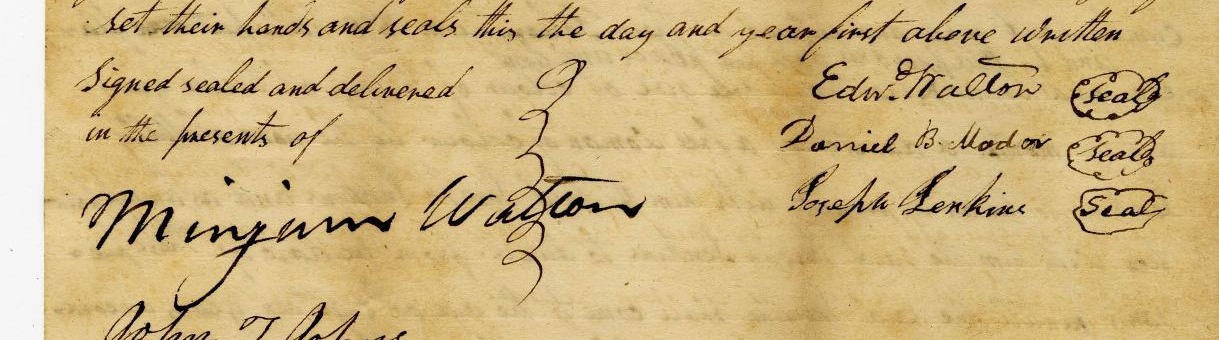
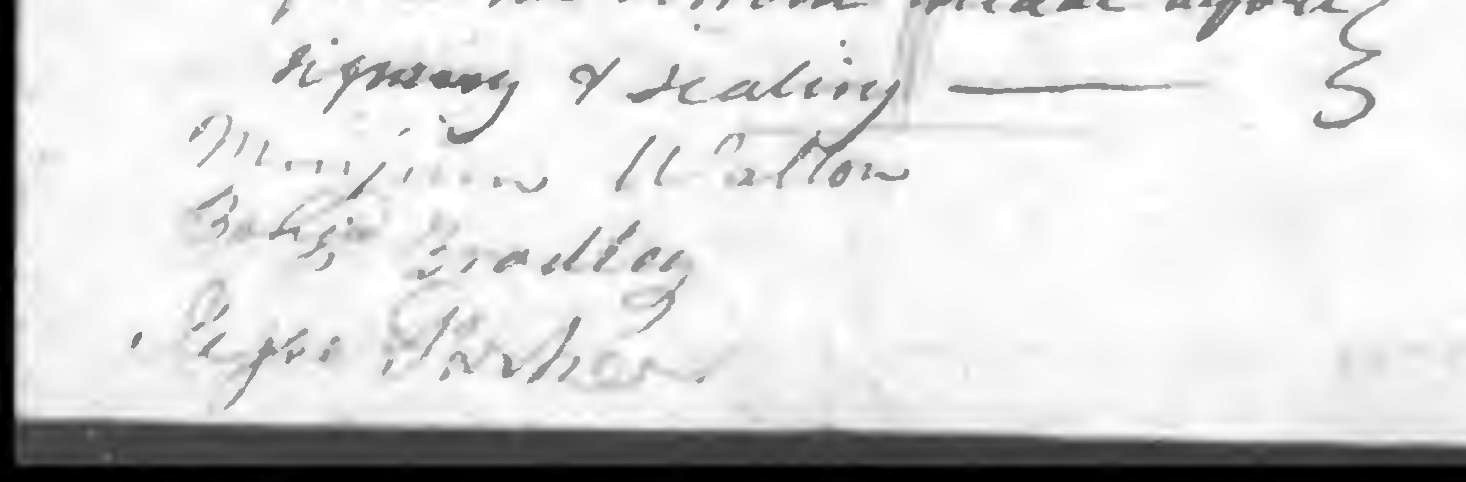
Readings, not findings

Two brothers, probably, and a verdict reversed

The 1860 Pole Cat page has John T. Walton, born about 1811 in Virginia, and J. M. Walton, born about 1814 in Virginia, with wife L. T. In the 1850 Pole Cat Beat schedule the same family is transcribed as Joseph Watters, 36, with Lucy T., 31, and children William P., Mary and Thomas born in Virginia and Josephine in Alabama; the transcriber wrote Watters for Walton. In 1899 a Perry County deposition commission names “Joseph M. Walton” and “J. T. Walton, of Hale Co.” together. The 1933 Amelia County abstracts have a bond for Jos. M. Walton to marry Lucy Gills, 17 November 1838. And the 1888 Hale County estate of Joseph M. Walton of Greensboro, which was first logged as a different family because its heirs were not John T. Walton’s children, pays out to W. P., S. W., R. F., Sarah E., M. A., Ella and Josephine: J. M.’s own children, seven for seven. He is Joseph M. Walton, born about 1814, married Lucy Tate Gills in Amelia in 1838, farmed on the page before John T.’s in Pole Cat Beat, and died in Greensboro four years before him. In July 1867 J. M., J. T., W. P. and Thomas H. Walton registered to vote in Perry County on consecutive lines, the two older men and two of J. M.’s sons on one page; W. P. and Thomas H. then married two Brand women in 1869 and 1870, and Mary A. and Josephine married the Downey and the Yancey who collected from the 1888 estate. So: two Virginia-born Walton men three years apart, who married two daughters of Pleasant Gills, lived beside Pleasant Gills in Alabama, and died in the same town. The trees call them brothers and sons of Minjum, on no cited record. I call them brothers, as a reading. One more thread in it: Joseph M. named a son Thomas Howard, and William Mann Walton, the one man a register calls the son of Benjamin H. and Sally, named one Minjum Howard. The H. in “Minjam H.,” expanded to Howard, turns up in two of the putative brothers’ children and nowhere else in this file. A record naming Joseph M. Walton’s parents would test it, and the compiled sketch gives him as Minjum’s son born about 1814, which is the fourth boy in the 1810 and 1820 counts.

John Julian, year by year: the census loses him twice and finds him once

My reading, after Luke asked whether John Julian could have been adopted. He is the son the whole line runs through, and the census loses him twice. In 1850 the Greene County page has no infant, though his stone and his own 1900 entry put his birth in January 1850. In 1860 the Perry County page has “July A.,” 9, marked F, where a boy of ten should be. Then he is found: in 1870, in his father’s house at Cedarville, J. Julian, 20, male, farm laborer, born Alabama, between his brother William J., 21, and his sister Alice, 17. In 1874 he married Minnie A. Roberts. In 1892 he was his father’s executor and is named a son. In 1900, in his own house in Greensboro, he gave January 1850, Alabama, both parents born Virginia, and twenty-six years married, with Jack T., born January 1880, at home. So the record has a son born in January 1850 who is in the family at 20, at 42 and at 50, and a girl of 9 who appears once and never again: no daughter July or Julia is in the 1870 house, the 1892 will, or any grave. The cheap explanation is one enumerator in 1860 who heard Julian as a girl’s name and wrote the F to match. The expensive one is a daughter who vanished and a son who was somewhere else at ten. Adoption would need a record, and Alabama kept one after 1852, a written declaration filed with the probate judge. None has been looked for, and nothing here calls for it; the next step lists it as the negative check it is. What the paper can still give is his 1912 certificate, which names his parents as the family told it. What no paper gives is blood, and that is a line already drawn on this page.

The 1850 page: a daughter born in 1841, and a man who was still working for someone else

The 1850 Greene County household has a Sarah J., 9, born in Virginia about 1841. The 1840 Cumberland marriage would put a first child right there. She is gone from the 1860 household, where she would have been about nineteen, and the family record lists a Sarah J. among the children of the man it calls John Tabb. The Perry marriage index has a Sarah A. Walton marrying Jacob Murff Jr. in July 1858, one initial off; I note it and do not bank it. A compiled company roster calls that bride Sarah J. Walton and puts “wife Sarah J Murff” in the Confederate register of claims, filed 28 March 1863, certificate 18515. I have read the roster, on a Wayback copy, and not the register. If the citation is hers she was alive in March 1863, and the file is the next paper; a pay claim is a thin place to find a mother’s name. A Drake descendant’s note says John T. married “L.F. (unknown last)” and lists Lucy, Elizabeth, William, Chely A., Allace and Joseph. That is the 1860 household, S.F. read as L.F. and July A. read as Chely A. She wrote that the last name was unknown, and L.F. is not a maiden name. The grandson in the 1892 probate, Urbin Lovell, is the child of a daughter who had died, and the Hale index now offers her: a Fannie E. Walton married William M. Lovell on 11 February 1879. If Fannie E. is the Betty of 1850 and the Elizabeth of 1860, she was a Frances Elizabeth, and that is a guess at a nickname. The same indexes carry the other daughters forward, Lucy C. to Alpheus B. Drake in 1864 and to James R. Ricard in 1876, Alice to Joseph A. Walker in 1875, which is how the will comes to say Lucy C. Ricard and Alice Walker. None of that is stated on the census, which recorded no relationships. Two other things on the page. He is an overseer with $2,000 in land in 1850, and ten years later he holds fifteen people and $16,070 in personal estate. And the children’s birthplaces say the family left Virginia between about 1843 and 1846.

Carringtons around him

In 1850 the household next to John T. Walton’s was Paul Carrington, 23, physician, born in Virginia, and a William E. Carrington, 46, born in Virginia, with children born there until about 1841 and in Alabama after, is on the same enumeration eleven days later. Carrington is a Cumberland County name: the family of George Carrington of Boston Hill, whose son George Jr. was the clerk who recorded Thomas Tabb’s will, and an E. Carrington’s estate paid into the Cumberland guardian account of the younger Benjamin Walton. William E. matches, name for name and child for child, the William Edward Carrington (1804–1854) of that family in a 1942 Carrington genealogy, married to Mary Gay Hatcher of Cumberland; the book does not name Greene County, and the match is the whole identification. Paul, the physician, is not identified; the same book has a Dr. Paul of the same line who married “Mary James of Alabama.” In 1855 and 1856 an Edward I. Carrington and John T. Walton were both planters in German Creek precinct. And the 75 acres that the 1840 groom and Jane D. sold in August 1841 ran “on William E. Carrington and others.” If the William E. Carrington of Greene County in 1850 is the Cumberland one, and the household match says he is, then the man whose line bounded the Cumberland groom’s wife’s land was on the same Alabama enumeration as John T. Walton nine years later. So Cumberland Carringtons around him is supported. A Cumberland colony is more than the sources say. And the same genealogy records a Carrington marrying a Cumberland Walton in the 1790s: Frances Ann Carrington and Thomas M. Walton (1772–1821), whose children George C., Nathaniel, Ellen Sydney and the rest are the Waltons in the Cumberland court dockets. None of this names his father. It says that the Cumberland families he could have belonged to were the ones living around him. One more column of names, read in October 2026: the 1850 agricultural schedule, in Linda L. Green’s transcription, runs in the same order as the population schedule, and where the population schedule has the two overseers, John T. Walton at dwelling 73 and Ephraim Knight at 74, the agricultural schedule has Ed I. Carrington’s 800 acres and Allen C. Jones’s 1,200. An overseer’s farm is listed under its owner’s name. If the order holds, John T. Walton was Edward I. Carrington’s overseer in 1850, with the young physician Paul Carrington in the house next door, and the Cumberland colony was where he worked, not only where he lived; and the John R. Webster whose farm is seven rows up is the Webster four lines from him in Hale County twenty years later. That is my reading of two lists; no record says whose overseer he was. Schedule 2 of the same day, read in October 2026, keeps the order with only the holders present: Carrington’s seventy-two people, then Walton’s three, then Knight’s four, then Jones’s hundred and eight, and no overseer, agent or manager written against any holding in the county. Three lists now, and still no sentence.

The Gills three doors down

This page is about John T. Walton’s father, and his wife’s parents are a different question, but the 1850 page bears on it. Pleasant Gills, 65, and Nancy, 58, at dwelling 76, with James A., Thomas P., Richard H. and Eliza V., are the family the compiled sources name as Sarah Frances’s, with the children the compiled list gives them, minus the ones who had married. Sarah, 23, is three doors away as John T. Walton’s wife, and Eliza V. married in Greene County in 1856. Ten years later, in Perry County, Pleasant, 77, and Nancy, 54, are next door to John T. and S. F. Walton, and T. P. Gill, 26, is four doors up. Two censuses, two counties, the same old couple beside the same young one. It is still co-residence. No document names Sarah’s parents. But it is the closest the maternal side has come, and it is a real record rather than a tree. In October 2026 an agent took the old man further than anyone had: the Amelia chancery bill of 1821 that makes him John Gills’s son, the 1877 Amelia death register, the 1812 pension list with his Bibb County remarriage of 1864, and the 1840 Amelia household with a girl of Sarah’s age in it. The Gills line now runs back a generation on paper. The one link that is still shape and not a name is the one between Sarah Frances and Pleasant.

Waltons were in that township before him

The federal land records put a George Walton and a William W. Walton, “of Perry County,” on a preemption in Section 12 of Township 20 North, Range 6 East, in 1831, and a David F. Walton in Sections 11 and 14 from 1834 to 1837. That is the township where John T. Walton and J. M. Walton were farming in 1860, fifteen to thirty years later, and where a later Perry County index lists David, J. Y., M. D. and Thomas Walton as buyers. A preemption means the two men were already settled on the land around 1830. So John T. Walton did not pick an empty township. He picked one with Waltons in it. Who those Waltons were, and whether any of them came from Cumberland, has not been asked. The Perry grantor and grantee indexes have been read, and no line is John T. Walton. The deed books themselves were not paged through.

Nancy Walton, who turned out to be Nancy Walker

For a day this page carried a lead, a Nancy Walton, 77, born in Virginia, two doors from John T. Walton in 1860, who could have been his mother. A second look at the frame killed it. The woman at dwelling 278 is Nancy Walker, 77, born in South Carolina, with a ten-year-old named Henryetta Moody; Ellick Walker, 55, born South Carolina, is at 277; and in 1850 the same Nancy, 67, born South Carolina, is in Alexander Walker’s household. She is the Nancy Walker whose estate J. M. Walton gave a deposition about in 1879. The lead is dead and the ledger is corrected. The same re-read fixed the other neighbor: Pleasant Gill at 279 is 77, not 44, which makes him Pleasant Gills himself, born about 1784, next door with Nancy, 54. A misread by a person is not a fabrication by a machine, but it goes on the page for the same reason.

What would settle it

  1. Start from John T. and never say Minjum. Luke’s instruction, and the right one. Every Virginia search so far has been run with three inherited assumptions in the search box: that his father was Minjum, that the T is Tabb, and that the county is Cumberland. Only the Alabama side was built from his own records. The test is to rebuild his origin from those records and his associates alone: Joseph M. Walton traced on his own; the first wife and the two Virginia-born daughters, forward through Lucy Ricard’s 1914 death record and back through every John T. Walton marriage in Virginia between 1838 and 1842; the neighbors and in-laws in Greene, Perry and Hale traced each to a Virginia county by their own records; every John T. Walton heading a Virginia household in 1840; and what his children’s death certificates say about where he was born. If those trails converge on Cumberland without being pointed there, the Cumberland case stands on its own feet. If they converge on Amelia or Powhatan or Goochland, the file has spent months on the wrong man.
  2. An Alabama deed in which John T. Walton, as grantor, recites land from his father. Wills name heirs downward. A deed is the one record class that recites upward: “conveyed to me by my father.” Greene County is read and dry. The Perry Walton sections and the Hale general index for 1867 to 1895 are read too. No John T. Walton deed is in them, and the one Hale line indexed as Walton J. T. is a court appointment to partition someone else’s land. The deed books were not paged through beyond that. A deed the index missed is still possible. It has not been found.
  3. Joseph M. Walton’s 1888 Hale County estate, the whole file, and his 1838 Amelia bond. The estate was read only far enough to misfile it, and his will is indexed at Hale Will Book A, page 240, thirty-seven pages before his probable brother’s. If John T. and Joseph M. were brothers, the probable brother’s papers are the nearest thing to John T.’s own. The 1838 Amelia bond for Jos. M. Walton and Lucy Gills is imaged on FamilySearch; its surety is the question. A John T. Walton standing for his brother in 1838 would be the strongest paper yet, and it would still not be filiation.
  4. John Julian’s 1912 certificate, and the Perry and Greene probate books for a declaration nobody expects. Alabama registered deaths from 1908, and his certificate of May 1912 names his parents and his birthplace as the informant knew them. He died at Selma, where he had gone for an operation, so the certificate is filed under Dallas County and not Hale, which is why every Hale search for it came back empty. Alabama also had an adoption statute from 1852, a written declaration filed with the probate judge that gave the child a share; if one had ever been made for him it would sit in the Perry or Greene probate minutes of the 1850s or 1860s; the Perry minutes for 1850 to 1871 are FamilySearch films 1577904 to 1577907, by a catalog snippet an agent found, and the Greene minutes for 1850 to 1856 cover the years the family was at German Creek. Luke asked whether he could have been adopted after the 1860 page lost him; the 1870 page found him, so this is the negative check, not a lead. Both are on the order sheet.
  5. His own hand: the Alabama papers he signed. Every T and J on this page is a clerk’s or an enumerator’s. The 1841 Cumberland deed is signed, but the signature has been read only in Raider’s typescript, and the deed book itself is the clerk’s copy of the instrument, signatures written out in the clerk’s hand; only the original paper, if the Cumberland clerk’s loose papers kept it, would carry his, which ChatGPT pointed out on 15 October. In Alabama he signed the 1867 registration oath, which the Archives’ register points to at oath book page 461 and which has not been found online; the original 1892 will, if the Hale probate packet kept it; and whatever Perry and Hale deeds he made between 1855 and 1892. The grantor indexes have been read: Perry has no John T. Walton line, and Hale’s one Walton J. T. line is a court appointment, not a deed in his hand. One more place, which ChatGPT pointed to and then corrected: the Freedmen’s Bureau. A planter who held fifteen people in 1860 and farmed on after the war contracted with freedpeople from 1865, and a labor contract carried the employer’s signature when the office kept the original rather than a clerk’s register copy. The Alabama field-office records are National Archives microfilm M1900, on FamilySearch behind a login and at the Smithsonian; by the National Archives’ inventory, which I read on 15 October 2026 after ChatGPT pointed at it, Eutaw kept two labor contracts of 1866, Cahaba a contract volume of 1865 and 1866 with a name index, the Selma office a register of the freedpeople employed in 1865, arranged in its second part by employer, with their names and terms, and among its loose papers the labor contracts of 1866 to 1869 themselves, Demopolis and Tuscaloosa their own complaint registers and contracts, and Greensboro and Marion are not catalogued as offices at all. So the search is small and ordered: Selma’s 1865 register at the employer’s letter, Selma’s loose contracts, Cahaba’s index, the complaint registers, and Eutaw’s two contracts. A contract would show three different things, a mention of him, his hand, and the names of the freedpeople who worked for him, who are not shown to be among the fifteen of 1860 by that alone, and each has to be read for what it is. One signature ends the T or J question as far as it concerns him. Set beside the 1841 deed book, read on the film, it would say whether the Cumberland groom’s hand is his, which is the comparison Luke asked for and the one no clerk can make for us.
  6. Lucy C. Walton Ricard’s death record. John T. Walton’s eldest surviving child by the census was born in Virginia about 1843, before his 1847 Alabama marriage. The Perry index now carries her forward: Lucy C. Walton to Alpheus B. Drake in November 1864, Lucy C. Drake to James R. Ricard in September 1876. The Greensboro Cemetery survey has a “Mrs Ricard,” born 11 August 1843, died 20 January 1914, entered beside a J. R. Ricard, 1825 to 1894, and just before J. T. and Sarah Walton, and a 1908 history has a Mrs. Ricard owning a house in Greensboro. The index is in, read signed in on 15 October 2026: Lucy Cathrin... Ricard, age 70, died 20 January 1914 in Hale County, certificate 263, father John T. Walton, and no mother. The certificate image opens only at a FamilySearch center or an affiliate library, and that is where the mother’s maiden name would be, if the clerk wrote one. Sarah F.’s own 1900 count, six children born and three living, has already settled that the mother was not Sarah F. If the image says Jane, the two-marriage structure is proved and the Alabama John T. is the 1840 Cumberland groom. A blank proves nothing. J. R. Ricard’s will, Hale Will Book A, page 285, is the other paper to pull.
  7. The Find a Grave memorial listed as John Tabb Walton, and his son’s 1929 death certificate. There is a memorial for him after all, number 73065454, created on 8 July 2011, last updated in October 2025, and marked as having a biography that nobody here could load; Find a Grave blocks every robot. The biography may carry the Benjamin and Sally Mann tradition or something better. And Joseph P. Walton’s 1929 death certificate, indexed with his father as “Jack T. Walton,” may give the father’s birthplace, and would say whether he went by Jack, which would explain why his grandson did; the same index swaps his mother and his wife, so Jack T. may be a misread Jno. T.
  8. The Alabama Beacon, Greensboro, July or August 1892. An obituary that says “native of Cumberland County, Va.” would settle where he came from. It would not name his father. Origin and filiation are different questions, and only one of them is close. The 1892 Beacon is not on Chronicling America, and the state archives’ free scans stop at 1877; the issues sit behind a newspaper subscription.

Above Minjum: George and Margaret Tabb, the DAR story, the trees, and my uncle’s record

The records that put a father on Minjum. The leading theory is George Walton, on the 1805 power of attorney, the 1807 Laurens deed, the 1817 sale, and Kerns. The DAR applications and my uncle’s record put William Walton Jr. there instead.

The records

  • 1759 George Walton and Margaret Tabb, Cumberland marriage, 25 June 1759 index entry

    Shows The couple existed and married in Cumberland. A Thomas Tabb is on the record.

    Does not show Their children. The index field naming a Thomas Walton as father has not been checked against the bond.

  • 1782 Thomas Tabb’s will, Cumberland Will Book 2, page 291, dated 8 January 1782 transcript

    Shows Sons Edward and Langhorne; daughters by married name, including Walton; executors Jesse and Lockey Cobb. Margaret Tabb Walton was his daughter.

    Does not show Anything about 1811. The image on the FamilySearch film has not been read; this is a compiled transcript.

  • 1786 Langhorn Tabb Walton and Elizabeth George, Cumberland bond, 22 July 1786 read in the image

    Shows The Tabb name inside the Walton family a generation before John T. Walton. Same page of the Elliott abstract as the 1806 bond.

    Does not show Langhorn’s parents, though Kerns and the 1817 estate make him George and Margaret’s son.

  • 1805 Minjum Walton, Cumberland personal property tax, 4 April 1805, charged in his own name read in the image

    Shows Commissioner John Baughn’s return, dated 26 July 1805, film 007849104, image 485, read 15 October 2026. Under W, 4 April: Minjum Walton, a short line, charged in his own name and not written in under another man. On the facing page, 22 April, a Geo. Walton is a separate charge. The column heads were not read, so the figures are not assigned.

    Does not show That the two lines are father and son, or that this Geo. Walton is the man who gave the power of attorney on 20 October 1805. Same name, same county, same year. The list does not say which.

  • 1807 Minjum Walton of Cumberland to Leonard Miller, Laurens District, South Carolina, 31 March 1807, reciting George Walton’s power of attorney of 20 October 1805 (the acknowledgment, image 252) read in the image

    Shows Laurens District, South Carolina, 31 March 1807, film 008140754, image 251, read 15 October 2026. “I Minjum Walton of the State of Virginia and County of Cumberland,” for $350 paid by Leonard Miller, grants a plantation on Durbins Creek. He signed Minjum Walton. The chain, in three parcels, runs to George Walton and then from George Walton to Minjum Walton by a power of attorney bearing date 20 October 1805, and from Minjum to Miller. A dower note on the same page, for the widow Mary Hughes who had married Leonard Miller, was read “the said Benjamin Walton doth not defend the said Dower.” The acknowledgment on image 252, sworn 4 August 1807, was read as John Meador seeing the within named Benjamin Walton sign. The two spellings are left as written.

    Does not show The power of attorney itself. It is recited, not produced. Any word for son, heir, or brother. That this George Walton is the Geo. Walton whose Cumberland estate was sold on 15 March 1817. Benjamin Rains appears in one chain as a prior grantor, and he is not the man who signed. Micajah Hughes on the deed and Joseph Hughes on the certificate were both read and were not reconciled.

  • 1817 George Walton’s intestate estate: the February 1817 order, and the March 1817 sale on Will Book 6, pages 106–107 (the sale, film 007644345 image 62) read in the image

    Shows February 1817, Order Book 1815–1818 page 195: the estate committed to the sheriff, sale on twelve months’ credit, Thomas Tabb among the appraisers. That order-book frame has not been reopened. Will Book 6 pages 106–107, film 007644345 image 62, read 15 October 2026: Samuel Ralston’s account as deputy sheriff for Willis Wilson, and an account of sales made 15 March 1817, returned August Court 1818, totaled at $253.15. Purchasers, as read, in order: Elizabeth Merryman, William Flippen, Minjum Walton, Jesse D. Merryman, Patsy Robinson, a John L. whose surname was not settled, Wm. F. Mann, Mrs. Walton, Ellet Brooks, Fr. Armistead, Jesse Flippen. Minjum Walton’s line was read $57.10 on three crops. Mrs. Walton’s line was read $25.30. The other figures were not reconciled to the total, so they are not quoted.

    Does not show A list of heirs, or the word son. Nobody on the list is called a son, a daughter, or a distributee. The list does not say Wm. F. Mann is the man who consented to the 1806 bond, and it does not give Mrs. Walton a name. Pages 262–268 of the same book are other estates: Elizabeth Palmore, Osborne Jones, Alexander Guthrey, Samuel Stokes, Francis B. Deane. An earlier note that pages 262–263 are Langhorn T. Walton’s letters, with John Tabb and Thos. B. Haskins as securities, does not match those folios. Langhorn’s letters have not been found. Page 105, the appraisal, has not been reopened.

  • 1890s–2020s DAR Ancestor A120328, William Walton Jr.: 44 associated applications compiled

    Shows Virginia and North Carolina private, pension S17184; born 12 January 1767, Amherst County; died 18 May 1844, Greene County, Alabama. Four child lines: Amelia Tillman (the majority), Justina S., Louisa Whiteford, and Minjam H. or Minjam Howard, husband of Sarah E. Mann, on six applications (National Numbers 167991, 285669, 404135, 404136, 461926, 539396). The site’s own banner: the listing does not constitute proof of lineage.

    Does not show A document for the Minjam link. The applications cite “Family Bible and traditions.” The public lineage pages: every one of the six puts Minjam’s marriage to Sarah Mann in 1810 and her birth in 1795, which would make her eleven at the 1806 bond; the earliest, 167991, is Wyllie Walton Dunlap of Lawton, Oklahoma, John Julian’s daughter; 539396 gives John Tabb as born 25 March 1812 and dead 12 July 1892, against the stone’s 28 March 1811 and the probate’s 21 July, and is flagged by the DAR itself as carrying unverified lineage. Dates that miss the bond, the stone and the probate were estimated, not copied from a Bible. One thing in them is right and useful: they call Sarah Gill his second wife, so the family knew there had been a first.

  • 2026 DAR Genealogical Research System, record copies, June 2026 compiled

    Shows Application 167991, the earliest Minjam-line filing, was not available for online purchase. Applications 285669 and 461926 offered a $15 record copy and no supporting-documents option, which appears only when a Bible page, deed or will is on file.

    Does not show Any paper behind the splice. Nobody filed one.

  • 1833 Pension S17184: William Walton Jr.’s deposition, Greene County, Alabama, 12 January 1833 transcript

    Shows In his own words: born 12 January 1767 in Amherst County; father William, brother Tilman, uncle Jesse; the family Bible was with Tilman; Wilkes County, North Carolina, for service; then Augusta County 1784–1791, Burke County 1791–1800, Charleston 1800–1815, then the Alabama country.

    Does not show A son named Benjamin, Minjam or John. The handwritten file on Fold3 (NARA M804) has not been checked against Will Graves’s transcript.

  • 1811–1855 UNC Walton Family Papers #01437, Strawberry Hill, Forkland, Greene County compiled

    Shows William and Justina Walton; “at least two children, Justina S. and Louisa W.”; and an indexed John G. Walton, fl. 1811–1844, who is John Gennerick Walton, William Jr.’s documented son.

    Does not show Minjam, Benjamin, or John Tabb.

  • 1919 DAR Magazine, volume 53 (1919): “Sketches of Two Real Daughters,” October, page 607, and query answer 6369, November, page 694 (November 1919, page 694) compiled

    Shows The October item is a Real Daughter sketch of Justina Walton Webb, the youngest child of William Walton Jr.’s second marriage, with the Delaware-crossing tradition told under her uncle Tillman. The November query answer lists the children of William Walton Sr., born Goochland 1736, married Elizabeth Tillman: Tillman, George, William Jr., John, Thomas, Edward.

    Does not show A list of William Jr.’s children, which is what the Find a Grave citations implied. No Minjam or Benjamin in either item. Every DAR Lineage Book entry under this patriot that is in print, six of them, runs through the second wife and, but for Justina Webb herself, through Amelia Tillman Walton Glover.

  • 1946 The Tilghman-Tillman Family (1946), entry 619, page 100: William Walton Jr.’s nine children by both wives compiled

    Shows By Jennie McIntyre: Clarissa (1795), James Stewart (1796), Alfred Young (1798). By Justina Louisa Gennerick: Amelia Tillman (1807), Justina Gennerick (1809), John Gennerick (1811), Louisa Whitefoord (1823), Jane Eliza (1829), Justina Smith (1831). Read on the page scan in October 2026. The first marriage’s sons are the Alfred Y. and James K. Walton on the Greene and Marengo land patents of the 1820s.

    Does not show A Minjam or a Benjamin, in either marriage. And the first marriage’s eldest child was born in 1795, when William Jr. was 28; Minjam was born about 1775 to 1784.

  • 1844 William Walton Jr. (1767–1844), Find a Grave, Strawberry Hill Plantation compiled

    Shows The DAR-marked grave and the linked family memorials.

    Does not show Anything the applications did not already claim.

  • 2012 The family record: “Walton Paternal Lineage,” a Word document from December 2012, sent to the family by Luke’s uncle on 18 December 2012 with a note about his tree of almost 900 forebears compiled

    Shows Thirty-five names from 1049 to Luke, with the line “Minjam H. T. Walton (1779-1839)” between William Walton Jr. and John Tabb Walton. Transcribed in full near the top of this page.

    Does not show Its sources. It cites nothing. The covering email says where the names came from in general, a tree of almost 900 forebears he was building in 2012, and that tree, with whatever it cites, has not been seen; the DAR line, the Tabb compilations and the online trees were all there to be copied from by then. The bottom six rows match the documents; nothing above them has one on this site. The 2012 email is the newest link in the chain that carried John Tabb and Minjam down to this page, and the 1921 DAR filing is the oldest found; what lies between them is the provenance question.

  • 2005 Wilmer L. Kerns, Waltons of Old Virginia (Heritage Books, 2005; reprinted 2013), pages 35–36 and the Minjum sketch, FamilySearch Digital Library item 101125, read 15 October 2026 (HathiTrust, search only) compiled

    Shows Read in the FamilySearch viewer, item 101125, on 15 October 2026. Copyrighted. Cited, not copied. Pages 35 and 36 are George Walton, called the son of Thomas Sr. and Martha (Cox) Walton, born about 1740 in Goochland County, died intestate in Cumberland about 1817. The death note cites the appraisal in Will Book 6, page 105, and a sheriff’s administration in Order Book 1815–1818, page 195. The marriage sentence says 22 November 1759. The footnote is the Cumberland bond of 25 June 1759. Margaret is the daughter of Thomas and Lockey (Langhorne) Tabb of Buckingham, born 4 April 1744, probably Charles Parish. George and his sister Patty (Walton) Mosby were to receive one-half of the remaining estate of their stepfather, Isaac Hughes, cited to Will Book 1, page 145, 22 January 1758. The children, in his order: Langhorn Tabb, about 1763, died June 1821 in Williamson County, Tennessee, married Elizabeth George on 24 July 1786. Jesse, called a proved son, and nothing more. Thomas G., about 1765, died 1825 in Smith County, Tennessee, married Agnes Mosby. Maurice H. Tabb, no birth year, married an Elizabeth whose surname is left blank. His father appointed him to sell 200 acres in South Carolina, cited to Deed Book 10, page 73, 29 October 1805. Lockey, named in her grandmother Martha (Cox) Walton’s will. Elizabeth Hatcher, about 1775 to 1854, married John T. Merryman on 4 September 1800, and Kerns says she is not a proved daughter. Minjum H., about 1779 to about 1839, married Sally F. Mann on 5 February 1806. Kerns writes her father as William Ford Mann. The later sketch repeats the son sentence. Footnote 35 is Ancestral File 14PX-CLX. Footnote 36 estimates the death from the Cumberland personal property tax lists, 1817 to 1844. He says the name may have been a variation of Benjamin, and that the records write Minjum. He cites a purchase from Jesse Parker on 4 April 1827, 72 and a quarter acres, Deed Book 18, page 387, and an 1831 sale of 85 acres to his oldest son, Jesse W. Walton, Deed Book 20, page 199. Further on, the sketch of John T. Walton calls him the son of Minjum H. and Sally F. (Mann) Walton Sr., born 28 March 1811 in Cumberland, died at Greensboro, Hale County, Alabama, on 21 July 1892, and says the compiler identified that man through the Cumberland tax lists of 1843 and 1844. That is Kerns’s statement. It is not a clerk’s sentence of filiation.

    Does not show A record I have read that calls Minjum the son of George. The Ancestral File number is not that record. Deed Book 10, page 73, which I have not opened, so the 29 October 1805 appointment of Maurice is not yet the power of attorney the Laurens deed recites for 20 October 1805. A birth year for Maurice. The rest of the John T. sketch, past the sentence and the tax-list note. The will of Isaac Hughes, which Kerns cites and I have not read.

  • 1997–2015 The Tabb family compilation, M. H. T. Walton (person i4418, last edited 30 January 1997), and Stephen Frakes’s Walton genealogy of 4 October 2005 (Frakes) compiled

    Shows Read from the live pages on 15 October 2026. M. H. T. Walton, person i4418: male, born Cumberland County, Virginia, in 1765, father George Walton, mother Margaret Tabb, last edited 30 January 1997. The narrative the software wrote from the given-name field is “M. died. M. was born at Cumberland County, Virginia, in 1765.” There is no citation block. On George’s page, https://www.tabbfamilyhistory.com/p80.htm, person i2745, last edited the same day, the children are Langhorne Tabb Walton (1761), Jesse Walton (1763), M. H. T. Walton (1765) and Martha Walton (1770), and that family has no citation either. Margaret’s only citation is the History and Registers of Charles Parish, on her own birth of 4 April 1744, not on these children. Stephen P. H. Frakes, dated 4 October 2005 and updated 4 August 2015, prints “Maurice H. Tabb WALTON, born 1765, Cumberland County, Virginia” as the first child, under a heading typed “Children of George and Margaret (TABB) WALLTON,” and nothing under that son says where Maurice came from. He also lists Thomas G., Langhorn Tabb, Jesse, Martha and Lockey. The same chapter prints Edward Walton, born 1682, son of a blank father and Frances Elizabeth of a blank surname, died 27 April 1720, married Elizabeth Mason, and a Thomas born 20 February 1702/03. No citation sits on that block. On the Tabb site the one John in Thomas Tabb’s line, John Langhorne Tabb, died in Kentucky in 1816 by an unpublished researcher’s account. An earlier note made a John Tabb the surety on George’s 1817 administration. Those will-book pages are a different estate, so that John is not being measured against a record we have found.

    Does not show The name Maurice in the 1997 compilation. Minjum, Benjamin, a Mann, or an Alabama. A source for the initials or for 1765. The parish register, read separately, does not say Elizabeth Mason, does not give Edward a birth in 1682, and does not print a clean year on Thomas’s 20 February baptism. Frakes’s Elizabeth, born 4 September 1707, is not the register’s christening of 7 February 1707. Kerns’s pages 35 and 36, read the same day, list Maurice and Minjum as two sons and put about 1765 on Thomas G. Walton, not on Maurice. They do not show where the 1997 compiler got the initial or the year.

  • 1698–1728 The parish register of Saint Peter’s, New Kent County, Virginia, from 1680 to 1787 (printed 1904) transcript

    Shows Read from the Internet Archive text of the printed register on 15 October 2026. Mary, daughter of Edward Walton, baptized 4 December 1698. William, son of Edward Walton, baptized 25 December 1700. Thomas, son of Edward Walton, baptized 20 February; the year digit is broken in the text I read, and the entries on either side are 1703 and May 1704, which is where 20 February 1703/4 sits. Elizabeth, daughter of Edward Walton Jr., christened 7 February 1707. John, son of Edward Walton Jr., born 8 September 1709, the register’s “7br.” Elizabeth, wife of Edward Walton, died 5 April 1717. Edward Walton died 27 April 1720. The same book records children of Robert and Frances Walton, a Robert born 7 January 1717/18 and a Sherwood baptized in August 1728, and does not call that Robert a son of Edward.

    Does not show That the Thomas baptized in 1703/4 is the Thomas who married Martha Cox, or that the John born in 1709 is the Hanover doctor who died in 1772. William’s line and Thomas’s say “Edw’ Walton.” Elizabeth’s and John’s say “Edw’ Walton Jun’.” Whether those are one father is the first check against the original register, which I have not seen. It does not make the Declaration signer this Edward’s descendant. Robert and Frances are in the parish. Their Robert is not entered as Edward’s son.

  • compiled CLP Research, Partial Genealogy of the Waltons of Georgia, Virginia, and Florida compiled

    Shows A one-page chart. It puts Edward Walton II (1668–1720) over a Robert line and a Thomas line. The Robert line runs Robert I, Robert II (1718–1750) and Mary Hughes, then the signer, whom the chart dates 1740 to 1804. The Thomas line is Thomas Walton (1703–1772) and Martha Cox, then Josiah, Ann, a Jesse born in Cumberland in 1774, and a blank it calls “7 Others.” It is a map of what one compiler claims. A second-cousin story starts by filling that blank with the George who married Margaret Tabb, and then with Minjum.

    Does not show Minjum, Margaret Tabb, or the George who died in Cumberland in 1817. Those names are not on the sheet. The signer’s birth year on it is 1740, which is the other George’s year. A man born between September 1749 and February 1750, as his father’s codicil requires, was about nine when Margaret Tabb married in June 1759. The sheet also says Robert Walton I emigrated from England and draws him as Edward’s Virginia son. The parish register is the record. This chart is the hypothesis the register is there to test, and it does not establish the signer as anyone’s cousin.

  • 1740–1804 A compiled tree that merges George Walton of Cumberland, who married Margaret Tabb in 1759, with George Walton the signer of the Declaration of Independence for Georgia compiled

    Shows Luke found it, and I read the page: “Declaration Signer George [signer] Walton, b. 1740 Prince Edward, Virginia, d. 2 Feb 1804 Meadow Gardens, his home in Augusta, Georgia,” given parents Robert Walton II and Mary Hughes of Cumberland, and a marriage to Margaret Tabb in Cumberland County. The signer, who went to Georgia in 1769 and married Dorothy Camber in 1775, is a documented man with a documented wife. The Cumberland George who married Margaret Tabb died intestate in 1817, thirteen years after the signer. The tree makes them one person.

    Does not show Anything about this family. It is on the page as a specimen: same county, same surname, same given name, and a signer of the Declaration within reach. It shows how a Cumberland Walton line acquires a famous ancestor in the trees, and it is the kind of merge that could feed a family story about a grandfather named George. It is not a document that caused this family’s story, and nothing says it did.

  • 2014–2025 FamilySearch Family Tree: George Walton (G9FN-69L), Benjamin H. or Minjam H. Walton (L6L6-KZD), John Tabb Walton (MDFG-MTX) compiled

    Shows George with sixteen children, including a “Minjum H T Walton” listed as female with zero sources. Benjamin H. with three sources, all from one contributor, one of them the 1860 marriage of William M. and one a note that “Benjamin’s nickname was Minjum or Minjam Walton.” John Tabb with thirteen sources, every one of them about his Alabama life. As of October 2026 the tree attaches John Tabb, born 28 March 1811 in Cumberland, as a son of Benjamin and Sarah Mann, with brothers Jesse W. (1807–1889, Goochland), William Mann (1809–1883) and Joseph M. (1814–1888, Greensboro). Jesse W.’s 1834 Goochland bond, in the tree’s own image, names no parents. His 1858 register index, attached to Sarah Mann’s profile, reads her as Sarah; the free index of the same entry reads Hannah and the father Morgan. The William Mann Walton profile has a younger William Miner Walton, born about 1832, who married Margarett Ann Gill in 1853, merged into it. George’s profile carries both a Benjamin Walton, 1765 to 1839, and an unsourced Minjum H T Walton, 1765 to 1865, as separate sons.

    Does not show A record naming John Tabb’s parent. The deep pedigree above him is tree structure on other profiles, not a source on his, and whoever attached him to Benjamin did it without one. I should check the change log to see whether that was me.

  • 1761–1800 Amherst County will abstracts (King and Davis), will books 1–3 transcript

    Shows William and Tilman Walton as executors and witnesses on other people’s wills in the 1780s and 1790s. The pensioner’s family, where he said it was.

    Does not show A Walton testator or child list. The W volume of Davis’s abstracts has not been read.

Readings, not findings

The right family, and the wrong sons

The printed register of St. Peter’s gives Edward Walton two sons the 2012 list needs, a Thomas baptized 20 February 1703/4 and a John born 8 September 1709, and Edward dead on 27 April 1720. That is a contemporaneous record of two boys, not two trees agreeing. It is not yet a pedigree. Thomas’s line in the register says Edward Walton. John’s says Edward Walton Jr. I have not seen the original, so the first check is whether those are one father. The second is whether this Thomas is the man who married Martha Cox and died in Cumberland in 1772, and whether this John is the Hanover doctor of 1709 to 1772. A compiled list of that doctor’s children puts a George, born in 1736 and dead about 1806 in Wilkes County, Georgia, in the years where my uncle printed Major William Walton Sr. (1736–1806). If that list is right, the 2012 line left the family at the brothers and walked down the wrong son. The other road runs from that Thomas to the George who married Margaret Tabb in 1759 and then to Minjum, which is what Kerns asserts and no estate has confirmed. The signer is a separate question. Robert and Frances Walton have children in the same book, and the book does not call their Robert a son of Edward. A one-page chart put both lines under one Edward and invited a second-cousin story. The chart does not name Minjum, and the register does not name the signer. What the register does is give the two branches a place to be tested. My uncle may have been right about the family that was in New Kent in 1700 and wrong about every link from there to Minjum. That is a reading. The three links still open are Edward to the Cumberland Thomas, that Thomas to George, and George to Minjum. The last of those is the leading theory, probable on the 1805 power of attorney and unproved.

What would settle it

  1. The power of attorney of 20 October 1805. The Laurens deed of 31 March 1807 recites it and does not attach it. George Walton authorized Minjum Walton to sell the Durbins Creek land. The original, if it survives, is the paper most likely to say where George lived and what Minjum was to him, including the sentence “my son” if that is what he wrote. Kerns cites a Cumberland recording under a different son and a different day: Deed Book 10, page 73, 29 October 1805, Maurice H. Tabb Walton appointed to sell 200 acres in South Carolina. That page is its own search. This one is the instrument the Laurens deed recites. It has not been found.
  2. Where the 1997 compilation got M. H. T. Walton. Read 15 October 2026. Person i4418, last edited 30 January 1997, is male, born in Cumberland in 1765, son of George Walton and Margaret Tabb. The narrative is “M. died. M. was born at Cumberland County, Virginia, in 1765.” No citation. George’s family on the same site lists the same four children and cites none of them. Margaret’s only citation is the Charles Parish register for her own birth. Frakes, dated 4 October 2005, writes Maurice H. Tabb Walton, born 1765, with no note under that son. The paper still missing is whatever was in front of the 1997 compiler when the given name was entered as M.
  3. Cumberland Deed Book 10, page 73, 29 October 1805. Kerns’s note under Maurice H. Tabb Walton. His father appointed him to sell 200 acres in South Carolina, and the citation is this page, dated 29 October 1805. The Laurens deed of 31 March 1807 recites a power of attorney of 20 October 1805, and the signature read there is Minjum. One page would say whether those are the same appointment, two appointments, or a name Kerns supplied. Unread.
  4. Thomas M. Walton (1772 to 1821): whose son he was. The will of 7 May 1821 and the 1825 heirs’ bill are read. They name George, Maria M. Wilkinson, Phebe A., Ellen S., Nathaniel, Henry and Benjamin H., and no John, and they do not call Thomas M. a son of George. What is still unread is the rest of the executor’s suits (1824-008, 1828-020, 1830-023) and the 1830 sale of the Willis River tract. If any of those calls him a son of George Walton, then George C. and Nathaniel were Minjum’s nephews. Kerns’s seven children of George include a Thomas. The question is whether this is the one.
  5. Whether the register’s Edward and Edward Jr. are one father. The printed register baptizes Thomas as the son of Edward Walton and records John as the son of Edward Walton Jr. The original parish register, or a cleaner copy than the Archive text, would show whether “Jr.” is on every entry or only on some, and would settle the broken year digit on Thomas’s baptism. Two Edwards would split the family the 2012 list treats as one.
  6. Thomas Walton’s 1772 will, and Martha Walton’s will of 6 June 1798. The boy baptized in 1703/4 is the Cumberland Thomas only if the man who married Martha Cox is that boy. His will, and hers, are the papers. A compiled history says her will left land to her son George and then to George’s son Jesse. If the will says that, it names a son George and a grandson Jesse. That Jesse is not the Jesse W. of the 1831 deed. It still would not name Minjum. The Cumberland will index lists Thomas Walton in 1772 and Martha Walton in 1798. The books are on the FamilySearch film already used for George’s 1817 estate.
  7. The Hanover will of the doctor who died in 1772. The parish John was born in September 1709. The family record’s Dr. John died in 1772. His will is the document that says whether those are one man, and whether he left a son William born about 1736 or a son George. A compilation puts George, 1736 to about 1806, Wilkes County, Georgia, in the years where the 2012 list prints Major William Walton Sr. The will chooses.
  8. Cumberland Will Book 6, page 105, the appraisal. A June note described an inventory on this page, Harry and his wife Lucy, Charlotte and Dick, returned to court on 26 May 1817. Kerns cites the same page as the appraisal of George Walton’s estate, and Order Book 1815–1818, page 195, for the sheriff’s administration. The folio map that holds from image 62 through image 143 puts page 105 on the right-hand page of image 61. That frame has not been opened. Until it is, the inventory is unlocated, not read.
  9. Langhorn T. Walton’s letters on George Walton’s estate. An earlier note put them on Will Book 6, pages 262 and 263, with John Tabb and Thomas B. Haskins as securities. Those pages are Elizabeth Palmore’s division. A full-text search of film 007644345 for Langhorn returned nothing. The order book of 1815 to 1818, page 195, was read in June as a sheriff’s administration, with Thomas Tabb among the appraisers. That parenthetical, that Langhorn later got the letters, is withdrawn until the letters are found.
  10. Cumberland personal property tax, 1807 and 1815. The 4 April 1805 list is read: Minjum charged in his own name, Geo. Walton a separate line. The 1807 list is the year of the Laurens deed. The 1815 list is the year before George’s death. Same film as 1805. The images have not been opened. Two lines in one year do not make a father and a son.
  11. The other Walton matches on the Laurens deed film. Images 251 and 252 are read: the 31 March 1807 deed, signed Minjum, with a dower note and a certificate read as Benjamin. The film has other hits that have not been opened. The power of attorney of 20 October 1805 is its own search. None of the unread frames has been checked for the word son.
  12. Maben Jones Papers, William & Mary, Mss. 69 J72. Catalog only. The public guide names Walton, Flippen and Woodson, says most of the families are from Buckingham, and says the inventory is staff only. Folder titles reported from a catalog search, including a Cumberland petitions folder and copies of wills, have not been re-verified. The question for the repository: does any paper call Minjum a son, brother or heir of George, or name John T. Walton’s father. Nothing in the collection has been read.
  13. Morton Genealogy Collection, William & Mary, Mss. 90 M85, Box 1. The finding aid is read. Folder 37 is Cumberland wills and does not name Walton. Folder 33 is Cumberland marriages, including the years 1806 to 1808. Folder 11 is typed copies of allied families and does name Walton, among a long list. Folders 32 and 34 are a census typescript and a wills-and-deaths notebook. Ask 37 and 33 before 11. Nothing in the box has been read.
  14. Hugh Reid Miller papers, Mississippi Department of Archives and History, Z 2215.000. The finding aid is read. Hugh Reid Miller married Susan Grey Walton, daughter of Jesse and Joanna Lawson Hobson Walton of Cotton Gin Port, Monroe County, Mississippi. That Jesse is not yet the Jesse Kerns lists as George’s son, and not yet Minjum’s brother. A letter of 6 April 1835 from Lucy Catharine Walton Cook is a citation from a 2019 article, not a letter this file has opened. Ask only with that question stated.
  15. Hubard Family Papers, University of Virginia, MSS 8039. Lower. A large Buckingham planter archive. The description that was read does not name Minjum. A separate three-item 1827 Cumberland diary group was not confirmed. Not a first ask.
  16. Carter Harrison of Elkora, and the Lenaeus Bolling diaries, both at William & Mary. Lower. Harrison’s letters are Elkora finances and then the war, and the scope that was read names no Walton. Bolling’s diaries are January to March 1820 and late 1834, a Buckingham plantation, not a Cumberland diary. Neither has been read. Neither is a first ask.
  17. Y-DNA, which I am not going to do. For completeness. The Walton surname project at FamilyTreeDNA publishes results from its members. A test of my own Y chromosome against a documented male-line descendant of William M. Walton, Benjamin H.’s one proved son, would say whether I share a male line with Benjamin H. at all. Against a descendant of William Walton Jr.’s sons, it would test the DAR story the same way. If it matched neither, story four. It is the one method that does not depend on a clerk having written the right sentence in 1811, and it cannot name a father. One more thing against it. The printed register of St. Peter’s puts a Thomas and a John under an Edward Walton who died in 1720. The two stories would share a Y chromosome only if the Amherst patriot descends from that John and Minjum from that Thomas, which is the unproved part. The project’s public page does not show its members’ earliest ancestors, though a tester’s own match list would. I am not doing it. I find consumer DNA testing, meaning all of it that is not covered by HIPAA, dystopian. That is the whole reason.

Read, and it did not settle it

  1. Kerns, pages 35 and 36, and the Minjum sketch, read 15 October 2026. Read in FamilySearch item 101125. Not copied. Pages 35 and 36 list seven children of George and Margaret. Maurice H. Tabb is the fourth, with no birth year, and the son appointed to sell 200 acres in South Carolina. Minjum H. is the seventh, born about 1779, died about 1839, married Sally F. Mann on 5 February 1806. The about 1765 birth is Thomas G. Walton’s. In the later sketch, the footnote under the sentence that calls Minjum George’s son is Ancestral File 14PX-CLX, not a will or a deed. The death note is the Cumberland tax lists, 1817 to 1844. The appointment Kerns cites is Deed Book 10, page 73, 29 October 1805, and he attaches it to Maurice. The Laurens deed I read is signed Minjum and recites 20 October 1805. Closed. The deed book page is the open search.
  2. Cumberland Will Book 6, pages 264 to 268, read 15 October 2026. Read by the folio on the frame. Film 007644345 image 141 is pages 264 and 265: Osborne Jones’s inventory, then Alexander Guthrey’s account with Thomas Maddox. Images 142 and 143 are pages 266 to 269: Samuel Stokes, then an account with Francis B. Deane. Image 140 is pages 262 and 263: Elizabeth Palmore’s division, not Langhorn T. Walton’s letters. No distributees of George Walton. The George sale is pages 106 and 107, image 62: purchaser no. 3 reads Minjum Walton, purchaser no. 8 reads Mrs. Walton, and neither is called a child. Page 105 and Langhorn’s letters are separate searches. This one is closed.

Dead ends

What was tried and came back empty. An empty result with its path is still a result.

Two citations the machine invented

Two citations in this file were invented by the machine, and I want them on the page. The first was “Piedmont Virginia Historical Collection, Item 276,” said to name a William Mann Walton, a Benjamin H. Walton and a Herman Hidmore Walton in one tidy household. No such collection exists. The second was “Texas & P. Ry. Co. v. Smith, 67 F. 524,” said to describe the railroad wreck behind the guardianship that sits next to John Tabb’s probate petition. The citation resolves to a Louisiana land-title case with no Paoli, no wreck and no guardian.

Both read beautifully. Both were false. The lesson stuck: a snippet reading “John Tabb Walton, son of…” is the most seductive and least verified thing a research agent can hand you. Since then every claim here has had to show the image, the index entry, or the transcript it came from, and the ledger above says which of the three it is, every time. The same rule caught a human error when a second look at the 1860 frame turned a Walton neighbor into a Walker; that one is under readings. I write about machines and answerability for a living. This is what it looks like at the kitchen table.

The name

Whatever the Cumberland clerks were trying to write, I kept it. Minjim Minjum is an Alabama royal claimant in The Signatories, the novel I wrote with Jonathan Gillie. The character owes the man his name and nothing else. That does not make the man an ancestor, and the name was too good to leave in a deed book.

If you are holding a primary source that connects Minjam Walton to John Tabb Walton, or that names John Tabb Walton’s father, or that lists the children of Minjam Walton and Sally F. Mann in a clerk’s hand, email luke@lukefwalton.com. I will put it on this page, with your name on it if you want it there. If it kills the story, it goes up anyway. That is the whole point.

The family page is the names and the lives. This page is the attempt to find out whether the story above John T. is true.

Ask a question for a sourced answer, or type a page name to search. Try: